The Lure of the Open Road.
Wartime wandering through the Eastern states by bicycle, truck, and riverboat. 1944.
by Thelma Popp Jones. 2007.
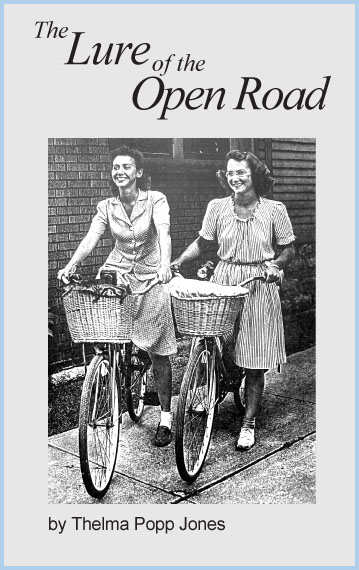
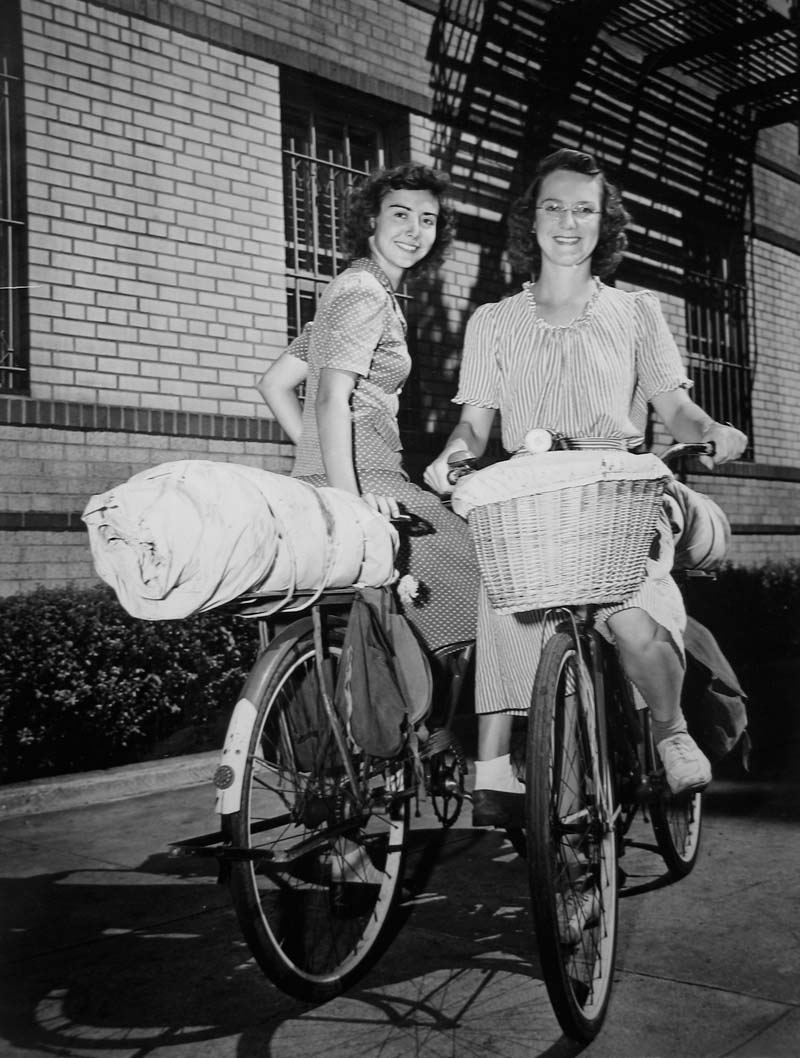
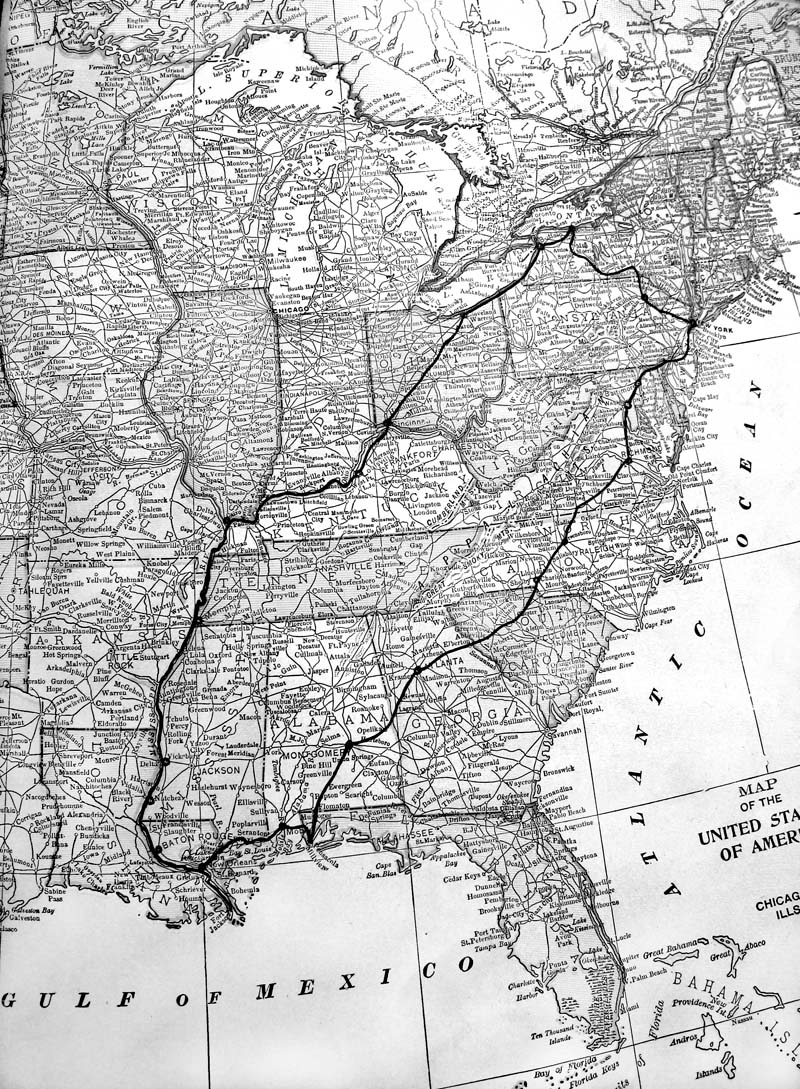
In 1944, a dear friend, Doris Roy, and I undertook an adventurous journey that we dreamed of during countless hikes together over our college holidays. We had been Camp Fire Girls together, loving the out-of-doors, camping and hiking the open road. Our dreams finally developed into a plan to ride bicycles from our home in Buffalo, New York, to Cairo, Illinois, where the Ohio River met the Mississippi. We admired Mark Twain’s adventures, had read his Life on the Mississippi, and sought to follow his path to the Midwest.
We were 21 years old, just graduated from college: Doris Roy from Michigan State and Thelma Popp from Buffalo State College. We often referred to each other as "Mouse," as we were two blind mice wearing glasses. I had the nickname "Poppy," characteristic of my last name.
World War II affected our college life as most of the male student body joined one of the services. Women assumed some of their roles by taking jobs in armament industries. During the summer, I worked from early morning to evening in a public school caring for infants whose mothers were working in aircraft factories or other related industries.
But now, before starting our careers, we decided that the coming summer after graduation would be the ideal time to have our adventure. We had a limited period of time to accomplish this. I had signed a contract to begin teaching first grade in Middleport, New York, on the Erie Canal on September 4, 1944. And so - with the leanest of equipment - we made our preparations and were ready to leave on June 22, 1944.
Part 1
June 22 - July 21, 1944
Leaving
Buffalo
June 22, 1944
This was the day, the first day of our adventure by bicycle. It was the reality of a dream one day toward completion. It was the beginning of an adventure, months of hoboing through the country to live as we pleased and go where we willed. And now, at 7:30 a.m., the Roy family arrived at the Popp residence at 134 Oakgrove Avenue, Buffalo, New York, to share breakfast together with their children, Doris and Thelma. Perhaps in the future we would be looking back at the wealth and the pleasure of that breakfast and the kind words of our parents still attempting to discourage us. Perhaps it was a ridiculous venture, but we were determined never to be put into the category with those who say, "I always wanted to, but never did." Out on the driveway were standing two beautiful new bicycles. Both were blue and their chrome fittings shone like silver in the sun. A previous checkup reported all parts oiled and geared for efficiency. These were our wartime Victory bicycles, lightweight and practical. Thelma’s bicycle had but one speed, and Doris’s had two. But an ordinary bicycle never looked like this! Every extremity was used as a carrier. The usual rack over the rear wheel was extended to hold the weight of a sleeping bag and duffle, and below, saddle bags bulged on either side of the wheels. Strapped to the handlebars was a wicker basket outfitted with oil cloth for protection against inclement weather. These were our bicycles - carnivals on wheels! We were all keyed up to this exciting moment.
"Where was this packed? Can I leave out those rubbers Mother said to take?"
"Which would you rather carry, the hatchet or the kettle?"
"Did I remember the pot scraper?"
"And now what bag did I put the canned heat in?"
"Do we need my compass? Wish we had a bike speedometer."
"Remind me not to tip the bike on that side, Mouse. I put the camera in there."
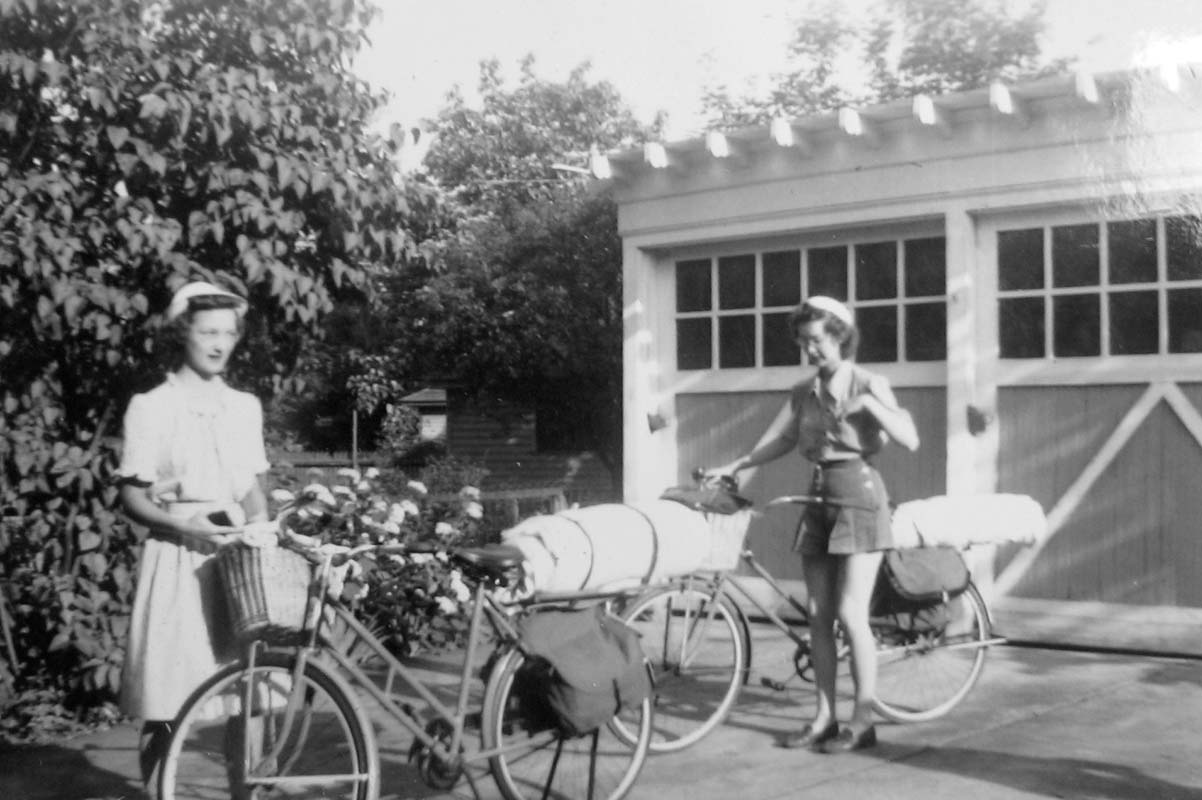
Leaving Buffalo. (22 June 1944)
Mr. Popp started focusing the movie camera. I snapped closed the cover on my basket for the last time. Farewell kisses....
"Keep dry! Wear your hats!"
Mr. Popp clicked the lever of the camera and aimed at us through the lens. We pedaled down the drive, into the street, and out into the world. Down over the rough brick pavement, up the viaduct and over the freight yards we pumped and sweated. The outskirts of the city were an endless line of mills and factories belching smoke and soot. The odor of the chemicals stung our nostrils and dried our throats. We were glad to leave the city.
We must have been a humorous sight - bicycles bulging at all angles, tin cans jangling as we hit the bricks, and riders vainly attempting to keep their floppy hats from being carried off in the wind.
I had packed my bicycle the preceding night and only took a turn around the drive to determine how I could navigate with a heavy load. Now things seemed different. I couldn’t be tired already. We’d only gone two miles!
The low grades of the highway assumed great heights. I pressed hard on the pedal and could see the muscles in my knee tense and relax. My heart pounded as we reached the top. Then, easing off on the pedal, down the other side we flew with a rush of cool air hitting our hot faces.
Our route had been mapped toward Pittsburgh. Could we have chosen more mountainous country? Undaunted, we rolled out of the city south to the Appalachians. The highway was broad now. Factories, trolley cars and houses were left behind. Before us lay the world, the world of waving grasses, scorching sun, hills for a bed and two months of an unfettered vagabondish life. We were to be the transient neighbors of all who lived by the side of the road.
There was only one thing against us - the wind that blew from Lake Erie. Only a few miles along the lake to Fredonia and we would change directions. Things would ease up then.
Doris was saying, "Let’s stop for a sip from our canteens and rest a little. We don’t want to overdo it the first day."
The ice cold water we had poured into our canteens was now lukewarm. We lay with our backs to the ground. The wind that had restrained us on the highway felt cool as it rippled over us. After that little refreshment, we once again bent against the wind, following the sun through the sky. With the road as our guide and the sun as our timepiece, we chose the hour of eating and rest as we willed.
Now the sun was setting; this was to be our first night. We drew up beside a narrow dirt road that wound back into the hills. We were about six miles from Silver Creek, New York.
"What do you think, Mouse? Shall we try our luck for a camping spot down this road?" The friendly little dirt road turned out to be a deserted one. From rut to rut we bounced, continually climbing to lonelier territory. Our camper’s handbook had always described a good campsite as one being on smooth, level ground, beneath shady trees and by a babbling brook, but our visions of a Shangri La faded and we began searching for a fairly private and level piece of land. "Hello, neighbors!"
A very active, tail-thumping mongrel had jumped out into the road and dashed madly between us and a small gray house set back in the trees. Several people were on the front porch, and one small girl came down the stairs and along the driveway. She welcomed us with a broad smile. Her mother and father then came down and greeted us. "Hello, girls. Are you on a camping trip?"
Who would ask permission? Would they receive us? So much depended on our first night. Then Doris explained our mission.
"We’re on a camping trip. We just started from Buffalo this morning. It’s been quite a pull against the strong wind and we’re rather tired, so we decided to look for a suitable camping spot for the night and give our legs a rest."
"Jim," the woman turned to her husband, "why couldn’t the girls go down by the creek?" The father rubbed his chin. "That would be all right, but there are a lot of mosquitoes down there. Why not over on the bank beyond the west field? That’s about the most level spot around here."
Before we knew it we were being escorted through the west field, and then we were on the bank. Who said no Shangri La? This was it!
We were in a small clearing bounded by trees. On one side was a wooded cliff, and below it was a shallow stream and a picturesque waterfall.
Home! Out came the tin cans. Out came the cooking kits. The bedrolls were untied. The provisions for dinner were placed on a level rock. We scoured through the trees, cracking wood and dragging back dead limbs and twigs.
"This shouldn’t be hard at all," Doris said as she knelt on a cleared spot and began shaping the twigs in tepee fashion. I began cutting the potatoes into smaller pieces, washed the lettuce in an inch of water in the canteen cup and laid out the veal chops.
"There it is!" She began blowing gently on the yellow spiral of the flame. Then - the sizzling of the chops in butter, the bubbling of the water about the potatoes, the lettuce dividing - we sat back on the grass balancing our cooking kits and canteen covers. It was the first real cooked-out meal, and a well earned one.
With the dishes washed and the prunes put in to soak for breakfast, we were off with our soap and towels to the creek below. We bounded down the side of the bank and ran out for a quick swim and a splash in the waterfall. Joyous laughter and singing floated along with the soapy suds and the current. We washed clothes and draped them over the branches of trees.
Up again on the bank, we pounded through the brush, walking up and down small inclines searching for two pieces of level land for sleeping. At last we settled for a small clearing with the fewest roots and the least amount of stones and bumps. We sat on our bedrolls, creaming our faces, brushing our hair and violently slapping mosquitoes. Post cards to our parents were dashed off, and we wrote the following account in our logs:
June 22
miles - 32
8:30 Buffalo
12:00 Lake View (lunch)
5:30 Six miles from Silver Creek
Milk $0.15
Veal Chops $0.25
Prunes $0.16
Potatoes - free
4 eggs $0.23
6 slices of bacon
Lettuce $0.15
2 birch beers $0.10
Total $1.04 (Poppy pays first two days)
The moon was out, and in its light I could see a horde of mosquitoes walking up and down the netting in dizzy design, testing the size of each hole. One found a sizable opening to venture through where I had ruffled the cover. Others followed and then began the bombardment that sent me diving head and all into the sleeping bag. I could hear their droning and imagined the battle that might ensue if I let as much as my nose protrude.
A warm wind started up, and the rain flap over my head lapped to and from as the supporting sticks swayed. A quick look out disclosed a hazy moon and a reddened sky. I had just settled down, convinced that I must reconcile myself with these pesky creatures, when I heard a low growl behind me. I feared to moved a muscle or reveal I was alive. Visions of a watchdog grabbing off a leg, then the sound of scampering off through the underbrush. It was gone. For one brief moment I had forgotten the mosquitoes.
Was night always encountered this way? Was I really going through this every night for a whole summer? For one passing moment I doubted the success of our trip.
* * *
June 23, 1944.
The sun had swung far into the sky before we began to stir and stretch in our bedrolls. I gradually became conscious of the brilliant sunlight and was able to discern bushes and trees that had been the vague shapes and shadowy substances of the night before.
"Morning, Mouse," I called over to Doris. We inched ourselves up into sitting positions and observed the outside world, wet and sparkling with a heavy dew. "Up then, my comrade, and have a look at our soaking prunes!" Other than a few drowned ants mixed in they were ready for cooking.
Taking the dewy mat of grasses from our woodpile, we found our supply of wood dry and ready for use. It was no time at all before the firewood was crackling and snapping. The prunes were soon boiling, the scrambled eggs were simmering in the frying pan, and the bacon was curled and sputtering. Hunched on our knees to avoid the damp grasses, we sang the morning blessing and divided the stewed prunes. "How about sharing the salt mix?" Doris asked as she whittled at the bacon in the frying pan with her jackknife. Her plate was the pan, mine the cover. I tossed over to her the little glass tube that contained salt and pepper. The eggs were a little hard, but the tea helped out.
"More tea, Mouse?" I inquired. The cups that clamped onto the canteens each held a pint. I filled the cup up to the nails that held the handle. That was our measure for an equal portion.
With breakfast over, we slid down the muddy bank to the creek bottom and knelt in the water to scour the blackened pots. The #10 tin can with its wire baling handle was the blackest. We had used it for the dishwater, and it had sat in the coals to boil while we ate. We took turns breaking our nails over it.
Little sprinkles of white cleanser blew to the surface of the stream and followed the pattern of its swirl over the pebbles. Suddenly, a drop of water splashed into the pool, sending wavelets inundating to the beach. Others followed, prickling and bubbling the water. Quickly we grabbed up our kettles and made for the campsite. Our beds had to be rolled and the equipment stored away before everything was soaked. Down came the stakes. Down came the washing. Down came the rain.
"God bless the rubbers," Doris said, as I tied my oilskin kerchief over my head. "Better cover up that box of Mother Weed’s Noodle Soup. That and the canned heat might come in handy today."
The rain was falling softly now as we made one last checkup on the camping grounds. Upward and onward we cautiously rolled over the road, avoiding the unknown depths of the swimming ruts. Our wheels sped down the steep incline as the road brought us back to the main highway. Our raincoats flew out in back of us and our pigtails were whisked up into the air.
Rain or no rain it was a good beginning. We were well fed. We were happy. Along the shining road to Silver Creek we sped, the sound of the wheels’ song stinging the wet pavement.
The town was just creeping out of its slumber as we made for our objective on the village square - the Post Office. The tale of our first day had been written in our journals, and our first letter home.
We leaned our bicycles against the rail and scrambled up the steps. Before I had my hand on the latch the door swung open in my face. A ruddy-faced gentleman tipped his hat and held the door open. I murmured a greeting in return and stepped inside the doorway. After depositing our letters, we found the same gentleman flicking a match over the railing and glancing at the queerly loaded bicycles.
"Are you going somewhere or coming?" he questioned.
Unwilling to share the extent of our dream, we explained we were headed for Fredonia. After introducing ourselves, we found him to be a pastor in the town. Challenged by curiosity, he had to know the details of our plans, so we told him of our proposed route to Pittsburgh and Virginia, then directly west to the Mississippi River. We laid out our maps and studied the route.
"The hills?" he questioned. "How good are you at climbing hills? You’ll strike the mountains in Pennsylvania, and remember, there’s an up to every down." The first day of bicycling had proved the difficulty of pedalling up even a small grade with such a load, yet we would like to go south and touch Virginia. We mused and measured. Ohio seemed a dull state, but it was true - it was more level and the distance shorter. So, we decided to be sensible, follow his advice, and cross Ohio. In the afternoon we found ourselves in Chautauqua County, in one of the largest and most beautiful grape belts in America. The day was such a lovely one, the Maxfield Parrish type with lots of blue. A lazy wind puffed the clouds along above the sloped vineyards. The sky was blue and the was road level. Vineyards stretched their way over the slopes at our left, and at our right they marched in straight columns to the blue lake.
When we returned, that pattern would be interrupted by bobbing straw hats and a motley group of skirts upon a field of blue. Harvest time and yellow baskets brimming with grapes. We took advantage of that dream and stopped at a farmhouse for a cold glass of last year’s vintage.
All people, all signs interested us. We had time for everything, so when we read the sign "Antiques," we decided to investigate. It was a well-weathered sign, swinging there as its scrolled standard. Signs that are finely printed and hanging before the well-polished house do not interest me, but this one I found inviting.
The house played its part well, from the slate walk up to the crumbled brick wall. The jangle of the doorbell brought forth a very courteous connoisseur of antiques. The musty smell and thickness of dust were delightful. It meant old things with history behind them, perhaps some colorful stories, too.
Doris strayed off to another room and left me scrutinizing the cut glass, the fine China and an array of silver. Displayed on rows of dusty shelves and tables were the fruits of an endless search of the collector for the original and the unique. Here was a flowery Dresden figure with a dainty foot showing beneath her lace dress. And a red-lipped lover hovered over her under a bower of glazed roses.
I surveyed a low-hanging shelf lined with small pitchers. There was some copper lustre ware still boasting a metallic glow under the dust. Here was a Stevenson platter: a dark blue American scene painted in the bottom and bordered by the customary oak leaf and acorn.
Many of the antiques were collected throughout the historical era of New York State, the days of DeWitt Clinton and his canal, the Pan-American Exposition of 1902, President McKinley and Teddy Roosevelt.
Suddenly, beyond the rose-colored vases, beyond the paned windows, I saw the trees
bend and the wind sweep through the streets. It had become darker and we had yet to
find a camping spot for the night. I unearthed Doris from the grandfather clocks and
ladder-back chairs, thanked the shopkeeper for her kindness, and we rushed out to
get our bikes.
Swiftly biking along, we entered Westfield, a quaint small town with a broad shady street. The houses were spacious, comfortable and inviting. We stopped at a small grocery store to buy provisions. While busily deciding the cheapest and best brand of cereals and looking over the grapefruit and carrots, we overheard two customers who were leaning over the counter.
"The radio says it’s acomin’ right across Penn, taking down houses and trees, and people gittin’ hurt, too!"
"Where’s it ever goin’ to, Mrs. Johnson?"
"I don’t know. Probably we’ll get a little of it over here ourselves."
"Think I’ll go right home and close up the windows. Might just as well take precautions."
Indeed, the sky was getting darker and darker. We quickly paid for our purchases and set off. Turning north at the signal, we headed for the lake, but a short distance from the town we came to a stop at a farmhouse. It met our specifications exactly - a huge red barn with a prosperous hayloft and a pump next to the house.
A kind farm lady answered our knock. It was my turn to do the inquiring so I explained. "We’re on a camping trip, biking through the countryside. It looks like we’re in for a rainstorm tonight, and we wondered if we might sleep in your hayloft."
"It seems to me that a hayloft would be a mighty uncomfortable place to sleep in," she said. "I’m sorry I can’t offer you a bed in the house here, but my daughter is visiting with her baby. Just a minute. I’ll call John."
The barn door rolled back and John emerged carrying a basket of freshly laid eggs. "Certainly," was his answer. "As long as you don’t use matches the barn is yours for the night."
We rolled the barn door back farther to light the interior. What a spacious guest room! A wheelbarrow to lay out our breakfast, bars to hang our laundry, and a well-padded hayloft for us alone!
Doris swung up the ladder and I tossed the bedrolls up to her. Then we pounced around on the hay and stacked it into springy beds. The storm seemed far enough away. Surely there would be time enough to eat dinner, maybe even to take a swim. We rolled out our bikes again and went down the road and through a field until we came to a barren spot on the cliff. The stone went straight down to the jagged rocks below. The waves splashed up and broke into white foam.
Now the drops of rain were beginning to fall, but we gathered sticks for the fire and cut up the potatoes and carrots. Eventually the fire blazed and the water boiled feebly. We ate in our bathing suits with one eye on the southeastern sky and the other on the flame beneath the dishwater. At last we were all through and ready to go down into the water for a quick dip.
Taking our soap and towels, we cautiously climbed down the shale embankment, hooking our feet in the ridges where the shale had broken. We threw off our bathing suits and proceeded to the middle of the stream, ankle deep in warm water. Our songs vibrated through the ravine as we lathered and splashed.
Lake Erie looked formidable along the horizon. A stout wind pushed the black clouds across the sky until the blue was dissolved into low-hanging balls of darkness. Approaching us from across the lake came a veil of rain. It came as a curtain, leaving a churning wake behind it and breaking up the calm reflection before it. There was a sudden blast of thunder. The wind began to weep and wail, and a torrent of rain flung itself on us in a beating needle shower. The clouds were losing their reserves, the blackness was gone, but an eerie white light illuminated the sky, casting all earthly things in a dark shadow. The banks were hardly visible, except for a few trees curved with the wind, their branches sweeping to the ground. I struggled into my bathing suit and snatched after my case of soap as the wind blew it away. Turning to climb the foothold we had used in descent, I found a tumultuous waterfall of brown mud sweeping over the cliff. The current of the stream was forced to reverse itself as volumes of water tumbled in torrents through the narrow neck from the lake.
We were caught! We yelled back and forth to one another over the pounding storm. "What can we do? Are you all right?"
"Mouse, what’s happening to our bikes? Our bikes! Our bikes! I said, our bikes, our bikes! Will they be swept over the cliff?"
"What? It’s a cyclone! We’ve got to get up! Come on over here."
Doris motioned me over and we started digging our hands and feet into the mud wall gradually gaining height. Then, goaded with that spurt of energy that comes with fright, we scaled the embankment.
Our equipment was strewn all over. The corn flakes were sprinkled all about. A grapefruit had rolled several yards away. The carrots lay near the cooking kits and our water-filled rubbers. We righted the capsized bicycles and began to put things away helter skelter. Everything was soaked. Then Doris stood up and flourished her arm above her head.
"Here it is... the only thing that’s dry! Can you beat that?" She was holding aloft the precious package of Mother Weed’s Noodle Soup!
The corn field was a river of mud, a thick creamy mass rushing to spill over the cliff. With the path completely lost, we waded up to our knees in the mud in the general direction of the road. Mud worked under the fenders of the bikes and covered the tires; silt oozed between our toes. Never were the paved road and green lawn so welcome.
The cyclone had done its damage, leaving behind its victorious rainbow. We spent the rest of the afternoon scrubbing and polishing our bicycles under the pump.
And so, into a good dry hayloft to sleep. This was the second day. Somehow it seemed that our perseverance was being tested. One consolation: tonight there would be no mosquitoes!
Biking
New York, Pennsylvania to Ohio and Kentucky
June 24, 1944
Agenda for June 24
Morning - Parson's Farm
Noon - Held up by wind and rain
Night - Johnny Phillips' Farm, Pennsylvania
Breakfast - Grapefruit, bran flakes, dried prunes, milk
Dinner - (Restaurant) Mushroom soup, ham sandwich, milk (2 glasses)
Breakfast milk $0.05
Grape juice $0.20
Soup $0.20
Sandwiches $0.40
Milk $0.40
2 eggs (found lying in chicken coop) $0.00
Total $1.25 (Doris Pays)
It was the scratching and cackling of the chickens that woke us up. The room opposite us was alive with noises. The rooster crowed and from within came the whirring and flapping of wings of a hundred chickens. The barn was still dark and the rain was beating on the roof.
Daylight soon came and with it the feeble rays of sunlight. I watched the little flocks of dust revolve around the beam of sunshine that streamed through the broken pane. The slightest movement of the hay and puffs of dust danced up the beam, spun around, and came to rest again. We did not emerge from our bed rolls until late in the morning, and then lazily put on our slacks and sweat shirts.
After breakfast we went over to the farmhouse. They very hospitably let us dry our shoes and towels on the parlor heater. There, lying on the table, was our old favorite Larry. We used to read it by firelight at camp. Curled up in a big leather chair by the coal stove, with feet tucked under me and the familiar Larry in my lap, I wondered at the safety and security of two Mice along the road. After the excitement we had passed through the night before, here lay comfort and friends. Dried and packed we started on the road once again. Today we would put on miles and reach the state line. It was now 3:00 p.m. and we sped along the highway toward the Pennsylvania border. In the late afternoon we had biked eighteen miles to the northeast county of Pennsylvania.
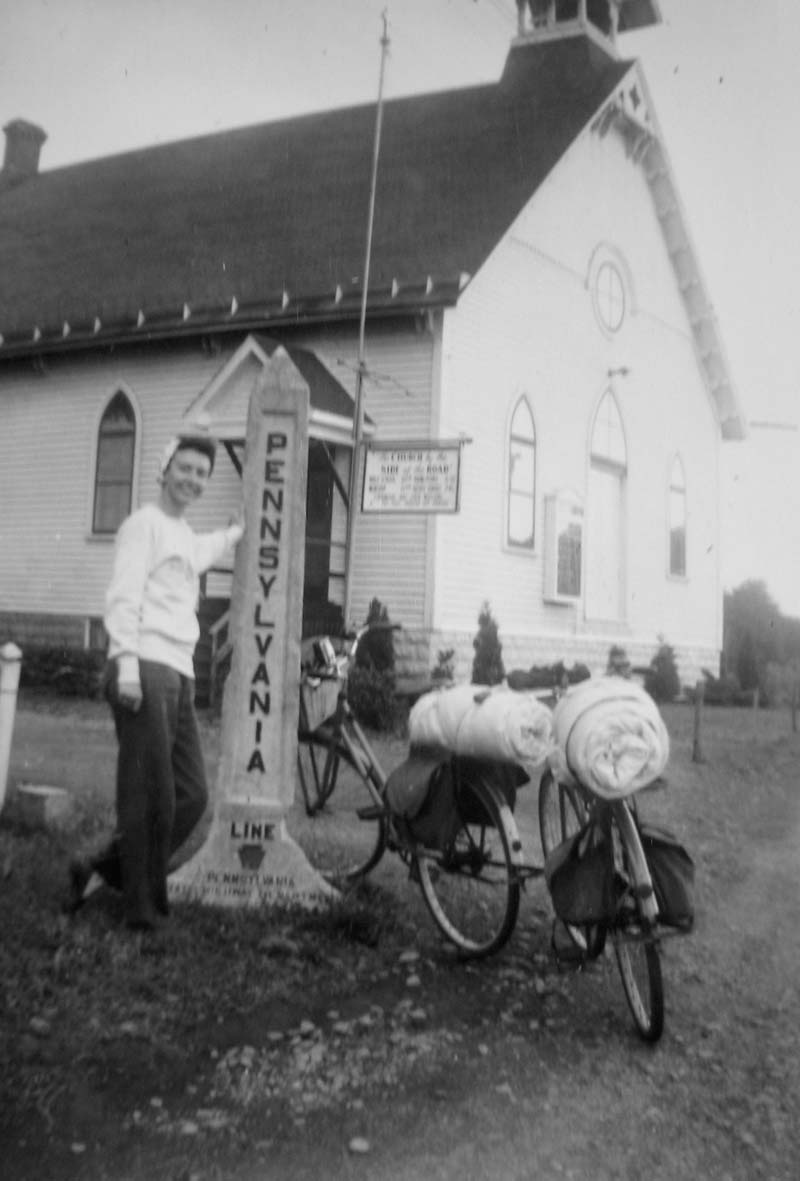
Reaching Pennsylvania State Line. (24 June 1944)
Barns, we decided through two nights’ experiences, were the best places to roll out our sleeping bags. Consequently, at sundown we rolled up to a red brick farmhouse and asked permission. This time it was granted by a young man, Johnny Phillips. Our mattress for this night was to be alfalfa, freshly mown and sweet-smelling. I climbed into the tractor parked at the barn door, intending to write the day’s journey in my log, when Johnny came whistling down the path. He stopped to pull off a cluster of cherries and tossed some to us.
"That’s a good looking outfit you have to carry you along," he said, swinging atop one of the tractor’s hard rubber wheels. "Where did you get the idea of going on such a trip?"
Johnny was a Penn State graduate, an Alpha Zeta, and he was a typical college boy - well built, ruddy faced, and bursting with pride for his Alma Mater and his fraternity. We all sat on the tractor dangling our feet over the sides and chewing on hay. Johnny was explaining about college.
"You see, this farm is 850 acres, so I decided if I was ever going to run it, I would have to go to an agricultural school. So, that’s what I did. The state paid most of my tuition and that helped cut down on the expenses. You see, this is mainly a fruit farm - fruit, trees and vineyards. That means you have to know a lot about insecticides and farm equipment."
"Yes," Doris said, "I know what you mean. I went to a state college myself, and they have an excellent ag. department. That’s one thing we’re learning on this trip. People have been so wonderful to us. They open their barns to us and want us to stay in their homes. They give us milk, dry out our wet clothes and give us parental advice for our trip. The people of the United States are pretty fine. We’re finding that out."
We had drifted from one conversation to another when I glanced around and said, "Look how dark it’s getting. We’d better be hitting the hay."
"You don’t mean this early," Johnny said. "It’s Saturday night and I’m going into town. How about letting me show you around? Let’s go to a movie."
"Thanks a lot, Johnny, but Poppy is right. We’ve got to start early tomorrow and that means a good night’s sleep. How about doing up the town for us, too?"
Johnny swung into the car and rolled down the drive. We jumped from the tractor and began to fix our beds in the alfalfa. Suddenly, a little old man appeared. He had gray hair, a wrinkled face and watery blue eyes. "Well now, what have we got here?" he asked.
We explained our presence.
"What?" he asked. "Girls sleeping in a barn? Well I declare. Now aren’t you afraid to sleep in a barn? You’re not? Well glory be! I tell ye what you do. You foller me... come on now... foller me right down these stairs."
We followed the little man named George down the steps, past the rows of cows and into the milk room. He began to fill large cups with rich creamy milk.
"This is just what you need to put some red into your cheeks. Make you feel peppy." And we did feel good. We felt like robust examples of perfect health. We thanked our friend and said goodnight. Then we climbed into the loft.
"Well, Mouse, this is Pennsylvania. Tomorrow we’ll be in Erie."
Doris put the last pin into the last curl. "Yep, and tomorrow’s Sunday. Well, I’m for some shuteye. Night, Mouse. Happy dreams."
I turned over and thought about all the things that had happened. If all that happened in three days, what would the rest of the summer be like?
* * *
June 25, 1944
The next morning the rays of sunshine filtered through the dusty cracked windows. A small black and white kitten had curled up on Doris’s chest and went up and down in regular time to her breathing. Another stretched its warm body across my feet.
"Morning Mouse," came from the bedroll near me. "Today’s Sunday, and isn’t it a beautiful day?" She freed an arm, stretched out from the hole and unzipped herself. We gathered up our tooth brushes and towels and hiked downstairs, past the sleeping cows and into the milk room. Breakfast on this morning was quite domestic. One of the hired men let us poach our eggs on his gas range and, for the first time, our kettles needed no scouring on the bottom.
Doris and I were on our knees rolling our bags into the smallest size we could when a friendly "Hello" greeted us over the rail. It was George, the hired man, coming to say goodbye.
"I’ve been on the road myself," he said. And he told us how he used to bum, hop freight trains, and win bike races. He had us quite convinced that we belonged to the same order of hobos as he. "You sure are going to make some hobo a good wife," was his last remark. He flipped us each a quarter saying, "You’ll probably need it." We were thoroughly initiated. We looked the part; we were taken in by a member; we were given a handout. Yes... we were hobos, because we are, as George put it, "on the road ourselves."
We left Johnny’s farm at 7:20 and arrived in Erie at 10:00. Erie was quiet and peaceful that morning. The church bells were ringing and well dressed people were waiting on the street corners for buses to take them to Sunday services. We headed for a gasoline station where we could change into our non-wrinkle dresses and comb out our hair before attending church.
Then, after riding around past several churches, we picked out the one with the most interesting sermon title and entered. The log account of it reads:
We arrived early, so one of the members ushered us into an adult Bible class. We passed from one host to another until we supposed we had met the entire congregation. The sermon was "God and our Troubled times." Very good. We put George’s quarters into the collection tray.
After church, we rode out to the peninsula jutting into Lake Erie, cooked our lunch, and wrote letters on the seawall. All of the people who had shown us hospitality were written notes of appreciation. As the heat of the day subsided, we once again headed west.
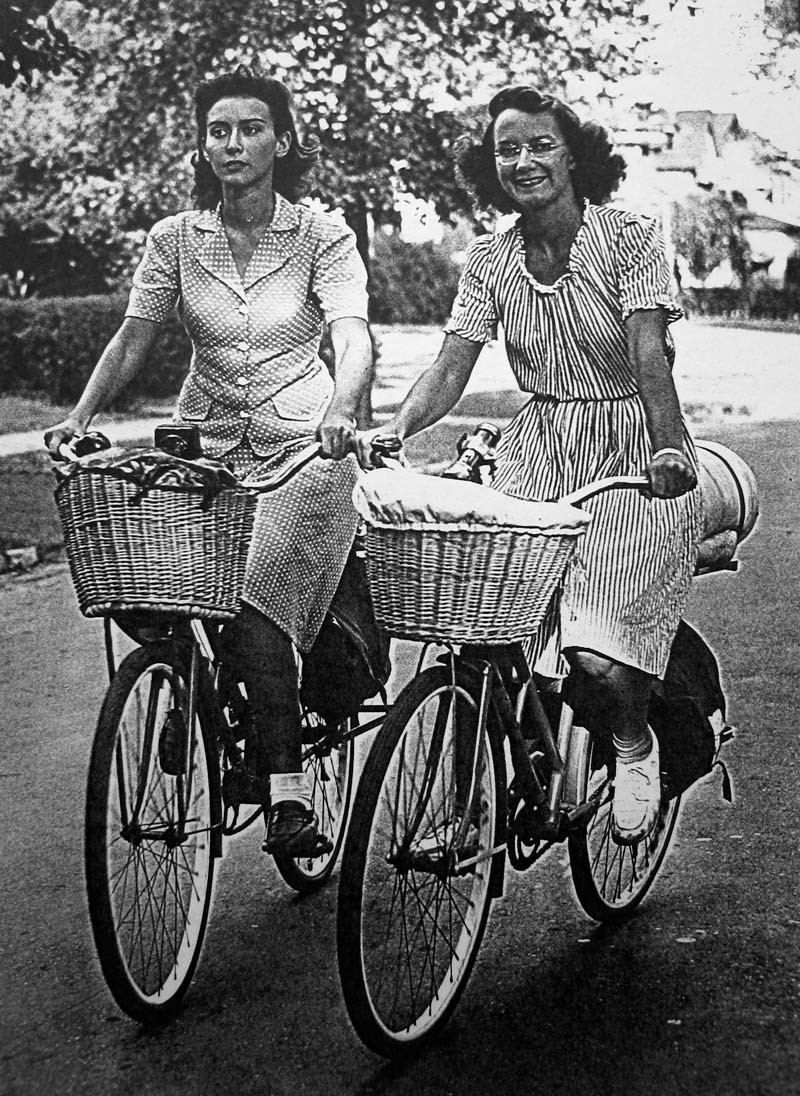
On the Road.
The only equipment our bicycles lacked were odometers to record our mileage. Wartime measures had taken them off the market, so we trusted to luck that we might find one on a dusty shelf or even a secondhand one along the way. Inquiries at the auto stores were fruitless.
Now, bent along the highway en route to Ashtabula, we came upon a one-story gray shop with a sign "Bicycle Repairs" hanging in the window. Rusty frames and bike parts leaned against the window from within. The shop was closed for Sunday. We stood peering in, wondering at the prospects of finding an odometer, when a short, fat man appeared around the corner of the shop. It was DeMarco, the man we wanted to see.
"Bike odometers? You’ll never get one of those. Are you girls going very far?" We explained our journey and he immediately became enthralled. "Say now, that calls for something more than leg muscle. I’d like you to come in a meet my wife." The little kitchen was permeated with the smell of garlic and meatballs. "You’re going to stay for dinner," he was deciding for us. "My wife makes the best spaghetti, and we’ll have plenty of beer. Beer is good on a hot day like this." Although the invitation was tempting, we declined in the hope of making more mileage before the day was over. We filled our canteens with fresh water and departed. Afterward, we regretted that we had not accepted. After all, we had no time limit. Why were we rushing?
By evening we arrived in the city of Ashtabula, Ohio. Another state line crossed and our first destination was the telephone booth. We had promised that we would call home on Sunday.
Buffalo rang our number. Someone on the other end lifted the receiver. "Hello Mom," I said excitedly. "Here are your two bikers in Ashtabula, Ohio. Of course we’re all right, Mom, except for very burned noses." I reeled off the list of things we had planned to say. "No, we haven’t any blisters. Yes, I do wear my rubbers. People are very kind to us and there is no need to worry."
I turned to Doris. "They still want to send us train tickets."
"Oh, tell them we are just ‘bums on the plush,’" Doris replied. "If we need any trail stake they can help us out."
The operator called time. The nickels jangled into the box. The voices that carried us home were gone.
Months before we embarked, our friends bonded in a mutual attempt to discourage our trip. "Foolishness!" they called it.
"How are you going to live in one dress all summer? And where on earth will you do your laundry?"
"What’ll you do when there’s no creek to take a bath in?"
"Don’t think you can always make a wet wood fire in the pouring rain."
"I know. You’ll get to Gowanda and wire home for some blister ointment and a feather pillow, and then beg somebody to take your seat and let you stand up on the bus." "Good Lord! A whole summer without mail. I’d die if I didn’t know when Bud’s unit got shipped out."
"Imagine not hearing the top jive on Hit Parade for a whole summer!"
They pelted us with a myriad of queries. We had answers to all of them... well, at least most of them. And for those unanswered, we would trust to the luck we hoped we possessed.
One dress nothing. We were equipped for rain, sun, snow, and swimming. Riding along the road in shorts, letting the wind blow through the toes of my huraches was the coolest form of travel. But those brisk mornings, which were very few, found us bundled in dungarees and thick sweat shirts. And every time we dug for the camera... out fell the rubbers.
What if it was storming? Hadn’t we always found shelter on our hikes before? If we could light a fire on one match, why worry about a little rain?
Maybe we were over confident. Maybe our egos were dangerously expanding. We didn’t wonder; we didn’t worry. We trusted an inner feeling of safety and strength in our independence.
* * *
June 26, 1944
And so it was that on June 26 we were to answer one of those questions. This was the day we were to pick up our mail, general delivery, at the post office at Painesville, Ohio. The post office was a beauty. It was white and modern, and to us it seemed the ultimate of American democracy.
We climbed the steps, passed through the glass doors, and inquired at the window, "Any mail for Popp and Roy, General Delivery?" Hopefully, we watched him reach for the mail in the pigeon holes under "P" and "R".
Thumbing through them, he laid aside some letters. "Roy and Popp?" he inquired again. "Three letters and a post card for you."
We grabbed them up and swung out the door. Like children saving the frosting until last, we went through the business of ordering chocolate sodas in the drug store before we broke the seals. We read them, re-read them, and read them to each other. What a time our parents were having! The war news was almost forgotten, and in its place were maps of the United States sprawled on the tables with the route of the "Two Wandering Mice" recorded. After the mailman arrived, the telephone between the Roy and Popp families was buzzing. Wonderful parents to even bother with such foolish adventurers!
When we entered Painesville, we had passed over a high bridge spanning the Grand River. The swim we had waited for was beckoning far below. Skirting around the edge of the cliff, we watched for a break in the iron rail that might lead to a pathway below, but the drop was sheer and only a few dwarfed bushes clung to the sides. "Let’s go back to the bridge," I said. "There should be a way of getting around the bridge by the abutment."
So we circled back to the huge bridge that spanned the river. Here the land around the abutment that held up the western span of the bridge sloped more gently to the shoreline.
Doris had already dismounted and was trampling through the underbrush in search of a path. "Here it is!" she yelled from under some bramble bushes. "It’ll be tough taking our bicycles down this incline, but I don’t think we should leave them up here."
"Lead and I follow," I exclaimed, pushing my bicycle into the thicket. It was a struggle going down the steep incline through rock heaps and broken glass. The bicycles gathered momentum and strained at our grasp. And then we came out of the tall weeds to the shadow of the concrete foundation. It was cool and moist. The rumblings of the trucks and autos above echoed off the concrete walls. Doris was taking off the straps of her saddle bags and clothes were flying left and right.
"Look where you’re throwing them, Mouse, right into the sand." "Exactly," said Doris, "I’m going to give them a good scrubbing. Have you forgotten that we’ll be in Cleveland tomorrow? I’d hate to have to see a movie in my bathing suit."
I was content to sit and dig my toes into the cool wet sand. The river was warm and lazy. I was feeling lazy, too. I had to admit it was a perfect laundry. Doris was sitting on a big rock in the middle of the river. I got up and splashed my way out to sit beside her on the warm rock and laundered my clothes, too.
"Ablutions of a hobo. And to think housewives have to keep changing the water all the time!"
The evening was cool as we passed through the town. Families rocked in the dark green coolness of the porches. Hoses sent up a shower of spiraling drops that fell, pelting the green grass. Little puddles on the walk mirrored faces looking down: children laughing upside down.
Next to the curb stood a huge chocolate soda four feet high. It welcomed the passerby into the white-tiled creamery. Doris glanced at me.
"Are you awfully thirsty?" I asked.
"I guess I don’t need another invitation."
More coolness inside. We stood before a refrigerated counter containing bottles of milk and cream. A man was polishing a row of glasses.
"A quart of milk, please," said Doris.
"And two large glasses," I added.
A little mystified, the man handed us the quart of milk and two soda glasses. We sat down in a little booth next to the front window. The man, still polishing the glasses, turned to watch us. Doris shook the bottle and poured the ice cold creamy milk into the tall glasses.
"Fill ‘er up." I held out my glass. "Then I can take the bottle back and get the three cents."
We drained it down to the last drop.
The little man swung the towel over his shoulder and clapping his hands to his hips, shook his head. "Well, I never... twelve years I’ve been seeing people drink milk here, but I’ve never see it go like that."
We went out on the sidewalk. I looked at the sky. "We’d better think about bunking." When I said that innocent word, "bunking," we realized only its connotation, a place to sleep, even maybe a comfortable place to sleep. We had been very lucky and had no cause to worry.
Suddenly it was dark and we could find no barns. The stars were all out. It was warm. There was a little school house in a large field. Why not just camp outside? So we unrolled our sleeping bags in the field under the stars in back of the school.
Beware of fields! Beware of fields on a warm summer night! Our bedrolls were very warm. They came from Iceland, so they should be. The night was warm, too. There was no breeze. We laid on top of the rolls under the light cover we had made for them. And then it began.
A hum... a drone... a little black spot hovering between me and the sky. There were millions of them - mosquitoes! They swarmed over us, and mosquito netting did no good. Our arms itched, our legs itched, our feet itched, our faces itched... and still they kept at us. There was only one thing to do - retreat to the hot bed roll. Up came the zipper, down went the head. It was stifling! Sweat began to trickle down my face; my hands were clammy. I peeked out of the hole and saw them still there, still waiting to continue the feast. The moon swung in a great arc. It must have been at least three a.m. The humming of the pests continued.
"Never again shall I spend a night like this!" I thought. "Soon it will be morning. Morning must come sooner or later."
I felt cramped, my back ached, my whole body itched, my face was swollen, and it was hot. Somehow under those conditions I fell asleep, and in the morning I was breathing cool air. It was quiet. The monstrous demons of the night before had disappeared.
Soon we were biking along the road, singing at the top of our voices. We felt good now. The wilting arms of the willows spread a cool archway over the highway. We pedaled through its sun-flecked shadows.
All the songs we had learned as Camp Fire Girls seemed to find their proper place on the open road. Pedaling side by side we kept up an endless stream of songs fitting the blue of the morning, fitting the white of the highway, fitting the wind in our faces, fitting the gypsy song in our hearts.
Along the road that leads the way,
We travel as it wills,
Our hearts a guidepost good enough
To find both dale and hill.
Our hearts are light, our courage high,
The way is good and broad.
Give a cheer! Give a cheer! Give a cheer! Rah!
Hurrah for the open road!
Willowby was our breakfast stop. At 8:00 a.m. the townspeople were preparing for the business day ahead. Brooms swept the papers fluttering to the curb. Water splashed from the window washers’ buckets and ran in little streams down to the curb. A white-aproned clerk piled pyramids of golden oranges against the window. Beneath was the freshly-painted sign, "Oranges - 5 cents." We went inside and bought the two biggest oranges we could find.
The village square was a convenient breakfast spot. We lined up the meal on a park bench. The bran flakes were dry, the oranges pithy. I chopped off another lump from the petrified sugar in the bag. It had weathered the storm, too. Then we filled our canteens at the gas station to wash cups and spoons.
Now we were on our way to Cleveland. Today we would hit our first really big city. We would be "bums on the plush"... sleeping in beds, eating in restaurants, seeing a movie. These things, we discovered, would be well earned. That sun we had greeted in the morning was now high in the sky and baked down on us.
Before entering Cleveland from the east, there is a long stretch of road without trees and with heavy traffic. We pedaled along for a long time, rationing out our precious water. The ultimate effort that day was crossing the viaducts that are near the large baseball park.
But now we were in the city. The streets seemed jammed. The houses were close together. And it was so hot! As we biked along the streets, people turned to look at us and car horns honked, but now we were veteran hobos. We were hardened to the stares of the public.
We saw a man standing on a street corner. He had on a blue uniform with a bright silver shield. People everywhere know him as a "cop," but this should be corrected, for he has another name; he is an "angel." Above his head, although he does not know it’s there, and although some people do not see it, is a halo. We have placed it there because we think he earns it.
From day to day, from town to town, he patiently and cheerfully imparted his information to us.
"Route 42? Well, you see that red stop light down there girls? Just turn to the right there and keep on going. Good luck!"
"Post Office? Why sure, I was going that way myself. Come on along."
"A place to swim? Well you look as if you could really use a swim! Now I’ll tell you, just go down this street...."
Yes, those cops deserve those yellow bands up there above those blue-visored caps. So when we saw this angel standing on a street corner, we naturally sidled over to the curb and greeted him.
"Well, look what we’ve got here!" He exclaimed. "You look like health poster girls! YWCA? Sure, that’ll be easy to find." His hearty voice boomed out directions, and his hands gestured the turns and number of blocks. We thanked his grace and took our leave to the city "Y".
* * *
June 28, 1944
The comfort of white sheets and springs kept us in bed to such an hour on June 28 that all hobo rules were infracted. From the window I looked down upon the maelstrom of the city. Crowds circled the buildings and taxis, trucks and cars moved and halted to the rhythmic scheme of lights. The trolley swayed to a stop and workers stuffed themselves behind the door. Theater lights blinked above the enormous exaggerated pictures of the actors. Mothers, half running to escape the change in prices, towed their children inside.
A gigantic watch hung over the jeweler’s shop. Its hands beat out the movement of the throng. It jerked to the minute, disregarding the seconds between time and rush, rush and time. I moved away from the window feeling tightened and strained, yet amused at their aimless way.
In our freshly-laundered clothes and tight curls, we wove in and out of the parked cars to the southern end of the city. The sight of the markets reminded us of the breakfast we had passed up. Mounds of fruit were heaped up on carts along the curb. We questioned the prices and asked for two oranges. The huckster surveyed our outfits, grinned a toothless grin, and handing four oranges to us he said, "I’ve been on the road myself!"
The rough brick pavement, the veil of smoke, the line of heavy trucks and stop lights proved an obstacle course for us until we reached the open country again. And still the heat did not let up. We wanted to make up for the morning we lost, but the wheels turned slowly. Doris was walking her bicycle up the hill. I stopped to drain my canteen. Drops of perspiration stood out on my arms. My nose tightened from the burn.
It was useless to pedal further. We stopped at a gasoline station and stretched out on the lawn in the cool shade. The heat of the afternoon was intolerable. Little did we know then that the temperature was 102°F, and we had gone thirty-five miles! A barn one mile outside of Medina, Ohio, was our quarters for the night. The quart of fresh milk the farmer’s wife brought us was all we could drink after the strenuous day.
* * *
June 29, 1944
On June 29 our log reads:
We were up at six, because we wanted to get our riding done in the cool early morning. The sun was just rising as we turned out the gravel driveway after leaving a thank-you note in the mail box. We had a bountiful supply of food, so after biking five miles we stopped to cook breakfast. It was a royal meal. There were grapefruit, cereal, bacon, and soft boiled eggs and milk. We hard boiled two eggs for lunch and then did the dishes.
After continuing about six miles, we dismounted to push our bicycles up a steep hill. A heavy truck slowed at the base of the hill, shifted into second gear and met us at the top. Hearing the truck slow down, we turned to see what the driver wanted. A smiling face topped with a shock of blond hair was thrust through the window. "G’morning girls. Is it tough pushin’?"
"Yes sir," we agreed. "We didn’t think we’d find many hills on this road."
"You’re going to find a bunch of them from here to Delaware. They’re building a new road about fifteen miles from here that should be more level. They’ll be workin’ on it today, though, so you may have to take a bumpy detour."
Doris and I groaned at the thought of another day like the one we just passed through. "How would you like a lift?" he asked. "I’ve just delivered a load of hogs and am on my way back home to Delaware."
We were to find our next mail in Delaware. There was temptation, although we thought it would be sort of cheating. We stepped around to the rear of the truck. The slatted sides of the truck enclosed a floor of mud stamped down by a score of pigs. We wondered whether we would be a reasonable facsimile to haul back!
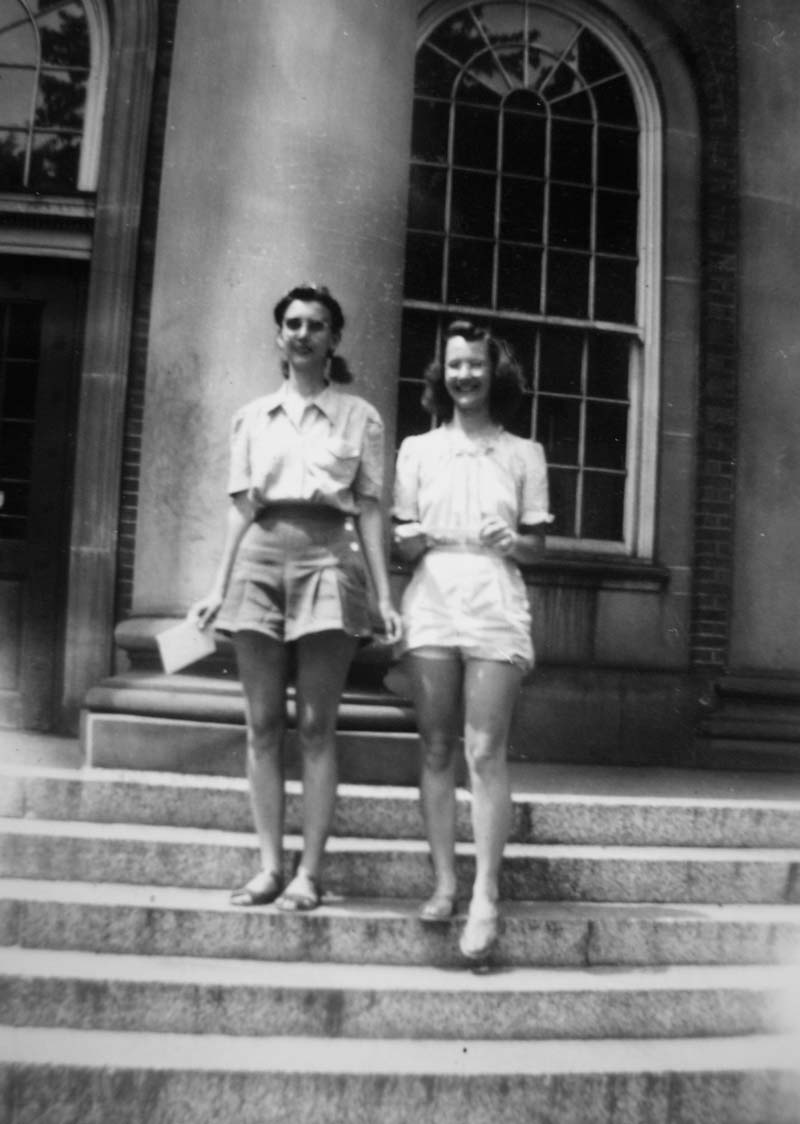
Post Office, Delaware, Ohio. Mail General Delivery. (29 June 1944)
"Sure," we decided. "We’ll go along with you to Delaware. That’s just the place we’re headed for, too."
The driver pulled the truck off onto a siding and climbed into the trailer. He unloosened some straps on the side and said, "Hand up your bike and I’ll strap it to the side."
He leaned over precariously while two of us hoisted the bicycles up to him. How genial he was to offer us a ride and then obligingly haul our bicycles with us. With our bikes secured, we crawled into the cab beside Bob, holding the kettles and knives that would have tipped out in the trailer.
Never before had we appreciated the effortless travel of a car. On the way up every incline my leg tensed and I felt like helping the truck to make the grade. We took turns shouting above the roar of the motor and proceeded to learn about the "Big White" we were traveling in, the four shifts in the truck’s gears, and about the $1,700 worth of rubber in one outfit.
"Once in a while I take my boy on one of these trips," Bob said.
"How old is your boy?" we asked, as soon as we learned about Bob’s little girl and boy, and his wife. We found out that a good trucking job paid well and was secure. "It’s hard to get used to," he said. "You have strange hours and have to catch up on your sleep when you can get it."
Another large truck was approaching from the opposite direction. Bob honked his horn. The other driver honked his in answer. They both waved. We were learning a new code of the road.
We were now on the very summit of the range of hills when suddenly a large city appeared in the valley before us. What was a city of that size doing here? Then we saw the coils of smoke and the numerous factories - war production!
"How about a place to eat at girls?" Bob asked. "This is my usual stopping off place. Come on in. I’ll introduce you around."
We were now to enter a trucker’s stopping off place. We learned that wherever there are many trucks in one spot, you will be sure to find good food.
We sat down at the counter and gazed at the friendly smile of Tiny. Tiny was big - big in every direction. She was the wisecracking waitress who made everyone forget their monotonous night of driving. She was the one who listened to the fellows’ troubles. "Where’s Joe?" she asked. "Haven’t seen him around lately. Had an accident? Not hurt, too? And he with a wife and kid." She filled a cup of coffee and managed to turn around in the crowded space behind the counter. "Nice boy, Joe. Oh, he’ll be back soon. Can’t keep one of these hard boiled truck drivers down!"
Everyone laughed at that, for these truck drivers were not "Hard boiled." They had heavy jobs and hard hours, but they also had families and children, and they had their troubles and their happiness. They were an important part of the makeup of these United States.
Hospitality
The Humble Farm in the Countryside
June 30, 1944 - Gruber Farm
Our shelter for the night was again a warm, comfortable barn. No matter how spacious a barn might be, it is always cozy. Perhaps that is because with so few windows it is dimly lit. Then the musty fragrance of the hay and alfalfa makes it a homey place.
A barn is warm. If it is quiet, you are completely at rest in an atmosphere of reflection and comfort. If the chickens are fluttering about and cackling and the cows are shifting in their yokes, you feel the warm comfort of your animal neighbors.
I sat outside the barn door. The cool breeze of evening wafted across my warm face. Beyond the hedge row and the wheat fields, clouds floated in the sea of crimson sunset.
Doris sat with her back to a leaning ash tree, with pen poised beneath her tilted chin and writing case open in her lap. She, too, gazed at the beauty beyond. Wonderful friend, Mouse. Wonder who else would partner an adventure like this. A shuffle of footsteps came through the tall grass. It was Mrs. Gruber coming from the farm house.
"Good evening girls," she said, touching the knot that tightly held the grayed hair from her forehead. "Won’t you come in and join us before the mosquitoes eat you up?" Her tiny eyes peered at us through the heavy bifocals. A furrow for every worry creased her brow. We heartily obliged and followed her up the flagstone path to the screen door.
"Down Shep, down," a voice from within warned, and a big white sheep dog brushed past us as the door opened.
Mrs. Gruber ushered us through the kitchen into her living room. It was one of those rooms boasting the final payment on the modern chair that fought with the Boston rocker. Grandfather hung in a six-inch gilt frame over the bouquet of faded paper roses. A China doll dressed in red feathers, the latest prize in a bingo game, balanced on the edge of the window sill. It was all neat and clean, but one colossal failure at interior decoration.
"How would you like some ice cream?" a smiling face questioned from around the kitchen door.
"Come in and meet the girls, Clare," motioned Mrs. Gruber. "This is my daughter Clare. She’s living with us while her husband is in the army. My daughter-in-law is living here, too, while John fights in the Pacific."
She rose and went over to the mantel where a row of pictures stood. Bringing them over to us she said, "These are my sons." Four uniformed boys smiled in their paper frames. "The boy you saw driving the tractor this evening is the only one I have left. He’s just nine years old. I don’t know what we’ll do for help on the farm. We lost six acres of corn after the last hail storm."
Her nervous fingers fidgeted with the spoon as we dug into the heaped bowls of ice cream. The mention of the war and her sons deepened the lines of her face. She toyed with the mound of cream.
"It’s been so long now. My only happiness of the day seems to be the sight of the mailman filling the box. There’s Clare’s husband," she said pointing to a picture on a low table. "All of them in it - spare nobody," she murmured.
In vain we attempted to divert the discussion to a more cheerful topic, but rigidly she stuck to her own thoughts.
"I suppose you have sweethearts in the army, too?"
"Yes, we have friends over there," we nodded our heads.
She seized upon our answers. "Where were they? Maybe they knew her boys! No, they were in different armies. There are a lot of men in the army."
After hopefully reassuring her the war would be over soon, we retreated over the damp grass to the barn. It had grown dark, and we felt our way around the hayrack to the corner where our bicycles stood. I unscrewed the flashlight clamped to the handlebar and swung the beam around in search of the pump. We found a water tap next to the cow’s stall.
"This is a perfect bathroom," Doris said, swinging her towel up on the cow’s yoke. "Nothing like having milk bar and powder room combined!"
I ran some water into my cup for my toothbrush. Moonlight flooded through the barn door, so I turned off the flashlight. As I was leaning over the pig pen vigorously brushing my teeth, I heard Doris splashing in her cup of water, then a crunch, then a groan.
"What’s happened, Mouse?" I cried.
"Oh, those confounded glasses. I forgot where I laid them on the floor and stepped on them."
We were both Blind Mice without our glasses, so I could sympathize with her loss. After gathering up the pieces, we groped our way back to our bed rolls.
June 30th was the ideal day. Each day had its pleasure, its adventure and happiness, but the memory of this day has been filed away with those of rarity. We pick it out when we want to relive a beautiful day - a sunny one, with a cool breeze, a blue sky, and the fragrant aroma of open country.
If we want to think about exercise, we remember a long, broad, white highway stretching miles ahead of us, level and smooth. We can feel our legs pumping rhythmically so that soon it becomes a mechanical force. We are in motion - a continuous motion that feels comfortable. The road slips beneath our wheels. The pebbles and gravel along the side of the road become a blur. We are going someplace and we are happy in our effort.
That day we saw the United States. We saw green fields - miles and miles of green fields leading off to the horizon. And across the fields came a stampede of hogs. The hogs were fat, sleek, clean. They jostled along, racing to keep up with each other. Then suddenly they would stop alongside a fence or in the shade of a tree. "What ho there... get along," we shouted to them across the field. And they would start pounding the earth again. Big calico hogs rooted along the fence and scrambled through the rows of corn to keep abreast of the bicycles. Little ones squealed and raced to keep up.
More green fields. More sleek and prosperous hogs for miles and miles of rich, fertile land. We saw the fields of yellow corn, tall and waving in the sun and breeze. There were no houses, no barns. This was the great hog and corn belt of Ohio.
Farther along, two white horses with manes flowing galloped along the fence beside us. It was times like these that Doris and I rode along silently, seeing and feeling all the things that were happening about us.
Trees were sparse, but when we did find one along the road, we took advantage of its shade and the tall grasses below. That was meant to be a short relaxation, but it turned out to be a long nap there by the side of the road. How much a part of the earth we were then! How independent of people and all their accessories. No one else would stop beneath this tree and see it as we did. Oh yes, they would drive by at fifty miles an hour and say, "We have seen it." But in their rush they would have missed the stoney silence of a scene filled with nothing but earth and sky. They would have missed the unmistakable fragrance of a breeze wafting over acres of growing things and the color of wheat under the shadow of a passing cloud.
This was the time we realized that our method of travel was the best. Under our slow pedaling, nothing escaped us, from the change of the pavement at the county lines to the gradual change of the speech dialect from North to South.
If we wanted to talk to someone in a field, we just pedaled over and dismounted. If we were tired, we just curled up under the nearest tree and slept. Bicycle hobos were we!
When we read history, we look back on our ideal day and think how much better it is to seek out the history, to be wide awake and feel the romance of a nearby situation.
I was the first to notice the houses. "Look, houses without shades and not painted either. That seems strange."
I saw an immaculate farm yard, a fence, a gate and a clean driveway. The windows of the house sparkled. Ornaments here would be superfluous. The very cleanliness was beauty.
There were more houses, and then we saw an owner. He emerged from the house - tall, lean, bearded, wearing a broad-brimmed hat. Two healthy, robust children were following him. Their hair was trimmed as though patterned around an overturned bowl. Long bangs framed their foreheads and blue eyes sparkled from beneath. What was all the cleanliness, orderliness and simplicity? We found the answer. This was an Amish settlement.
Many such colonies as this one began in Ohio before the Civil War. Some groups came from Pennsylvania, others from Virginia. In 1767 Christian Blanch founded a settlement near the headwaters of the Ohio, and many Amish drifted from there and established new colonies in the nearby states.
Then, in 1852, a congregation from Pennsylvania was organized in Ohio by Ephraim Hunsberger. Many of these Amish colonies moved on to Indiana and Illinois, but here was a group that remained with their faith, beliefs and customs intact around Plain City, Ohio.
We decided to call on our Amish neighbors. Perhaps we could have our lunch on one of their lawns. We approached the side entrance of one of the farms. It was the kitchen, and it seemed overflowing with people. We were warmly greeted and the mistress of the house explained the great activity.
"We are having a community dinner after church and all of the women have gathered here to clean chicken and help prepare the meal. Yes, certainly you may have your lunch here. There is a nice shady tree beyond the hedge."
These were indeed the friendly people.
When we dream of easy domesticity, we see again that afternoon siesta beneath the shady tree just beyond the hedge. Put cheese and lettuce together for sandwiches, pour the creamy milk from the canteen, open a can of fruit, unwrap a candy bar and behold! We have a delicious lunch. And there in the soft grass we darn socks - the only two pair we have - sew the only button on the only pair of overalls and we are finished.
Voila! This is the life! Stretch out full length and relax, listen to the birds sing, watch the clouds float by. No troubles, no worries, no cares. Just be happy and be glad to be alive.
A friend wandered into our ideal day. We found him that afternoon in the lovely town of London. But did we find him or did he find us? Doris and I were standing on a street corner with our bikes when he came along. He was an elderly gentleman especially interested in our bikes, and we were especially interested in him.
"Now where would you be going with those bikes?" he questioned. We dropped all false pretenses and came right out and said, "to the Mississippi!" His eyes twinkled. "I know that river. I used to work right near her on the Ohio. I could tell you a lot about it. Come on in and have a bite to eat with me, won’t you please?"
We did. We had met John L. Park, a guard at the prison farm nearby. We discussed our past experiences and he helped mold our future ones.
"There are still many boats on the Ohio and Mississippi," he assured us. "Why don’t you girls buy a Johnny boat and go down the river a’ways? You can pick up a John boat anywhere around there."
More romance! More adventure! We mentally decided to find out what a John boat was, buy one and proceed down the river.
"The very best of luck to you girls," our friend said in parting, "and drop me a card to let me know how you are getting on."
Our conception of a perfect day includes an event that is different and exciting. This day was not without it. We remember how the twilight gathered and how we pedaled along the road just outside London, Ohio, searching for a night’s lodging. But alas! It was Saturday night. The farmers had all gone to town, and there was no one of whom we could ask shelter. It was getting darker and darker. We knew we must find a place somewhere.
Then one of our ambitions was realized - to be just as sacrilegious as we could and sleep in a cemetery. There wasn’t much of a choice in the matter this evening, and Doris was willing.
Kirkwood Cemetery, just outside of London, was a hilly little "bone orchard" surrounded by an iron grilling. The gate was open. We picked a bunch of posies, to look more appreciative, and we rolled past the caretaker’s house. Toward the back of the cemetery the monuments grew larger, the trees more enveloping, and ourselves more obscure.
"Let’s take a look around," said Doris, hopping from her bicycle. I followed her over the slope, surveying the habitats of the Smiths, the Wolfes, and their ancestors.
"Look at that skyscraper over there, Mouse," I said, pointing to a tall monument. "That’s not cozy enough to sleep under though."
"Let’s pick out a nice respectable family and spend the night with them," Doris suggested. "How would the Kanes do? No, they have a daughter still living. She might walk in and request her plot at any time. Here’s a family of six with the aunts and uncles thrown in. No, that’s too crowded. How does this suit you over here, Mouse?" On a knoll a giant evergreen spread its branches over the large granite monument of the Harrison family plot. Soft green grass sloped toward the drive. I surveyed the location to give my thorough approval. It faced the setting sun, a fancy white bench leaned against the tree, and isn’t that a pump I see through the tombstones? All the conveniences. So near to heaven and rent free!
"Well, let’s move in," said Doris. We hauled our bicycles up the slope, leaned them against the tombstone and untied the bedrolls. There were two headstones at the foot of a grave marked "Father" and "Mother."
"Choose the one you want, Mouse. A soft spot for a change, eh? No sticks or stones, just bones!" Doris was sitting on a neighbor’s tombstone putting up her hair. We never neglected our good neighbor policy. I shut my eyes just for the effect - just like home. I opened them. A breeze caught the G.A.R. flags on some of the graves. Doris’s sleeping bag looked like a mummy case. What if the caretaker came around to check the cemetery? He’d run a mile. We might even start a ghost legend of London - Angels on bicycles!
I rolled over and looked up at the engraving: "Benjamin Harrison... Died 1885." I paid my respects to him and shut my eyes.
Now I lay me down to sleep
Gravestones at my head and feet.
If I should die before I wake
Just bury me here
For pity’s sake.
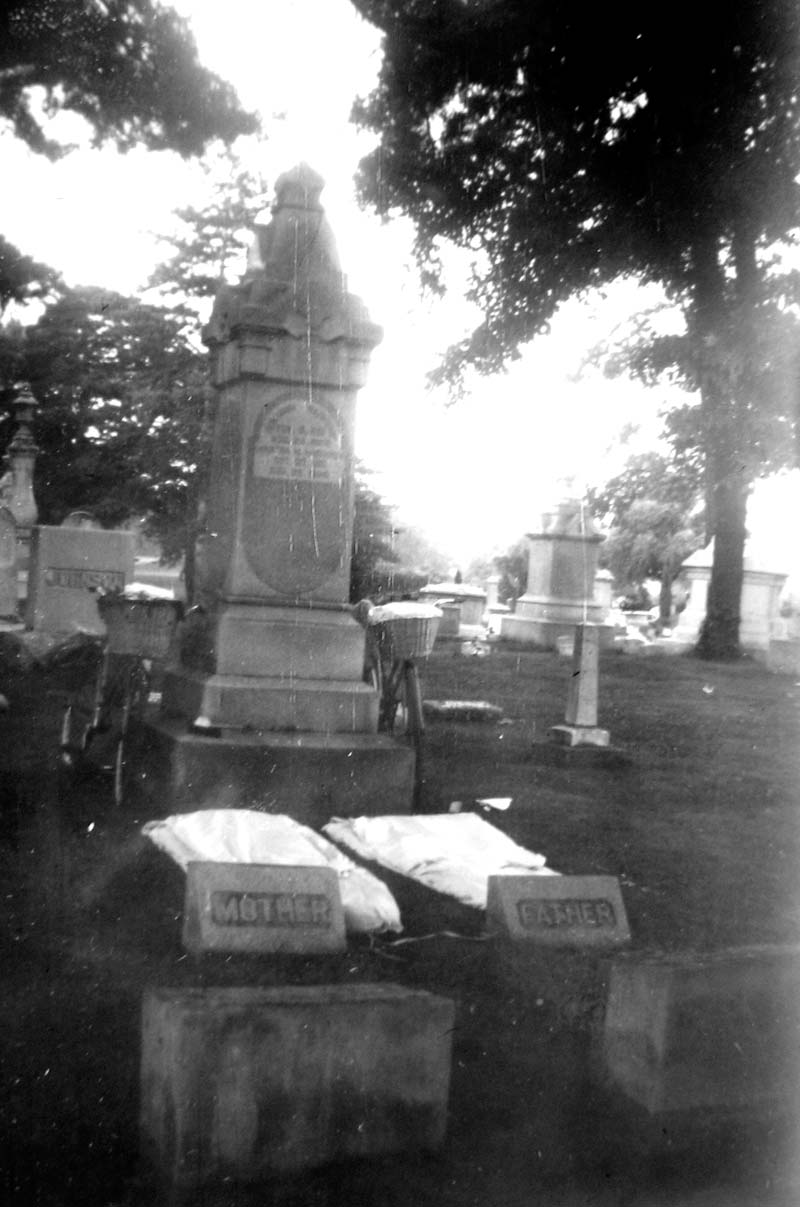
Slept in Kirkwood Cemetery, Ohio. (30 June 1944)
* * *
Morning, July 1, Kirkwood Cemetery
I opened one eye slowly. A forest of gray obelisks surrounded me, and the early rays of sunlight elongated their spindly shadows. A caravan of ants kept up their steady trek over my sleeping bag, their massive shadows marching along beside them. I opened the other eye slowly. Doris was still asleep in her sack. I slipped out and dressed quickly. The pump was not far away, so I gathered up my toilet articles and set about the morning scrub-up. Brushing teeth over a tombstone would have been an uncanny sight for any early morning cemetery visitor, and to have someone find me standing there with one foot under the pump would have been quite embarrassing. Fortunately, I had no such experience, and when I returned to our family plot, Doris was already up.
"How was your night?" I inquired.
A growling yawn and a long stretch was her first response. Then she replied, "I feel like a mummy. Those ants trooped in and out all night."
"Well let’s pack up and move out of here before they hand us a shovel."
This morning we had business to attend to. We immediately contacted the postmaster in the town of London and soon all the workers of the post office were aware that an important package containing a pair of glasses was to arrive in the mail that day. In fact, every hour we appeared at the package window and were informed, "Not on this train, girls. Try the next one at 9:30."
This period of waiting was not an unproductive one. We had breakfast on a sunny patch of grass in the town park. We rode up and down the London streets waving greetings to the townsfolk who now accepted us as a customary part of the community. We shopped in the "Five and Tens" and bakery shops; we feasted on our cheese sandwiches on the steps of the county building.
At twelve noon the post office closed, but the remaining workers were still pulling for us. As soon as the glasses arrived, one of the workers would leave them at a nearby gas station for us. Where in any large city would we find such kindness and service?
Yes, they at last came on the one o’clock train. We left our neighborly village and once more, with the world in sharp focus for both of us, journeyed on our way.
The contour of the land gradually changed from the level lake plain to rolling farm land. Mr. and Mrs. John Bush’s farm was set on a curve of the highway going to Xenia, Ohio. It was a different kind of a farm than we had seen before. Black and white geese filed along the fence, chattering and flapping their wings at the intruding chickens. Five little pigs rooted in the mud. Inside the barn, pink-nosed rabbits sat in their cages.
And then a collie pup bounded through the gate and greeted us with a thrashing tail. Mrs. Bush followed. Mrs. Bush seemed a little old fashioned. She pondered our situation and seemed dubious about the fact that two girls would travel so far and sleep in barns.
"Well," she said, "I don’t see how you could be comfortable in a barn. Don’t your parents worry about you?"
"Yes, they do worry about us," I answered. "However, we write them once a day and telephone them once a week so they will know we are all right. And now that we have come this far safely, they are more assured that we can take care of ourselves." Mrs. Bush smiled. "Won’t you let me fix up a mattress on the front porch? It would be a lot more comfortable. We have plenty of blankets to give you."
We explained to her how much we enjoyed sleeping in barns.
"I just can’t understand it, but you go right on in and use whatever you need." She held open a garden gate and we walked down a stone path past a raspberry arbor to the barn. "Meet our visitors for the night, John," she said, drawing us around to the stalls.
Mr. Bush was milking the cows. Six little kittens sat in a row with tails curled around their toes, crying and blinking. "This is our cafeteria," said Mr. Bush. "They’re waiting for the next pan of milk."
He filled a pan with warm foamy milk. Immediately the kittens all jumped into the pan, stood in the milk and lapped for all they were worth - white whiskers, white feet and rounded stomachs.
Mrs. Bush guided us through the shed to the hayloft still anxiously questioning us. "Where do you wash up? How do you keep your clothes clean? In streams? But you don’t have hot water."
She disappeared and a few minutes later called us to the back porch where we found tubs of hot water, a wash board, soap flakes and a wringer. How good it seemed to our feminine minds to immerse our arms up to the elbows in that hot sudsy water! Doris washed, I rinsed and hung the clothes out, and Mrs. Bush hung some of the clothing up to dry by the hot stove in the kitchen.
By eight o’clock the geese had all waddled back to their roosts, the squealing pigs lay in a heaving mass beside their mother, lamps burned in the farm house, and two Mice were sound asleep in the hayloft.
* * *
July 2, 1944
The next morning Mrs. Bush invited us into the kitchen to breakfast with her. "Be careful, girls, of the automobiles on the road," she warned. "Goodness! I feel as though you were my own daughters. You must write and tell us of your adventures." They waved goodbye to us as we rolled down the road. This day we did not look like hobos. We were adorned in our one and only non-wrinkle dresses and very clean white ankle socks, for this was Sunday - church day. Up and down hills we went to Waynesville, where the tolling of bells drew us to a little brick church on the hill.
We sped up the hill, leaned our bicycles against a tree, patted a loose curl into place and sedately walked into the church. We slipped into a rear pew. "Page Number 105," boomed from the altar. Someone passed us a hymn book, a Methodist Hymnal. We had not found out what church we were in until then.
After church Doris and I held a pow-wow. "Let’s eat out today. Let’s have a real good Sunday dinner," said Doris.
"Can we afford it? I have only two dollars left before I cash another traveller’s check."
We looked in our basket and drew out several shriveled dried up carrots. Further on down, under a tin can rested some moldy potatoes. There was still the Mother Weed’s Noodle Soup. We looked at each other. Our clean dresses getting smoked up by a fire? The Number 10 tin to scrub when the soup was all eaten? No meat? What for dessert? Fifteen minutes later we were reclining in comfortable chairs looking down on plates garnished with roast beef, mashed potatoes, gravy, corn, salad and rolls. Beyond the screened windows was a blue artificial lake dotted with row boats. From a juke box a top orchestra swung out our favorite tune. Tomorrow would be time enough to cash that check.
We were in no hurry. The peppermint ice cream was good enough to rate a second dish, the little lake was pretty enough for a stroll along its edge, and the grass on a nearby hill was just soft and cool enough for a two-hour siesta.
Never did we worry about the night’s shelter. Pity the poor people who must stay in hotels and tourist homes! What if none showed up when they were ready to stop for the night? What if the hotels and tourist homes were all filled up? The prices might be high, and what about the inconvenience of unpacking and packing a suitcase? Pity the elite of the road who whiz by in shiny automobiles with their eyes on the mileage gauge, and who only know the features of the trip by the size of the hotel rooms and the restaurants of each town.
Here on this grassy hill we laid, not knowing where we would spread out our bedrolls in the next four hours. All we knew was that we were on Route 42, between Waynesville and Lebanon, Ohio, and about thirty-five miles from Cincinnati. What we did not know was that we were near the town of Mason, and that just outside of that town was a beautiful home and barn, and that the owners were Mr. and Mrs. Tompkins. But once we ended our siesta and biked on into Mason, we could not help but notice the Tompkins home. It was on a hill, and following the Victorian style of architecture, it was large and gabled. We paused just to look at it, and then we noticed there was a barn nearby. Would we possibly be accepted here?
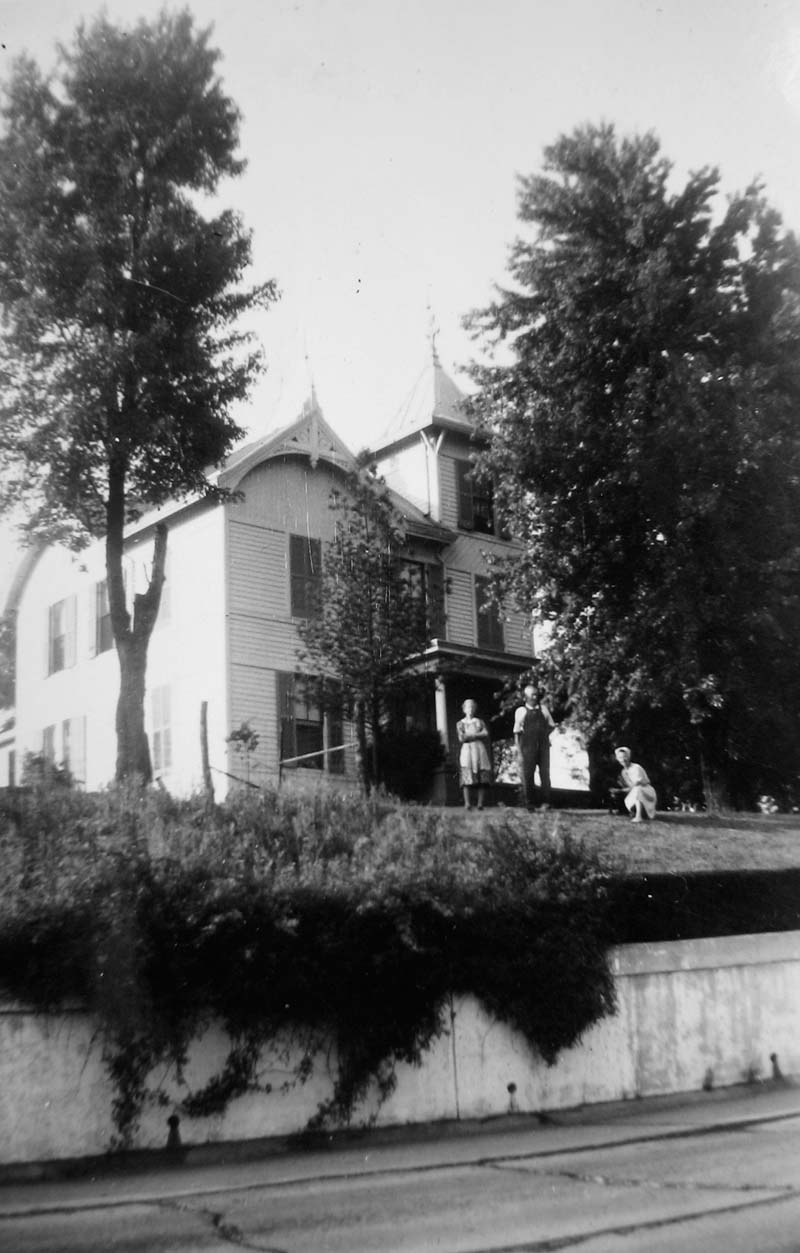
Mason, Ohio Route 42. Farm of V.W. Tompkins. (2 July 1944)
Accepted? That is not the word. Mrs. Tompkins does not accept, she energetically welcomes people into her home and into her heart. She is a thin, spry, and extremely active little person, whose eyes twinkle and whose smile constantly reassures you of her kindness and understanding.
"My," she exclaimed, "that’s just the kind of trip I would like to take, just what you girls are doing. Good healthy exercise," she declared as she made us comfortable in her deep living room chairs.
"I’d like you to meet my brother, Mr. Bowyer. He writes poetry."
We stood up and shook hands with Mr. Bowyer.
"Have you ever been in Mason before?" Mrs. Tompkins inquired.
"No, this is our first trip south," I answered.
"Well, we have a nice little town, but the place of most interest is the W.L.W. radio station."
Before we knew it we were all in the car on our way to the W.L.W. radio station. They told us this was the most powerful broadcasting station in the country. We circled the maze of towers and met some of the Tompkins-Bowyer relatives. We had been lying on a hill of grass four hours ago, but now we were part of a family, riding around town in the car, discussing rain conditions for the crops and new neighbors. We drove up the drive to our new home, and brought our miscellany of wash clothes and towels into the house to wash up for the night. They tried to persuade us to sleep in the house tonight, but we decided to roll out our bedrolls on a mattress of corn stalks in the spacious barn, with Brownie the dog at our side.
* * *
July 3, 1944
Cincinnati was only 23 miles away, so we made it by eleven o’clock the next morning. It was a city of hills and brick pavement. Sweating up the winding red streets behind the swaying trolley and bumping down past the Baldwin Piano Company, with tin cans jangling, we flew. Our hair was in pins and our overalls were getting too warm, so we looked for a place to clean up. We looked for one of our havens.
Throughout the United States there is a network of oases. They are the havens of the destitute and weary. We are speaking of that great blessing, the gasoline station. No matter where it may be, how many gas pumps it may have, it is as typically American as ice cream, hot dogs or the World Series. But it has broadened its main function of filling up gas tanks and pumping air. Now there was, in its inner sanctum, a supply of soda, cracker sandwiches done up in cellophane for five cents, candy bars, sun glasses, and tablets to keep the drivers awake nights. Most important of all, somewhere in the vicinity of this oasis will hang a sign, "Rest Rooms." These little stations are very welcoming, but first we must establish a beachhead.
"Hello, what’s this?" some man in greasy overalls would say, and we all would get started in a conversation. Meanwhile, he would be checking the air in our tires and giving us weather forecasts. Then we would park around the back and bring forth from various bags and baskets an array of towels, tooth brushes, soap, a clean blouse, dirty socks to be washed, makeup and comb. Hoping that no others would be in need of our cubical, we took sponge baths and washed our clothes. Socks were hung on the bike handle bars to dry. We were completely at home! Never will we forget our friendly gas stations!
Next we prepared ourselves for another ritual. We leaned our bikes against a tree in a shady spot across from the gas station and sat down on the curbstone. Our most precious possession was in our hand: the A.A.A. travel book. I flicked the pages, stopping at the chapter "Ohio," and then found the subtitle "Cincinnati." We began reading its history and the descriptions of places of interest.
Cincinnati, we learned, is situated on a series of plateaus rising above the Ohio River. Longfellow called it "the Queen City of the West." It is also famous as a center of music and art. But what the manual didn’t tell us was that the hills in Cincinnati are tough on bicycles. We walked up long steep ones pushing our paraphernalia before us. At last we came down on Broadway and rode along Fifth Street to Fountain Square.
This was especially attractive. A green park stretched along the center, and here people wandered and lounged. The buildings seemed high, the stores large and prosperous. We were greeted as usual.
"Hi there girls, where are you going?"
"Hey! Put a motor on it!"
"Good luck girls!"
But now something had happened. There was a slur someplace in the words. Suddenly we met the beginning of a new language.
"Hey you-all!"
Doris and I smiled. Now we were really getting someplace. She stopped for a red light and I rode up beside her and yelled: "Hey, you-all. Put a motor on it!" "Where you-all going," she said, "camping?" Yes, it sounded good.
Now we headed for our destination, the Ohio River, the river that was a milestone in our journey - it flowed into the Mississippi. The river that divided the North from the South and that we had never seen. And now it lay deep and muddy beneath us, flowing languidly, carrying in its stride the cargo of a hundred cities.
We were standing on a suspension bridge connecting the worlds of the North and the South, Ohio and Kentucky. Beyond, the smoke of the two cities rose and blackened the skies. Tugs convoyed their precious cargo to rest at the wharves. Directly below, a miscellany of small crafts returned the slap of the water and strained at their ropes.
Gone were the flat-bottomed excursion boats with their gaily painted sides and crowded decks. Gone were the stern-wheelers that left their snowy fountain behind. But could that be - up on the levy - yes, it was - a houseboat! We had read of such things, but thought they were obsolete. And there, even though it rested on dry land, lay a houseboat.
Over the bridge we sped, winding under viaducts and finally joggling down an ill-paved road to the water’s edge. It was to become a habit, this irresistible quest of boats, warehouses and streets along the water’s edge. We crawled down the bank past broken bottles and rubbish heaps to gain our grandstand view from the levee. So this was Kentucky!
We sat on the bank peeling our lunch oranges. Yelps and wails and yipping broke
forth from the shack behind us. A screen door slammed, and we gazed around to find a
grimy boy walking toward us.
"Hi girls," he grinned, mopping his sweating face with a greasy hand. "Today sure is a hot one."
"What’ve you got in there?" we questioned, motioning toward the shack. "Sounds like a zoo." Three dogs peered through the screen door and scratched at the screen. A breeze sent an unpleasant odor our way.
"Oh that," he waved a hand. "Them are some old dogs I take care of for the S.P.C.A." We supposed the dogs would have been much better off at large. He eyed our trappings. "Where from?" he syncopated.
"New York," we answered.
"Aw, that’s a heck of a place to come from. Nothin’ but crowds, ‘n night clubs, ‘n women, ‘n factories, ‘n dirt." He had some queer idea of New York state. To him the place was just one big New York City with no fields or farms. We hoped we might straighten him out.
Then he said, "Where you-all goin’?"
In two seconds we established a destination. "We’re going to Louisville."
"Louisville? Gee...." He accepted one of our raw carrots and offered more information. "I’ve been to grammar school."
"Aren’t you going to high school?"
"I’ll get by." He had another carrot. "See, there’s my car up on top of the hill." We looked up at the ‘32 Chevy.
"Pretty nice," we said.
"Well, I gotta go now." He paused halfway up. He looked dubiously at our bikes.
"Well, I hope you-all get to Louisville."
He jumped into the car, honked the horn for a goodbye, started the motor and sped off. Doris looked at me and I looked at her. "So we’re going to Louisville? Well, let’s go!"
There’s a hill leading out of Covington to the south. It leads for miles and miles up and up. We started out on it with spirits high. After 50 feet we dismounted and started pushing. Children all along the way were lighting fire crackers. Cars were climbing next to us in a steady stream.
A mile and we began to get very tired. The sun was beating down, the fire crackers were popping off every second, and cars and trucks were still edging along in second gear, one behind the other. The top might be around the next curve, but it never was. Our canteens were drained, the sweat trickled down our foreheads, and still the never-ending procession continued. What a relief when we actually found the top of the hill! There we found the source of the fire works. A shack was standing at one side of the road decorated with flags, and to this spot the younger population of Covington had to tramp to collect their stock for the coming Fourth of July. Also on the top of the hill was a gasoline station. We made a beeline to it. "Hello, I wonder if we could fill our canteens with water here?"
Several men were lounging in front of the station. They all rose as if in joint ownership of the business. One took the canteens, another turned the water tap, another supervised the process. The last man devoted himself to asking us questions. We answered them all and suddenly found ourselves surrounded by an audience. "So, you’re going to Louisville, girls?"
"Nice place, Louisville, but you’ll find mostly hills from here on. It will be hard pushing."
"Hold on. That boy over there is going to Louisville."
"Yep. Why don’t you girls ride with him? He’s a nice fellow, real reliable. He stops in here almost every day."
We looked over and saw a huge truck. The colored driver was just swinging the large doors on the back shut.
"Wait a minute, Lee. I think I’ve got some customers for you."
Lee turned around with a huge friendly grin.
"What do you say girls? You’ll be in Louisville by five o’clock, just in time for dinner."
More temptation! What would we be missing? How many people would we pass by? What kind of experiences would we be forsaking?
Now, on the other hand, the sooner we get to Louisville, the further we will be able to go in the long run. Perhaps the land will be so hilly we will gain very little mileage. Maybe there will be a scarcity of barns and gasoline stations. And it would be nice to send home postcards from Louisville.
"O.K.," we decided. "It certainly would be nice if he would give us a lift." Our precious bikes were hauled up into the truck. We inspected them to see if they were intact and would not fall out.
"Yes, Miss, they’ll be all right," our driver assured us.
We were ready to go. The men wished us a good trip, and stood around watching the huge truck swing out into the main highway. More suddenly than we had imagined we passed the Mason-Dixon Line and emerged into the South. We were made aware of it instantly. The exploited fancies of the South were advertised in every restaurant: "Southern Fried Chicken" and "Mint Juleps."
Up the red cliffs we rolled, and riding along its rim we gazed down upon the winding Ohio. Riverboats passed on that highway, rippling the stillness as they glided noiselessly along. And down the other side we rolled where acres of young tobacco plants clung to the slopes. Dry creek beds... tobacco drying shacks, then up another hill to look down upon the Ohio again. This was northern Kentucky - the hills, the fields, and the river.
The motor chugged to a stop and we jumped out, finding ourselves in front of a small restaurant. This must be another truck drivers’ "stopping-off place." We remembered how much we enjoyed the last one with Bob, so we opened the screen door and proceeded in.
"Let’s wait for Lee," I said. We looked behind, but he was not in sight. "Here are your cokes." A waitress shoved two bottles out on the counter. "The nigger in the other room paid for these."
Nigger? Other room? Suddenly, with a feeling of aversion, we realized that new social laws had separated us from our jovial singing companion. Here was something more we had to learn, something different from our strict teachings of equality. We drank our cokes and went back to the truck. A road sign was near, and we found that we were still on U.S. Highway 42. Lee slid behind the driver’s wheel and we were off.
Clouds gathered and it started to rain as we entered the suburbs of Louisville. The rain beat down. It rattled against the uncushioned body of the truck. The wipers lashed across the windshield. Through the blur I could see umbrellas whisked by slouched figures hurrying to shelter.
The truck rolled to a stop in front of a red brick tenement. Dark forms lurked in the doorway. We knew where we were.
"This is my home," Lee said. "If you girls knew your destination, I could take you there."
"Thank you very much," we said, "but if you will just give us the names of the streets, we’ll be able to find our way around."
It was still pouring when we hauled out the bicycles. My oilskin scarf and water repellent jacket were rolled away in the sleeping bags, far from reach in an emergency.
Lee was crawling up among the orange crates. "Easy there," he said, gradually lowering Doris’s bicycle to her outstretched hands. He balanced on the edge of the crates. They creaked and split with the weight. More oranges rolled out.
"How do we get to the Y.W.C.A. from here?" I asked, standing on tip toe to reach the wheels of my bike.
Lee leaned over precariously, breathing heavily. The fully packed bicycles were a heavy load. "Just turn to your right at the next stop light down here and you’ll hit third street. I think it’s on the corner of Broadway and Second Street. There she goes!" The wheels bounced down to the pavement. "Here, can you use some of these?" He threw us a handful of liberated oranges. Into the basket they went. I yanked the oil cloth covering over the top.
Through the teeming rain we shouted goodbyes. I pressed the pedal on the bicycle. The figures in the doorway leaned forward and waved.
Instead of waiting for the next stop light to change, we huddled under the sheltering eave of the corner saloon. I pulled out my rubbers and Doris dug for her kerchief. The people of Louisville must have waited for this. We didn’t see any unhappy faces. Little black feet splashed up and down the gutters. White teeth flashed beneath the gay umbrellas. The dingy curtains of tenements swung outward as curly black heads leaned out to catch the cool rain. Soon the rain ceased and our tires stung the wet pavement again.
"Look," pointed Doris. "Isn’t that the Y.W.C.A. up ahead?"
I looked in the direction she pointed. A WAVE recruiting sign swung near the curb, below the familiar triangle of the "Y." We parked at the side near the office door, smoothed a blown brow and entered.
"I’m sorry, we’re all filled for the night," we were hearing the unpleasant news from our informant. "But there is a woman a few houses down this street that takes in roomers. Just a minute, I’ll call her."
We waited for the news. It was good. We would start over immediately. "738½... 738½..." I repeated to myself, searching the houses for the number. Iron picket fences enclosed the meager front lawns of the once-imposing homes. And where the slippered foot had once stepped from the carriage, now hung a sign - "Tourists." "738½... 738½..." A soldier and his wife ate dinner in the bay window. Washing hung on the side porch.
"738½..." A grilled gate squeaked open on its rusty hinges. The row of ancient boxwood hedges stood rigidly against the foreign invader. No care, but strength. "738," I hugged the fence to let a group of soldiers pass.
"738, was that it?" The number hung over a back side door. We pulled our bicycles up the concrete steps and presented ourselves at the door.
Evidently they were waiting, for our ring brought immediate results. "Come right in, come right in," said a little old man bowing his way backwards. "Here they are, Lillian! It’s all right," he called up a spindly staircase, "they’re wearing dresses!"
Doris looked at me. We grinned at the unexpected comment.
He turned to us nodding his head in praise. "It’s a pleasure, it’s indeed a pleasure to meet two girls who bicycle in dresses. We just don’t allow girls in slacks to enter this house."
Secretly we sighed with relief that we had kept our skirts on in the rain. A patter on the stairway. Mrs. Yates, the gentleman’s wife, completed the duo greeting committee. She extended a skinny hand and put her stamp of approval on our attire. "You know, there are just so many girls who come here that we have to turn away. They dress so indecently. Why..." she touched her hand to the diamond drop earring. "In my day, a girl never thought of riding horseback in pants! It’s so much more lady-like to sit side saddle."
We still stood in the doorway. I shifted my weight to the other foot.
Mrs. Yates glanced down at our feet. "Now you girls wear sensible shoes. They keep your feet dry. Some shoes these women wear wouldn’t hold as much as a sieve. Well, of course we went to dances, too. Remember that fancy ball we went to after graduation?" she inquired of Mr. Yates. "I carried my dancing slippers in a bag and wore my sturdy shoes."
I wondered if we were going to get a course in ancient etiquette or a room. It was amusing, so we listened and wagged our heads in agreement.
Mousified was hardly the word for it. Mrs. Yates was in a cultural lag. She was a tiny, frail lady with wispy gray hair and thin glasses bridging a fine nose. The quick jerk of her head sent the drops at the ears flashing in the light. She swung around. "Come along. I’ll show you to your room."
We stumbled after her up the dimly lit stairway. At each landing was a little orange bulb - we judged it at about ten watts - then down a dark hallway and into a room with five beds in it.
"On weekends we open the house only to soldiers. They love this room. Most of them come back regularly every week. These will be your beds." She pointed them out to us, then went over to the door preparing to leave. We sighed in relief, but no... "One more thing girls," she said, turning to us again. We jumped back into position. "Be sure to turn the lights off when you’re not using them. I won’t give you a key, so you can call us when you come in. You should be in by eleven, anyway. Make yourselves comfortable. Good night."
The door closed. Doris plopped on the bed rolling with laughter. "Make yourselves comfortable! Mouse, hand me the flashlight so I can find my shoelace. Ho... this is great! I’ve dreamed of things like this."
"Do you think I should put my hair up tonight? It might take too much water." "Oh, do put it in a knob. This bobbed hair is so extreme!"
"Heavens. You say you don’t wear pajamas to bed? Well... you can’t stay in this room tonight."
I laughed so hard the tears rolled down my cheeks. It was a humorous situation. Even the telephone had a padlock on it.
"I’m going to get in there and take a bath before they shut off the water," said Doris. "G’night."
* * *
July 4, 1944
"Ummm," I yawned the next morning, stretching luxuriously beneath the white sheets. "A real mattress without ants, moths or kittens!"
"It’s eleven o’clock, Mouse. Come on out and look at the morning."
I rolled over and saw Doris standing with a towel wrapped around her, leaning out of the open window. Her unbraided hair blew back from her face. A morning breeze billowed the curtains.
Bang... ssss!! Bang... ssss! Came the sounds from the street below.
"Uh, the Fourth of July," I groaned, clamping the pillow over my head.
The next minute I was sorry I had said it. A bounce and a thud on my bed and Mouse was hammering at my pillow. "Say... this is a holiday. What’d you mean by groaning?" "Gee, that’s right," I said, jumping into a sitting position. "How’ll we celebrate? What do we usually do on the Fourth, shoot fireworks, go on a picnic, eat ice cream, visit friends...?"
Doris, sitting cross-legged at the foot of my bed, bolted upright at a surprising thought. "Friends!" she exclaimed. "Hey, I’ve got a friend in Louisville, Bernie Fong! Bernie is a college mate of mine. He’s doing graduate work here at the university. Let’s get dressed quickly and see if we can find him."
Springing from the bed, she rushed for the telephone, then stopped short. "Oh-oh, we have to ask permission."
We found Mrs. Yates puttering about in her pink kimono. Sidling up to her, Doris very politely asked permission.
"You don’t want to make any out-of-town calls do you?" she asked, eyeing us critically. "No ma’am," we said sheepishly.
"Well then, follow me."
We followed her into what must have been a butler’s pantry. In a corner sat the meek telephone with a padlock wrapped around the dial. Out came a ring of keys. It was unlocked, and with our overseer standing by, we dialed the number.
"Hello Bernie... Bernie? Well how are you?" Doris shouted excitedly. "How’d you ever guess it was me? Yes, we’re going to wait here for a couple of days so our mail can catch up with us.... Sure, we’d love to see you sometime. When is your last class?... Well, we’re going out for dinner so maybe we can walk up that way. So long. See you tonight, Bernie."
Doris put down the receiver. "Says he has a prelim tomorrow. A bunch of them at the house are going to cram all afternoon, but he couldn’t stand it all night, too. Good old Bernie."
"What do you say we get something to eat and take in a movie. I’m game for spending the afternoon sitting down on something that doesn’t bounce." And so the afternoon was spent in the cool darkness of the theater, followed by a dinner at the Blue Boar.
"I’m going to get another dip of ice cream for my cherry pie," I said, rising from the table.
Behind the glass on the frozen counters lay a colorful array of sliced fresh fruits, curled shrimp and wafers, tall glasses of fruit juice, and crisp salads, a welcome change from our tin can of boiled potatoes and vegetables. I guess it was the trimmings and the fact that we could have whatever we wished passed over the rail to us that made us enjoy it so.
"That second dip was the last layer for me," Doris said, looking rather stuffed around the belt line. "Shall we stroll some of it off now? Bernie’s lodging isn’t far from here."
The evening was warm. The old people sat along Louisville’s side streets, swaying in their rockers, smoking old pipes. The odor of frying fish permeated the breeze for a moment and then passed. Baptist Church... pillared house... yes, here was the house. We mounted the stone steps and rang the bell. There came a thump of running feet. Through the screen door I could vaguely see a short figure pelting down the flight of stairs. The door was flung open and there stood Bernie, short little Bernie, clad in slacks, a little green cap and sandals. Bernie Fong was Hawaiian. His short brown body was straight and muscular. Dark almond eyes sparkled a greeting. "How good it is to see you," he exclaimed, clasping Doris’s hand. "I got your card yesterday and never thought you would be in Louisville so soon."
"Well, how is med school, Bernie?" Doris asked.
She settled down on the top step of the porch, and then familiar places and names were reminisced until Bernie looking down said, "Say, you won’t have any leg left if you don’t stop scratching. Looks like you walked into some poison ivy. I think I have just the thing for that." Up he popped and was off up the three flights of stairs. Returning, he handed Doris a bottle of pink fluid.
"Thank you Dr. Fong. I hope it is the cure."
We remembered Mrs. Yates’s warning about getting in early, so we started to walk home slowly. Reaching home before the legal retiring time, we idled away our last five minutes on the concrete steps of the walk, but not without interruptions from Mrs. Yates.
"It’s almost eleven girls," she said, stepping near enough to get a look at our companion.
"Well, I’m not in the mood for climbing trellises tonight. Shall we regard the witch’s wishes?"
Bernie darted off through the gate and we climbed the dim stairway to bed.
* * *
July 5, 1944
Early on July 5th we hopped on our bicycles and rode down Broad Street to the Post Office. We sped along with surprising velocity and ease, because our packs had been removed from the rear wheels. Now the straps flapped loosely at the sides, and the wooden extension rattled on the fender.
Not far up we found the Post Office, imposing in its length and in the fact that it might hold mail for the wandering Mice. We pulled open the bronze doors and stepped into the cooled interior.
Heels clicked along the marble hall that spread the length of the building. Lines of people stacked with packages stood before rows of caged windows. Slouched figures leaned on the desks scribbling off notes or filling out forms.
Parcel Post, Money Orders, Defense Stamps... General Delivery, and no line standing before it. I eagerly stepped up and asked for mail.
"Uh, two letters for you, Mouse," I said dejectedly. "Maybe this afternoon."
Anyway, Doris shared her letters with me, that is, all but the last parts. And then I sat tapping my feet, thinking up the next thing we should do.
We pedaled down Fourth Street, getting a different view of it from our bicycles. It seemed better out in the street, less crowded than the narrow sidewalks with their milling crowds. Down we went, past the orange juice bars, the dress shops and the park until the color of the buildings changed to a sooty black, traffic lights were less numerous, and we became conscious of going downhill.
And there it was before us, the river again. We bumped over the last cobblestone street and under a black bridge to the levee. The sun scorched down upon the fishing shacks, the saloons and the warehouses. Little swirls of soot in the brown water splashed up against the wharf. Tin cans and oil floated along with the current. It was good to be back to the river.
The day was hot. Men loaded trucks from the wharf. They wiped their foreheads with large handkerchiefs and swore. We leaned our bicycles against a post and walked up on a plank connecting the wharf with the levee. A heavy man sat on the wharf. He tipped his old chair back, chewed the stub of a cigar and surveyed the sweating workmen. Then his watery blue eyes went to us, looked us over, and turned back again to the workmen.
"Hello," we ventured.
He removed his cigar.
"Pretty hot," we continued.
He nodded his head.
We threw forth a question. "Do you work here?"
He became alert and squared his chair on all four legs. "Yep. I’m watchman." He pointed to the building behind him. "That there is where they stored in all the fruit. Boats come up alongside and load up off of her. She’s just buoyed up out there."
We looked in amazement. The building out there in the water seemed very stable as though it had a firm foundation.
"When the river goes down, it rests on the mud," he added. We needed no further invitation to learn more about the river. Sitting down on a coil of ropes we lent an eager ear. He was proud of his knowledge of the levees and just as eager to tell about it.
"See those boats up there?" he said, flourishing his cigar up the river. "Those boats have just put in from Pittsburgh. Prob’ly carrying coal to the southern factories. They’ll come back up loaded with oil or alcohol for our factories up here.
Then a miracle happened. One of us asked a question to keep the conversation alive. "Do they have passenger boats on the Mississippi?"
"No, girls, no passenger boats. Why, we haven’t had a passenger boat since the beginning of the war. But we’ve got a lot of other boats - barges. You could get on one of those boats."
"Barges? Women on boats? As Passengers?"
"Sure," the watchman said. "You could work on a boat. Go down in the office of the Mississippi Valley Barge Line Company. Straight down this street. You’ll find it." Down by the next wharf a line of trucks was parked ready for loading. Over the shed hung a sign, "Miss. Valley Barge Line Co." Timidly we entered the door and walked up a flight of wooden stairs. We found ourselves in a large room separated by a counter. Several men in work clothes, lounging on a bench, looked up as we entered. A clerk came to the counter and asked, "What would you like?" Everybody was listening.
I leaned over the counter and as quietly as possible said, "We would like to know if there are any positions open on your boats."
We could hear the men shuffling behind us. The clerk smiled. "This company can not make direct employment," she said. "You’ll have to go to the National Maritime Union on Market Street for that. All hiring for the Mississippi Barge Line Co. is made through the union."
We clambered down the loading dock again. Big crates thumped into the back of trucks. Motors raced and part of the caravan took off with its cargo. We began climbing the stepped sidewalks that led to Market Street. I guided my bicycle along the curb. "Funny little shops along here," I thought. The windows of one little shop wedged between two tall buildings were wide open. Scrubbing brushes and whisk brooms hung on strings from the porch frame and spun around in the breeze. A white-haired man with a handlebar mustache sat behind the window lacing a broom. Through the steamy, musty window of the next shop, I could see the hunched forms of men with their legs spiraling the revolving stools, grabbing a bite for lunch. Hearing someone behind us, we turned to see a tall, lanky man with a gaunt face, wearing an old yellow straw hat slouched on his head. "Looking for the N.M.U. office?" He put his hands in his pockets and sauntered up to us. He must have been one of the men in the barge line office.
"Yes," we answered.
"Goin’ that way myself. I’ll show you where." He strode along beside us. "Lookin’ for work?" he queried.
"Yes."
"They need lots of help. Just came off the boat myself. Going to take a vacation." He waved the pink pay check in the air.
"What kind of work do women do on the boats?" I asked.
"Well, they are maids or cooks. The maids make beds and keep the boat clean. Say, by the way, my name is Carl. Here’s Market Street." We turned down a broad street and passed scores of pawn shops, sidewalk markets and saloons. "And here’s the office. I’ll wait outside for you."
We were standing before a small shop. Its large, dusty plate glass windows held several red, white and blue stickers. They were imprinted, "National Maritime Union of America" with big letters forming a circular pattern. Inside the printing was a ship’s steering wheel that bore the words, "Lakes... Deep Sea... Inland Waters." We walked in. A buxom girl sitting on a counter in the back of the room was watching another buxom girl pounding a typewriter. A small man with a well-tanned face and curly brown hair, perhaps in his forties, was also at the counter.
Several calendars were on the walls. A small table held an overflowing supply of the latest union news and circulars. In a corner, near the front window, several young boys were playing checkers.
"What do you have out there?" The man who was behind the counter was now looking at our bicycles leaning against the window. He talked in a smooth voice with a different type of southern drawl. When he smiled, the corners of his eyes wrinkled. We liked him immediately, and the feeling was mutual.
"We’ve just ridden from Buffalo, New York, on those bicycles!"
Doris began the explanation. "We’ve always wanted to see the Mississippi. We thought we would go to Cairo, Illinois."
"But we heard that women can work on barges," I continued. "Do any go to the Mississippi from here?"
His eyes twinkled and his grin broadened. "That is the best river to work on. I worked on steamboats myself ‘til I was voted to this job. In fact, my home’s in New Orleans, right next to the river. So, you want a job on a Mississippi boat?" He paged through some papers in front of him. Meanwhile, we talked to the two girls. "Martha here was a cook on a boat, and a good cook, too."
The one called Martha said, "It’s too bad you girls weren’t here sooner. Just a couple of days ago a boat was here short two maids. Leo, can you fix them up both together?"
"Well, it may take a little longer." Leo looked at our anxious faces. "It shouldn’t take more than a week, though. You’d better have everything packed and ready to come down here as soon as I call you up. These boats come in needing help just when you least expect them. Now, girls, you’ll need a lot of things first, and you’d better get them all together. You’ll need a Coast Guard pass. You can get that down by the river at the Coast Guard station."
We nodded. We remembered seeing it.
"Then," he continued, "You’ll need pictures for your pass. Here is the name and address of the photographer we all use. Then you’ll need a statement of availability. You get that at the United States Employment Service. Better get there early. It’s always crowded."
We were jotting down the important data on a piece of scrap paper.
"Now how about signing your names, address and telephone number here on this list. You have sixty days before you have to join the union."
We did not remember our telephone number. It was not in the telephone book under Yates. We said we would get it and bring it back.
"Now, if you get all that done," Leo said, "you’ll be all ready to leave, and we’ll let you know just as soon as a boat comes in."
They all smiled at us. We thanked them and walked to the door very bewildered. Our boat! The Mississippi! Mark Twain! Steamboats! Maids!
We stood outside on the street. Where to begin? What to do first?
"Oh-oh." Doris was looking down the street. "He’s still there." The tall lean figure was leaning against the building.
"Carl! How come he waited all this time? What do you suppose is the matter with him?" "Maybe he’s lonely."
"Well...."
He approached us. "Get it all straightened out?" he asked.
We told him what happened.
"Aren’t you hungry? Here’s a restaurant. Let’s stop for a sandwich." We had not realized until then how hungry we really were. We entered a small dive lunchroom, sat down in a booth, and ordered hamburgers all around. A juke box was playing.
Carl started asking plans. "Now would you like to go to a movie with me this afternoon?"
No, that was impossible. We had too much to do.
"Well then, how about meeting me here tomorrow noon for lunch?"
"All right," we agreed. We finished our hamburgers and shoved off for the big afternoon.
First, home to get "simonized," also to learn our telephone number. Then back to the N.M.U. office to put the telephone number on record. Then the Coast Guard station. Up the circular stairs of the boat we went and entered an office. Finger prints, questions, bring those pictures. We climbed back down the nautical steps.
Off to the photographer... combing of hair... the flash of the bulb. "That will be one dollar and a half. Call for your pictures tomorrow ladies."
The street was hot. Women pushed along in wrinkled cotton dresses. Men mopped their wet foreheads. The streets were crowded but the motion was slow.
Doris leaned against a store window. "What next?"
I brought out the wrinkled paper. "Statement of Availability. Well, we can get that tomorrow morning."
"And now we start waiting for our boat. I wonder how long it will be."
"Leo said maybe a week."
"You know," Doris began as we started walking down the street, "this is going to be expensive living. Room at night, three meals a day. We can’t very well start a camp fire in Yates’ back yard!"
"There’s Carl for an extra hamburger or so, but I don’t know about him. Uh-uh."
I looked in my billfold to determine cash on hand - two dollar bills. "Another traveler’s check coming up, too," I said.
There was a drug store across the street. We wandered in for a coke. Since these cokes could be sipped over a period of twenty minutes, we settled down for a financial discussion.
"The question is, how can we raise a little money or earn our room and board?" "Which brings us down to how can we earn money?"
I looked at Doris sitting across from me. Her forehead was sunburned from riding toward the intense sun. Her dress was fresh and clean after a scrubbing in the bathtub of the Yates residence. She was looking at me dubiously.
"We’re college graduates," I murmured, and then I wished I hadn’t. "What could we do?" Doris’s face expanded into a big grin. "Of course! Think. What have you been doing every day for these past four years? You know, waiting on tables in the dorms."
"That’s it. We’ll sling hash!"
"They must need help. Every other city does."
"And we’ll get daily tips besides our meals!"
"If our boat comes in, then we go."
A telephone book swung on a chain near the phone booth. It just reached to our table. Several pages were listed in the yellow section under "Restaurants." I read down the list and Doris made the comments.
"Al’s Lunch."
"No, I don’t think so."
"The Brown Hotel, coffee shop."
"Could be. Good tips there."
"The Chimney Latch."
"Sounds cute."
"The French Village."
"If they sell wine we could surely take in a pocket full of change."
We copied down several of the addresses, paid for our cokes, and started out to beat the pavement.
A shiny revolving door led the patron into the Brown Hotel coffee shop. The graceful hostess approached us. "Two?" she questioned.
"We would like to apply for positions as waitresses," I answered.
She withdrew the extended menus and smiled. "Right now we are all filled up, but I think there will be some places in a few days. Won’t you come back then?"
We thanked her and left the coolness of the electric fans and the clinking of the coffee cups behind.
In the entrance of the Chimney Latch there was a pretty stone wishing well. A bucket stood on the imitation green grass surrounding it. This, we thought, would be a nice place to work.
Our request was relayed to the head waitress. "Yes, I have a place open, but it is only for one. There might be another vacancy later on."
"Go ahead, Poppy, you take it."
We had not thought of working separately. That would not be so much fun. We couldn’t help each other out then if one got stuck with her tables.
"No," I said. "That wouldn’t be quite satisfactory, but thank you very much." The lady nodded. We left the wishing well.
"Now for the French Village, Mouse! There you go again!"
It was the poison ivy. "Well, it itches like all get-out."
"O.K., we’re going to get something for it right now!"
"Doris spied a Walgreen’s Drug Store. I followed her in.
"Poison Ivy?" said the clerk. "Just a moment." He turned around to the shelves behind the counter and began searching. We looked the place over. There was a candy counter and stands piled high with soap and stationary. It was a large store, air conditioned.
Way on the other side was a soda fountain, a long mirrored one, with alternating chrome napkin cases and bowls of oranges. We watched the sodas and sundaes being made. Trays filled with large glasses of fizzy cokes were carried to the booths on the arms of waitresses. Now a big banana split came up, topped with whipped cream and cherries... chocolate sodas, frosty and creamy milk shakes, lemonade with ice floating on top and a slice of lemon and a sprig of mint.
A young girl behind the fountain was pouring thick butterscotch over a mound of cream. Doris uttered some inarticulate words that sounded like, "Work here?"
"Meals," I said, looking at the butterscotch still dropping over the cream.
We turned and found the clerk holding forth a sure-cure for poison ivy, poison oak and various other external irritations.
"Do you need waitress help?" we began. "We have had experience and would like to apply."
The man dropped the box of poison ivy cure and rushed us behind the counter. We were employed.
That night we had to shift our belongings to another private home, as Mrs. Yates, our watchful counselor, was leaving for California.
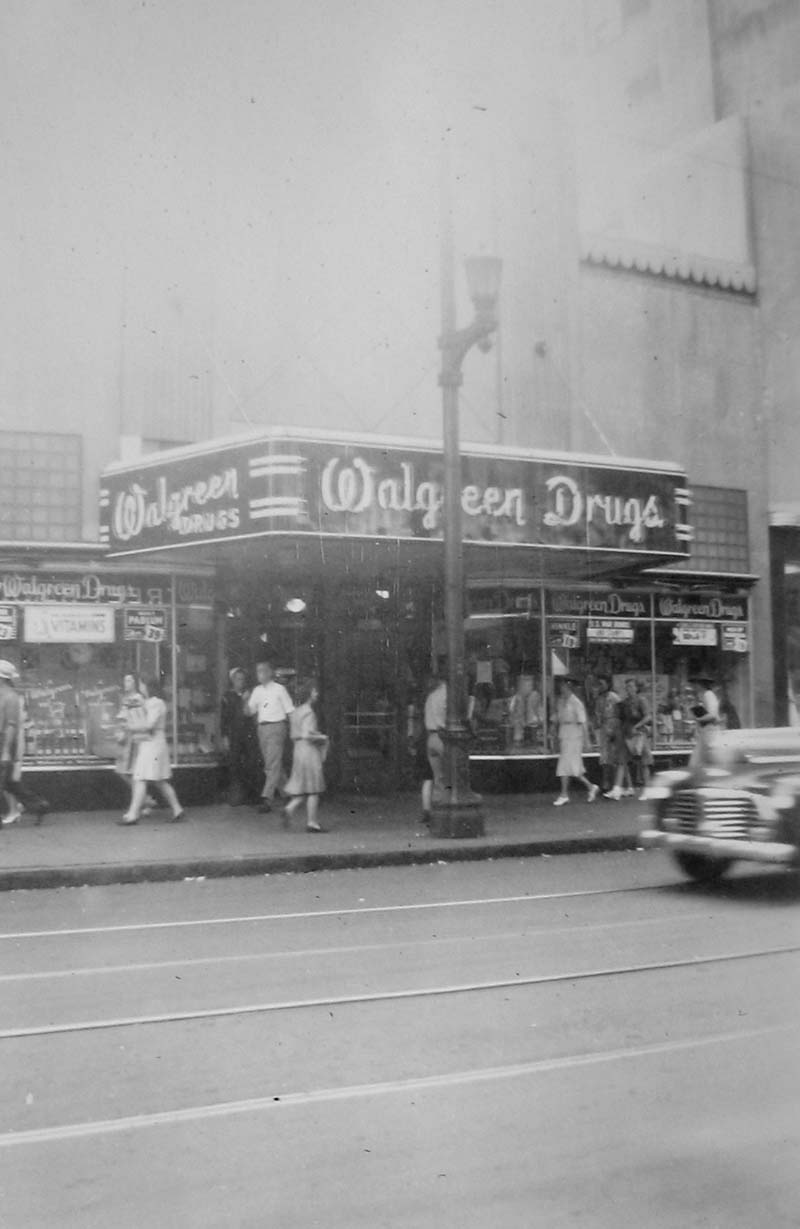
Job at Walgreens Drug Store, Louisville, Kentucky. (5 July 1944)
* * *
July 6, 1944
It was three o’clock the next afternoon. Up over the store, in a dingy restroom, we put the finishing touches on our new apparel. Only four more minutes and we would have to be pounding the floor below.
I talked with a mouthful of hairpins. "Here, will you do mine, too? I can’t seem to get the hair net fastened."
Doris tossed a small scalloped apron to the ironing board. I had just freshened up a bow on mine.
Heavy lagging steps pounded on the stairway. "Hello girls," said a woman in a low gruff voice. She fell into the battered green chair. Legs stretched out and head leaned back, she succumbed to the depth and relaxation that the chair provided. "Uh, Mouse, do you think they’ll give us tables right away?"
The woman raised her head and looked us over. A cigarette was thrust into the corner of her mouth and then, striking a match, she asked, "New girls?"
"Yes, we’re just starting in this afternoon," Doris said brightly.
"You’re in for some hard work," she said. She squinted as the first puff of smoke curled over her head. "My feet don’t feel like they belong to me. They just keep right on walkin’."
I smiled at her. "We’ve done this sort of work before. I think we realize what is ahead of us. Come on, Mouse. We’d better be on time for the first showing." I grabbed my apron and followed Doris down the steep stairs.
"Stop at the landing and I’ll tie your bow." Doris spun me around for inspection. The red-brown uniform hung in straight lines from my shoulders. The crisp white apron added something. The hair net, tightly holding my hair back, detracted. "I must say we both look a bit mousified," she commented, smoothing the Kleenex in my pocket. We were told to have a white handkerchief fanning from our pocket. "Can you tell I don’t have stockings on?" I asked, turning around. Maybe we would be reprimanded, but we certainly were not going to invest in a pair of stockings. "Come on, let’s go."
Three o’clock is a dead hour. It is an ideal time for waitresses to change shifts. When Doris and I entered the lunch room only a few people were sipping sodas at the fountain. Waitresses leaned against the sandwich grill with trays under their arms, ready for a customer, but snatching a brief conversation.
We did not know to whom we should report, but shortly a white-uniformed lady answered our puzzled expressions. She was thin and wiry. Her short black hair and snapping dark eyes accented the vivacity with which she conducted her orders. "I am the head waitress, girls. My name is Blackie. I’d like you to start off back here for the afternoon."
She led us to the rear of the store near some booths that were roped off. Each of us was given two booths to watch.
"Near the supper rush hour we’ll be using those tables, too." She motioned toward those that were confined to the ropes. "But now I would like you mostly to observe the other girls and catch on to the routine."
We were given trays and a towel, the dinner menu, instructions on putting in orders. Then we, too, leaned against the booths and watched. The doors swung in and out as customers came and departed. The heat of the afternoon swished in and out with them. Cracked ice tinkled in the glasses; cokes fizzed over the tops. I watched the level of an ice cold lemonade go down unaware of the figure passing me.
"Oh... Mouse." I looked up and saw Doris motioning to my booth. Gulping, I straightened up, put on my Sunday grin and proceeded with the encounter. "Tips," I kept thinking, "tips." The more tips, the less expense of room and board. "One grilled cheese on white toast, coffee and fresh strawberry sundae," I jotted down the order.
To the grill for the sandwich, pour my own coffee, order sundaes at the fountain. Now where do I get the sugar and cream? No sugar, pour your own cream from the pitcher.
Doris stood on the other foot. No one was at her table yet.
"One grilled cheese on nine!" a voice shouted from behind the counter.
I picked up the plate, established a pickle at the side and delivered the lunch. Soon the doors were in perpetual motion. Workers, late afternoon shoppers filed in. Now they were standing in line. Blackie was filling all the booths and ushering the people out as soon as they were finished.
Good service, more tips. It was an art, this waiting on tables. It was a game, too. I would try a different approach on each customer, scrap the unprofitable and try a new technique. Waiting on tables can be a sincere effort to deliver a meal in a gracious manner consuming the smallest amount of time.
I watched the faces of those who entered. Arms overladen with bundles, a woman dropped into the brown cushions in another booth. She rested a moment before ordering. Here was someone who needed an reassuring smile and a low, pleasant voice to aid her.
And then came the snappy business man in his pin-striped suit. He was always fun, giving you a friendly jibe when you forgot the biscuits, or delving into your personal history about the date last night that left you starry-eyed. They usually left a big tip under the cup if you knew the right answers.
But here came a boisterous group. The high school pals just out of the late afternoon movie. The girl with the ten silver bracelets and swinging the sun glasses must be the leader. She can’t decide whether they should sit on the stools at the fountain or next to the nickelodeon in the booth.
The booth won. A motley crew of colored skirts swung around the table. Toeless shoes tucked under the bench. Nickels jangled into the box and, as the music began, this mass of color and merriment swayed to the rhythm. This was always followed by ten minutes of deciding, coaxing, and changing of orders. My check book would finally read something like this: Cherry coke, lemon coke, plain coke small, limeade, plain coke large, and an ice cream cone. It is amazing the length of a conversation that can be held over these and the number of straws that can be chewed and cast aside. Now they are almost ready to leave. No, someone in another booth punched their favorite arrangement on the juke box. Oh well, another ten minutes and the supper rush....
Twelve thirty a.m. We polished the last row of glasses on the fountain. Blackie and two other girls were replenishing the sugar bowls and napkin holders.
"Wish those two fellows would hurry up and leave," I whispered. "Then I could finish cleaning off my tables."
The overhead lights blinked. The men, catching the signal, paid their checks and left. "Well, I guess I’m through," I said, dusting off the last crumb with my towel. "I’m not used to these odd working hours."
Once up in the dressing room again I freed my hair of the net and unzipped my uniform. An open window admitted a soft evening breeze. Although it was past midnight, the buses and automobiles hummed in their ceaseless line. Down below, a merry group was leaving a night club and stepping into an open taxi.
Doris had emptied her pocket on the table. Numerous coins rolled to the edge. "60, 85, $1.15. That’s not bad, considering this is only a soda fountain," said Mouse, gathering up the coins.
"And don’t forget, we only had two tables each," I added. We hung up the uniforms in our lockers, washed out the aprons and walked home, ready to fall into bed.
* * *
July 7, 1944
Two days of work passed. Although we could sleep as long as we wished, we had a definite routine to follow. After so many days on the road, with each day different and each day in a different place, we began to feel static in this new situation. The day began with breakfast at Walgreen’s Drug Store. The breakfast began with orange juice and ended with waffles and bacon and a side dish of eggs. Take it out of our pay check? Fine. It would last us until we came around again for lunch. In the two days we had been there, we had crowded almost every suggestion they offered on the menu into our few meals. A lunch was never complete without being topped off with a deluxe banana split, complete with three flavors of ice cream and nuts! Then down to the National Maritime Union we would go on our bicycles, to check on the boats. The screen door banged shut behind us. Martha was pounding on the typewriter again. The girl who watched Martha typewrite was sitting on the counter. Martha smiled as we came over.
"Sorry girls. There haven’t been any calls from the boats yet. It’s too bad. There are several on the waiting list before you, too!"
Leo had said that it might be two days or two weeks. We wondered what our luck would be.
The checker game was in full swing again. A young boy tilting his chair against the wall was reading a paper-covered novel. Above his head hung a huge map in a wood frame. I studied it a minute and then called Doris. "Look at this, Mouse. It’s the map of the Mississippi and all the bordering states. Just look at the territory it covers!"
She traced the Ohio River with her fingertip. "And here’s Cairo, Illinois, at the very place the Ohio flows into the Mississippi River."
"Yes, that’s the junction of the two rivers," said a voice behind us. It was Leo. "We have a big N.M.U. office there, too. At all these big cities along here, Memphis, Vicksburg, New Orleans," he located the cities on the winding river, "we have offices."
"Golly." Doris’s eyes lit up. "Just think. We’ll be seeing all those places!"
"Maybe," said Leo. "Not all boats go down the lower river. Some of them go north to St. Louis and other northern parts. You see, Cairo, Illinois, is the commercial dividing line of the Mississippi. All points south of it are said to be on the Lower River, and all points north of Cairo are on the Upper River. It’s just a matter of what boat you happen to be shipped on whether you go to the Upper or Lower River." I gazed at the southern states that we might pass through: Tennessee, Arkansas, Louisiana. Visions of cotton fields, plantations, fields of sugar cane, and live oaks bearded with moss. "I wish... I wish it would be the Lower River," I murmured. Doris examined the key to the map. The symbol for the location of a union office was found in many cities along the river. "You have quite a few union offices along the river," she conjectured. "Does everyone who works on the river belong to the union?" Now we had struck Leo’s greatest interest. And again, he had struck upon the most interested audience. He sat on the counter and proceeded to acquaint us with the functions of the union.
"No, they don’t," he said. "But, of course, it is the aim of the union to extend the membership to everyone. Some companies that run boats have closed shops, and that prevents the company from shipping anyone who doesn’t believe in unionism. Big things are in store for us on the river, though. We’re putting a million and a half dollars into the complete organization of the river. Now we have the full backing of the national office, which in itself is no small thing, for they speak for 90,000 members of the N.M.U."
"Do you think there will be a great need for shipping on the river after the war?" I asked. "I should think that the new oil pipe lines would remove the need for many of the oil barges. And when the railroads return to their prewar shipments and the companies produce those super airplanes they’ve been hinting about, won’t commodities be shipped on those speedier means of transportation?"
"Shipping bulk cargo on the river has always had a priority over shipment by rail, because of the quantity and weight that can be carried in a single shipment. Although the travel is slower, more can be shipped at one time. And you’ll find that most markets for domestic use or foreign exportation are in the city ports along the river. Our boats ran all through the last depression, and we have no doubt about them running after the war. We have contracts that are good for five years, to haul cargo. Some bulk cargo comes through in a steady flow every year and at different times during the year, such as grain, coal, steel, sulphur, whiskey, beer, and automobiles."
I had learned a lot about such things in an economic geography course, I reflected. Here was the practical application.
"How did you ever happen to get interested in working for the union anyway?" Doris asked.
"Oh, I’ve been working on the river ever since I’ve been a kid. In those days the working conditions were terrible. The boats were dirty, poorly managed, and just about the lowest paid job you could find, considering the hours you had to work. I’ve been fighting for the union ever since I saw the need for organization among the workers. You don’t know the half of the story. I’ve been put in jail, called a sea lawyer, a communist and everything you can think of, because I have always said a worker should get an honest day’s pay for an honest day’s work. I have no time for shirkers. Union men are expected to do a better job and faster than other people, for as a rule, they get more for it."
I thought about all I had read about the unions. My food and shelter never depended upon their activities and my interest in their negotiations was neutral. But now I was considering a man, among thousands, whose daily life depended upon it. Here again was reality.
"You must have been very energetic in your demands for the union to receive such a position as this."
"I have done a lot of trotting and worn out a lot of briefcases. I hope to wear out a few more before I leave this office. I guess you don’t know it, but we are elected to these offices by the people on the boats. I was elected to this port by a referendum vote of 8,851 for more than two years."
The ring of the telephone broke our conversation. "Leo, it’s for you," called Martha, extending the receiver to him.
Leo slid off the desk. "Stop around if you have any more questions. I’m getting paid for answering them, you know."
"Thanks Leo. The big question for tomorrow will be, ‘Have you a job for us?’ Hope you’ll find the answer by then. So long."
* * *
July 8, 1944
Just getting on our bicycles again gave us the feeling of wanderlust. The five days we had been in the city seemed more like weeks. During that time we had worked and made friends with the people of Louisville. The Lieutenant living with his wife next door had invited us for a jeep ride at Fort Knox; a Mrs. Columbus invited us over for a spaghetti dinner; Rickie, who lives below us, took us for a swim in the quarry; and Carl... well, Carl did give us a lot of information.
We were beginning to feel like old citizens. From the River Road to Market Street, from First to Fourth Streets and all the hotels and stores we had passed through while searching for a job, we knew them all well. But the river and the levee were our favorite haunts. Now it became a haven where we would puzzle and plan the future course of the summer.
"Come on over here and sit on the wharf," said Doris, dusting off some boards next to the capstan. "And bring the road map with you, too."
"Here’s the A.A.A. book, too," I said, digging into my saddle bag. I clambered over the cobblestone levee and sat down beside her.
"Mouse, we have a problem," she said simply.
"State the evidence."
"Well, we’ve been in Louisville five days. We’ve been working and we’re waiting for another job. Now the question is, ‘What if a boat doesn’t come in two weeks?’ Here we would be wasting our time in Louisville when we could probably have bicycled to Cairo in that time."
"Yes, and after waiting, we still may not get a boat headed for the lower river," I added. "Let’s look at the map." I unfolded it and laid it on the warm boards.
"Here’s Louisville," said Doris, pivoting her finger on the location. "If we went south on our bicycles on route #31W, we could go to Cave City."
"And see the Mammoth Caves!" I cried excitedly. "Golly, I always wanted to see those caves. They’re the largest in the world. I’ve seen pictures of the underground waterfalls and rivers."
"From there we could go straight across Kentucky on Route #68 to Paducah and then to Cairo. Let’s figure out how many miles that will be."
"32... 57... 79. I get about 300 miles," I finished counting.
"Those caves would be a high spot to see," Mouse agreed. She settled back on her heels and thought. "And if we still had enough time when we reached Cairo, maybe we could get a job on the boats there."
"But remember... Leo said they hire mostly negroes there. What should we do, Mouse?" The river flowed on beneath the wharf. The hoarse toot of a tug sounded across the water. The fascination for all that surrounded us would be difficult to relinquish. "Can’t we sort of meet both situations halfway?" I suggested. "We could work one more day at Walgreen’s, then take it easy on Sunday and visit a few more places in Louisville. If the union office doesn’t call by Monday, we can start for Cairo by bicycle."
"That isn’t giving the boats much of a chance, but we had better name a definite time limit." thought Mouse. "Let’s do it that way though: Monday on the boat or to Cairo by bicycle!"
Louisville on Saturday night was something we had heard about and did not want to miss. This was Saturday. It was Saturday afternoon in the Walgreen Drug Store. The excitement was not due until evening.
We ate an early supper before going on duty. This was the last supper, so we planned a magnificent meal. The waitress handed us a menu. We browsed through it. The same old things.
"Let’s have some variety in this meal," I said. "I think I’ll start out with pineapple juice. We surely won’t get that from here to Cairo. And that Tomato Delight salad, the pork chops and vegetables."
"But Mouse, the salad alone is a special for the luncheon!"
"I think I made it plain that this meal is going to have variety. A chocolate malted milk shake and... mmm. What shall I have for dessert? I guess a fresh strawberry sundae."
"It’s a good thing we got our pay this afternoon or you wouldn’t have anything left after charging all that," Doris said.
The pork chops were delivered and I dug hungrily into the mound of mashed potatoes. "By the way," I questioned, "if we quit work today, how will we ever get our pay for this day?"
"Oh, they’ll probably send it to us," said Doris, relishing a tomato cube.
"But we won’t need the money when we get home, we need it now." Draining the last drop of milk shake from the glass, I deliberated. I looked Doris squarely in the face. "Mouse, I do believe you need a darker shade of powder to match your suntan. And how about some stationary? You’d better get some before you use all mine up." She winked at me and said, "Now aren’t you cunning. We could buy a few things that would amount to our pay and charge it. Good idea."
After scraping the last strawberry from the tulip dish, we went to the other department of the store and started buying on our credit plan."
"Do you need anything for your poison ivy?" I asked, eyeing the lines of bottles on the pharmacist’s shelves.
"No, but I do need some toothpaste." We bought a large tube.
"Look what I found over here. Just the thing you need." Doris called me over to a table piled high with bedroom scuffs, bathing caps, and sun hats. "Try this on." She handed me a huge white hat with a visor inserted in the front. "Tilt it forward a little bit. See, it’ll be perfect to keep the sun off your nose. You won’t have any left if it keeps peeling."
"All right, I’ll take it."
Next to the candy counter was a book stand holding the small pocket size novels. "We need a change from those Damon Runyan stories," Doris said, thumbing through the volumes. "Here’s a good collection of Somerset Maugham’s work. What do you think about taking that and this collection of verse?"
She was talking to the atmosphere, for my eye was on the candy counter. Food again. "Look at this, Mouse. Just look at this!" I pointed excitedly at the boxes wrapped in cellophane and tied with pink ribbons. One of the boxes was different. It was shaped like a bale of cotton. Pictures of negroes picking cotton were printed on the paper wrapping. "See? They’re pralines made in New Orleans. A genuine southern candy! Let’s send a box to our parents."
These were purchased and mailed at the desk. Everything was added to the credit plan. Doris looked at the clock. "Uh-oh. It’s time to go on the floor. I think our packages just about equal our pay. Well, we’ll work extra hard for them today!"
Now Saturday evening approached. Our expectations were realized. This was an army town, and on Saturday nights, we were told, it over flowed with soldiers from Fort Knox and Bowman Field.
Each bus that stopped unloaded groups of laughing, joking men. The movement along the sidewalks turned to an olive drab. The gay colors of the civilians dissolved as the army took over.
The movies drew them, the bars drew them, Walgreen’s drew them. And then began the dizzy cycle from fountain to table, fountain to table, with a half dozen orders balanced on one tray. The number of tables allotted to us had risen from two to six. A mass of impatient humans poured into the booths, requesting their orders to be hurried, not waiting for tables to be cleared.
I took the order for three tables, cleared the next, refilled water glasses, more ice, another coke. The man at the fountain had a system, and he worked at top speed with not a second wasted. He lined up all the orders for plain cokes. Eight glasses, a shovel of ice in each, coke syrup, a short fizz under the faucet and all eight were slapped on the marble top. As each was snatched up, a soda or sundae took its place on the shelf.
My principles of good service were shattered. The main objective now was to fill the orders and deliver all the necessary parts. Occasionally, I gave out spoons with cokes and straws with sundaes. The wafers hardly ever went along with the milk shakes.
I ran the maze of people and tables until my feet ached and my arms ached, but soon the crowd grew thinner and I could see Doris and how she was managing.
"Say, what do you think you are doing? Where did you get that?" I inquired. There Doris stood at the fountain, gulping down a slightly melted hot fudge sundae.
"I’m waiting for an order," she said between mouthfuls. "Somebody forgot to take up his order and I’m not letting it go to waste."
"Hmmm." I gazed over the edge of the fountain. "Got any extra sodas lying around?" "No, but there’s a punch drink there."
I grabbed up a straw and started drinking. A nice refresher, but not for long. "Say, girls, get back to your booths. This is no relief period," called Blackie. Guiltily we put down the dishes and sped back to our booths.
"How about laying away something to take home with us tonight," Doris whispered to me. "O.K., what would you like?" I asked.
"Make mine a chicken salad sandwich on toast."
"I’ll put in an order for two chicken sandwiches wrapped. And a couple of bottles of milk, too."
It was almost twelve thirty and the lights blinked again. People started leaving. "You over there," Blackie motioned to me. "Fill this bucket and start washing these tables."
I went at it with the little remaining energy I had. Doris was pulled behind the counter and made to stock the black underliners of the paper ice cream dishes.
"There, I guess I’m through," I sighed, shining the last black top with finality.
"If you’re all done over there, come over here and help this girl," said Blackie from behind the counter. "Take this can and go around filling all the empty salt shakers."
The clock wound around to 1:00 a.m. I looked longingly at the two neatly wrapped sandwiches lying on the salad shelf.
"When I’m all done, let’s go," Doris half whispered to me.
Blackie was busily giving orders when I put the salt can away and Mouse finished up. I took two bottles of milk from the cooler, grabbed up a handful of wafers and hurried through the kitchen before we could get any more orders.
Once up in the dressing room I asked, "Got the sandwiches, Mouse?"
"Yes, and look what else I got on the way out." She emptied her pockets on the table. "More wafers!" I exclaimed. "I’ve got some, too, but I guess we deserve them. We certainly did work overtime tonight."
We laid aside the ugly uniforms for good, contributed the aprons to the pile in the laundry basket and started out of the side exit for home.
"And we’re giving you such good pay here - $20 a week - and you’re leaving already," laughed Doris imitating the manager.
"Such good pay," I sniffed. "On the boat we could get our room and board besides $25 a week."
"And nine days vacation for every month of work."
The sidewalks were jammed. A group of soldiers marched by in twos. "Hup. Hup. Hup. Hup, Two, Three, Four." The leader shouted, "Eyes... right!" We were being given the once over as they marched by.
Visored caps tilted in the direction of short skirts, curly hair, modest smiles. A few low whistles. Another group marched along singing.
Oh, the biscuits that they give us
They say are mighty fine
One rolled off the table
And killed a pal of mine.
"Mouse, are we being followed?"
"Oh, are we?" Doris answered hopefully.
"Left, right, left, right...." Some deep voices behind us marked the time of our steps. Then we were surrounded.
"Going some place girls?"
"How about a coke?"
"Hello, haven’t I seen you before?"
"Hmm, brown hair and eyes!"
"Just my style."
I looked over at Doris. "A mass attack."
She answered, "No date since Buffalo, you know."
"Sort of late," I added.
"And," she reminded me, "what about Bill and Gordie and Art and Tommy and Mike?"
That was the decisive moment. We continued with eyes straight forward, silent. The would-be Romeos filtered away.
Now we were going up Second Street. The suntan uniforms still filled all space. It was too good to miss.
"Mouse, do we have to go in?" We paused on the step leading to the porch. "How about sitting down here and eating our loot?"
"Right!"
We began unwrapping our sandwiches and uncapping the milk bottles.
"Hi goils! Gettin’ our dinner ready?" Two curly-headed sergeants halted before us. What was this, a Brooklyn accent? We weakened.
"All ready and waiting, Flatbush," I answered.
"Yip! A Yankee!" They took off their caps and bowed. "Two real Yankee goils! You from Flatbush, too?"
"No, Buffalo, but we’ve been there. Where do you live?"
"On Ten Eyke. ‘Dis here’s my buddy, Joe. My name’s Dick."
"Mine’s Doris."
"I’m Poppy."
"Woikin down here?"
"We just left our drug store jobs tonight."
"What d’ya think of dis place?"
"Well, Dick, we like it."
"Yeah, but don’t you t’ink it’s kinda slow? Jist mousin’ along, dose people. I’d give a hunnert bucks to be back on my subway job."
"Wasn’t that hard work?"
"Well, someone’s gotta do duh doity woik. It was darn good pay."
"And boy what I’d give for some of my mudder’s apple pie!"
"And a walk around Times Square."
"Central Park again. Hot dog!"
Fifth Avenue buses... double deck."
"A beer down at Joe’s Place, and a game of pool wit’ duh fellas."
"Hey! How about that. Speaking of beer...."
"What do you say, Poppy?" Joe turned on a charming smile.
"O.K., Doris?" Dick put out a gallant arm to be taken, and got across a wink.
"We’re hitting our bunks, fellows. Sorry, but we have a big day tomorrow."
"No kiddin’?"
"Honest?"
"That’s right," Doris agreed, "but we sure are glad to have met you. Lots of luck!" "Same to you goils." They began departing. "Say hello to Brooklyn when you get there again. So long!"
"They were cute, Mouse."
"Yes, but it’s getting awfully late." Doris began munching a wafer. "Just think. Brooklyn boys and we just happened to meet them. Good old New York State. You know, Mouse, I...."
"Pardon me ma’m, but we jest happened to notice you-all sittin’ here." He had a ruddy face and blue eyes. "My friend heah thought y’all might be waitin’ on company."
The good looking boy with him said, "I hope you don’t mind our stopping. Quincy here and I were just takin’ a walk."
"Of course not," I answered. "Won’t you sit down here?"
The soldier named Quincy spoke up. "We were jest lookin’ this town ovah. We only got here jest this week. Pretty far north for me."
"Where do you live, Quincy?" we asked.
"I’m from Florida, best state in the Union. Best quail huntin’, too."
"Just a minute bud!" the other interrupted. "You’ve forgotten that Michigan is the best state and we’ve got deer hunting!"
"Where ‘bouts in Michigan are you from?"
"Oh, I’m from a farm up in the thumb. That’s a peninsula that extends into Lake Huron. Gosh, I miss that farm. Miss my dog most of all."
"Miss mine, too," said Quincy. "That pup is the best huntin’ dawg! But what I want to get back to is the boat and the swamp in back of my house. Best quail around there."
"By the way, ma’m," Quincy asked, "do you-all know where we can get a night’s lodging ‘round heah?"
"Did you try the Y.M.C.A.?"
"Gosh, we didn’t think of that," the Michigan boy said. "Better try that right away." "Thanks a lot, ma’m."
"Not at all. Goodbye and lots of luck."
They waved goodbye and wandered up the street.
"Michigan and Florida. We’re really getting around the U.S. Wonder where it will be next."
"Here come two more. Wonder if they’ll stop."
We were now in view. The heels clicked the sidewalk more slowly. Smiles appeared. They were privates. One was a dark-complexioned boy with black hair and eyes. His white teeth flashed. His companion followed him, smiling shyly. This one had brown hair and a ruddy complexion. They both stood before us, shifting their feet, digging their hands into their pockets, trying to make easy conversation.
They were from Texas. The dark-haired one, we discovered, was Hispanic, and his name was Rafael. The other was Dick. Dick was an easy going bashful type. He leaned his lanky six feet against the fence.
"Doris and Poppy," he said. "Those are purty names."
Rafael sat down on the step and accepted a wafer. "Ever been to Texas? No? Well, when you get there sometime, go to San Antone. That’s where I live."
"But don’t miss the hills ‘n prairies," said Dick.
"What do you do back home, Dick?" I asked.
"Me? I’m a cow hand."
"A cowboy? A real cowboy? Do you ride horses?"
"Wal, I ride horses, but it’s not like it used to be. We use trucks now from my father’s ranch. It’s a lot more modern."
"Ever been down in Mexico, Poppy?" Rafael began munching half of my sandwich. Dick sat down on the step, too. "Well, Doris, up in the north of Texas...." For half an hour we compared notes on our home states and learned about a soldier’s life. The street became more deserted. I looked at my watch.
"Man! It’s really late! We’d better go in."
We all stood up. The boys put on their garrison caps. "Couldn’t we see you again?" they asked. "How about breakfast tomorrow morning?"
We agreed. "Tomorrow at nine o’clock then. Just ring the bell and ask for us. Goodnight."
"Night now."
We left our sidewalk step, which had suddenly become the crossroads of the United States.
* * *
July 9, 1944
Sunday morning in our stuffy little garret room the air was stagnant. The sheet was too hot. Trolleys rumbled by and a new throng passed through the streets. "Come here, Mouse, quickly! Look what’s out here!"
I threw back the sheet and jumped over to the window. Stretched on the lawn, our lawn, deep in slumber, lay six soldiers. "Charming landscape," I observed. "Any of them look like Rafael or Dick?" I asked, peeking over Doris’s shoulder.
"No, but here they come up the walk. Poppy, jump into something quickly!"
I did not have much choice as to what I wanted to jump into. It was either my white dress with green stripes or my green dress with white stripes.
Soon we made our entry onto the porch. The soldiers snapped to attention as we stepped into the light.
"Grab an arm, Poppy, and let’s make for some chow." Rafael whisked us into the street. Sunday morning in Louisville presented still another sight. On all the lawns bordering Broad Street lay sleeping soldiers, curled under the trees, stretched out on the porches.
Rafael, seeing us eyeing them so uncertainly, explained. "They put up cots at 30 cents apiece in the "Y" on Saturday nights, but there are never enough to go around."
"You mean they were just too tight to go another step," said Dick truthfully. We passed a restaurant with a green marble front. "Gosh, it looks like our favorite mess is filled up."
We settled for the hamburger joint across the street. It was painted white, looked clean, and besides, the picture of two eggs sunny side up was invitation enough. The place was jammed with soldiers. Doris and I established ourselves on the stools that were just vacated. We were starved, and we agreed on the same menu. "Make ours four eggs with pork sausage and toast," boomed Dick as the waitress rushed by. Rafael was putting nickels in the juke box. The Texas Playboys sounded forth. "Now that’s real music," said Dick tapping his foot in rhythm. We had our own opinion.
"Eggs right here." The waitress slapped down the plates before us.
No more sound from Doris and me as we dug into the free meal. The boys balanced their plates on the window sill. It must have been the Texas style to use the bread as a mop. It looked good that way, but we stuck to the forks.
We abdicated our seats to the next in line and swung out the door. Rafael and Dick turned to us. "Well, kids, breakfast is a funny time to end a leave, but I guess that’s it. The bus terminal is right across the street. Let’s make sure of the time."
Sweethearts, wives and children shoved through the aisle.
"Shelbyville, Frankfurt, Georgetown, Lexington... leaving Lane 7." "Hi-ya, Joe, have to leave now, too?"
"Leaving for Bowman Field Lane 3. Fort Knox Lane 5 in five minutes."
"Guess that’s us," said Rafael.
"Sure was mighty nice meeting you girls," drawled Dick. "Sorry it wasn’t earlier in the even’in."
"Say, how about giving us your addresses?" Rafael said suddenly, digging into his pocket for paper.
"Leaving for... last call...."
We scribbled our addresses hurriedly. "Bye Dick. G’bye Rafael. Thanks a lot and good luck to you," we called after them.
We left the bus station waving goodbye to the bus load of soldiers.
"Nice fellows," murmured Doris.
"Yep, swell kids," I agreed.
Corregidor
Jobs on the Steamboat
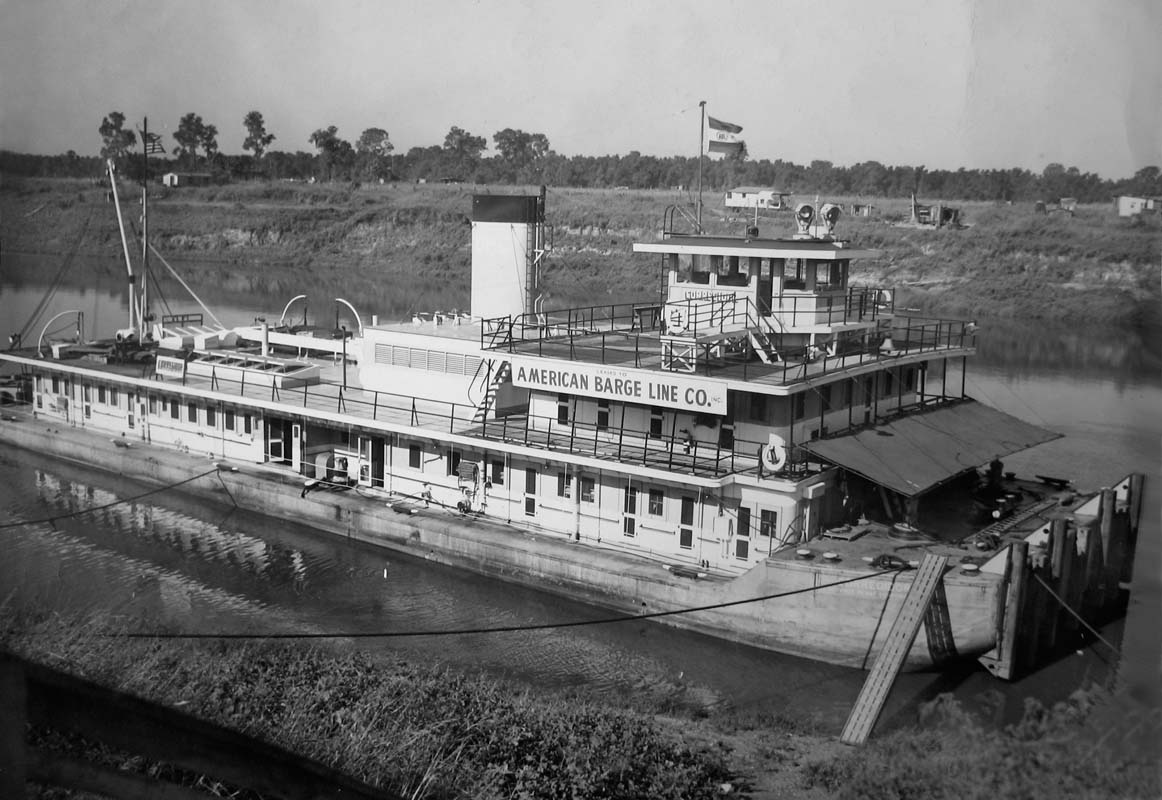
The Corregidor on the Ohio River. (10 July 1944)
July 10, 1944
"Our last night in Louisville and no boat... our last night and no boat." It went through my head as I tossed, seeking sleep. "Louisville last... last night... no boat." I did so want a boat... and then sleep.
Maybe Doris had been awake before, but it took several shrieks of the shrill voice of the landlady up the back stairway to arouse me to consciousness.
"Girls. Girls! There’s a telephone call for you."
Doris had the wonderful ability of being able to jump out of bed, run down the stairs, and carry on a lengthy conversation before being fully awakened. By the time I opened one eye, felt around for my glasses and managed to emit a sound, she was ready to hang up. "Probably for her anyway," I mumbled to myself, but no. I listened at the stairway. She talked excitedly. Now I lit down the stairway two at a time! "Mouse, Mouse, it’s wonderful news! We’ve a boat, a beautiful new boat. Oh yes, Leo. I know you’re still on the wire. Yes, we’ll be down right away, right away, Leo!"
"Oh, that’s just super!" I hugged Doris and exclaimed for joy. "Where’s the boat? When did it come in? When do we go?"
"Right now! We have to pack." She grabbed my hand and we flew up the stairs together. "When did he say it came?" I puffed, still firing questions as we threw everything together.
"He’ll tell us all about it when we get there. Come on. Grab your stationary kit and come!"
Our bicycles were finally loaded for their last trip out of Louisville. We went through the routine of checking our equipment.
"Do you have your rubbers, Mouse, and the sunglasses?"
"Yes, but darn it, I haven’t any room for this bath powder. Can’t I throw away the Mother Weed’s Noodle Soup now, please?"
Doris turned on me indignantly. "You don’t think we’ve carried it all this way just to throw it out when we get on a boat! That boat is not going to carry us all the way back to Buffalo, you know. Put it in!"
I peered into the bottom of the basket. The box of Mother Weed’s Soup lay painfully squashed under the hatchet. About a third of the noodles had leaked out.
We bade goodbye to our landlady and rolled down Second Street. Our bicycle tires, already soft from disuse, were squashed down further with the added weight. We did not notice them, nor did we feel the pull of our muscles as we pedaled. Oblivious to everything but our supreme happiness, we flew to the Union Office.
We burst into the office all grins and ready to pull up anchor.
"You got your wish sooner than I expected," said Leo. "You are now working for the American Barge Line Company."
"Where’s it going?" I asked breathlessly. We cheered in delight at his answer.
"Down to New Orleans! Down to New Orleans. I’m making out your shipping cards." Leo said. "Sign your name here."
I was always told to read over everything before I signed, so I laboriously went over the whole document to the most important part at the bottom. It read:
Port of Louisville
Steward Division
Rating - shipping as maid!
It was wonderful, especially the "maid" part. It sounded like just so many wash buckets, mops, and charwomen thrown together. I folded the paper carefully for future preservation as evidence of my hard labor. And to think that we’ll get paid $102.50 a month with 150 days off a year, plus room and board!
Leo smiled at us. "Doris and Poppy," he began, "you’re really going to get a taste of that old Mississippi. It’s a great river, and being on those boats and working on the river is a great life. But just you two wait. Once you’re on that old Mississippi, you’ll never be satisfied if you go away from it. It gets into your blood, kids, so watch out!"
Now we considered what we should wear for our new position. What would be an appropriate dress for waiting on tables on a river boat?
Leaving our bikes at the office, we headed for the shops on Market Street. The racks in the dress shop were filled with bare back sport dresses, frilly organdies or clinging silk jerseys.
"Here’s the one I like," Doris picked out a two-piece blue dress. "Oh, oh, bare midriff. That’s out."
"Something nice though," I said. "Give the crew a treat."
I took several dresses and proceeded into the fitting room to try them on. Among them was a white piqué with a pretty red frill on the front to give it an apron effect. That was it. Not dressy, but just right.
Doris dashed in, exclaiming, "I found just the right thing. And it is cute!" She held it up. It was exactly like the one I had chosen. They were identical copies. "Let’s get them. We’ll be dressed the same."
"O.K. Give the crew a shock when they come in from a big night and think they’re seeing double. They are heavy enough, too, so we don’t have to wear slips." That settled it.
Market Street was like home to us now. The men calling off their wares in the sidewalk markets knew us by sight and greeted us, but we were in a hurry and headed back to the Union Office.
"Mouse, is that our office? Who are all those men in front?" About ten men, both young and old, were gathered in a circle talking excitedly. The shorter men stood on tiptoe to peer over shoulders at something in the center of the group. We hurried to get a look at it, too.
"What is it? What’s the matter?" we asked. Then we saw the objects of curiosity - our bicycles!
"Here they are fellows!" someone shouted.
"Hello girls."
"Hi-ya. You the new maids?"
"We’re the boys on the Corregidor."
"Glad to meet you." A good looking fellow with curly blond hair and a devil-may-care smile put out his hand. We were now in the middle of the circle with our bikes. All around us were outstretched hands and big friendly smiles.
"Hello Buffalo!" another greeted. They had found out about us.
"How much for a ride on your bike?"
"A nickel," Doris laid down the price.
"Yeah, it is?" A man stepped forward. He was tall and well built. He had impish brown eyes and curly brown hair. He put an imaginary nickel into an imaginary slot. "Out of my way!"
"Look out Earl! That bike can’t take your two tons."
But Earl was already half way down the street. "Wow, Yipe!" he cried. After a shaky turn he pumped back.
"Next up!" The blond put his imaginary nickel in.
"Hey, Buster, that was a slug!"
"Sho-nuff?" He winked at us before leaving.
"Now girls, don’t worry about your bikes. I’m Dad and I’ll take care of you."
"Thank you," we said. Dad looked the type. He was an elderly man with gray hair and a kindly face.
The rest of the crew started to introduce themselves when Leo, Martha, and the girl who watched Martha typewrite came out of the office.
"Let’s go everybody," Leo said. "Buster, who said you could ride a bike?"
"Well now, I think I did pretty good!" Buster leaned the bike back against the window of the office. Buster, we decided, was a wolf, but he sure was a lot of fun. Somebody grabbed my arm and we were all crossing the street. Now we were members of the crew. With less than a sentence spoken, we had been automatically accepted and now were being towed off to their favorite beer joint on the waterfront. I took a hasty look at the signs along the way. Every other one was a tavern.
"Here we are." My escort held the door open and we all stepped inside. The name of the place was "Tip Toe Inn." Where they ever dreamed up such a name is a mystery to me. As far as I could see, the people that tiptoed into that place must have been wearing hiking shoes soled with hobnails. It was a fertile breeding ground for a variety of the six-legged specimens. The only thing that was shined was the mirror behind the bar.
"Come on, let’s go to the back room!" somebody shouted. So we all proceeded into the back room. In the center was a large round table. An old upright piano stood nearby and immediately a crew member started beating out some boogie-woogie.
"Right here girls." Buster motioned us to two chairs on either side of him. "Just a minute!" Earl said.
"Come on over here, girls!" came from across the table.
"Wait a minute," Dad interrupted. "I’m taking care of these two."
Then there was confusion with a scrambling of chairs and everyone mixing around. At last we were all settled. Conversation started up on union matters, pay checks, the length of stay in Louisville.
"Say girls," Leo called across the table to us, "why don’t you write home for your birth certificates so you can have a permanent pass made out? Then you’ll have it whenever you want to go fishing."
"I’d probably only lose it," Doris said.
"No, they’d always be returned to you, because it has your picture on it."
Someone tossed his pass to me. It was sealed between cellophane; thumb print and picture were on it. I turned it over and the face of the handsome looking fellow called Earl smiled at me. The card read:
"Earl Johnson (Only)
Age: 25"
"Hmmm," I unconsciously thought out loud. I looked around the table. He sat opposite me. I aimed the little card toward him. He caught it and laughed heartily. His eyes brightened like those in the picture.
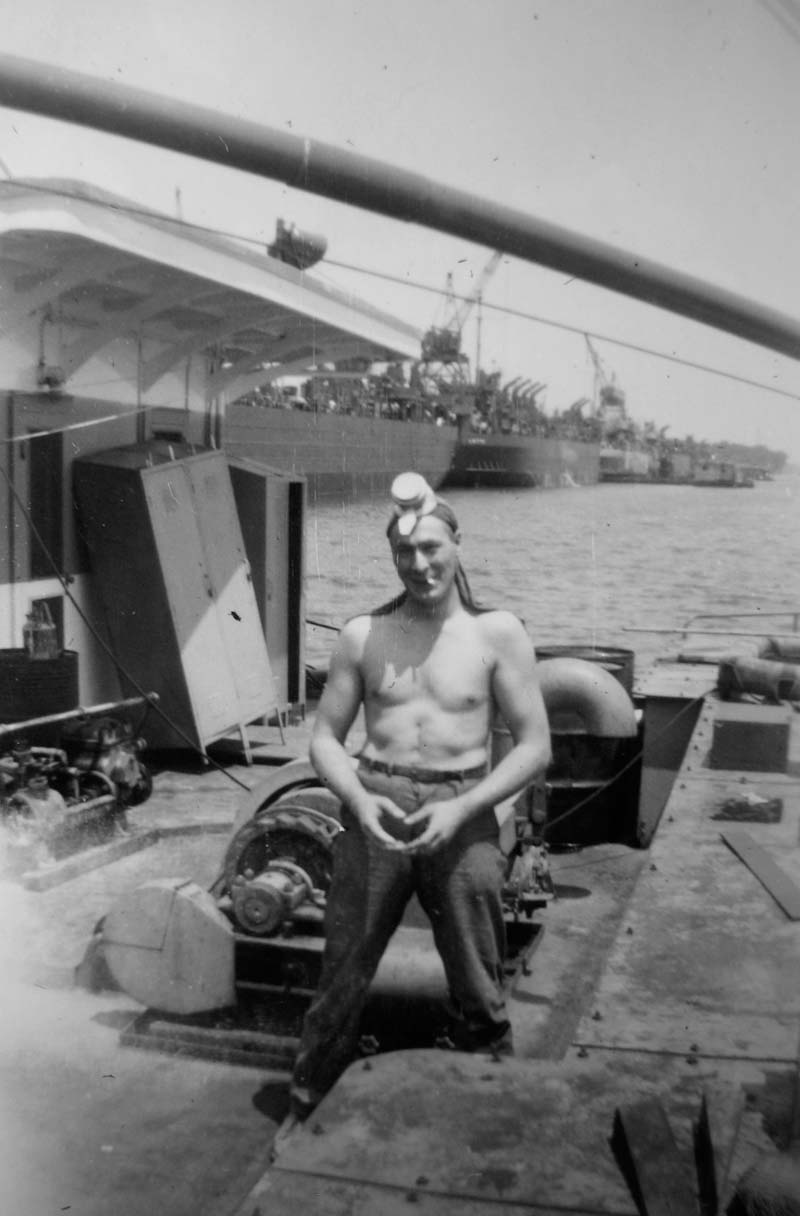
Earl.
"I suppose I should... I mean I think we should get a permanent pass," I stammered. "Yes," said Leo. "Earl is the ship’s union representative. He can tell you how to get it."
A waiter appeared.
"One beer all around."
"Two beers all around," said another voice.
Sitting between Martha and the girl who watches Martha typewrite was a good-looking young man with a brush cut, pleasant face and a happy smile.
"Come here a minute Shorty!" The young man stood up and came over to us. We saw that he was very short, just about coming up to our shoulders, despite his twenty-three years.
"Girls," someone drawled, "I want you to meet Mistah Shorty."
"Doris and Poppy." Buster stood up. "I hereby make a toast to our two new members." All glasses were raised. "Welcome to the Corregidor!"
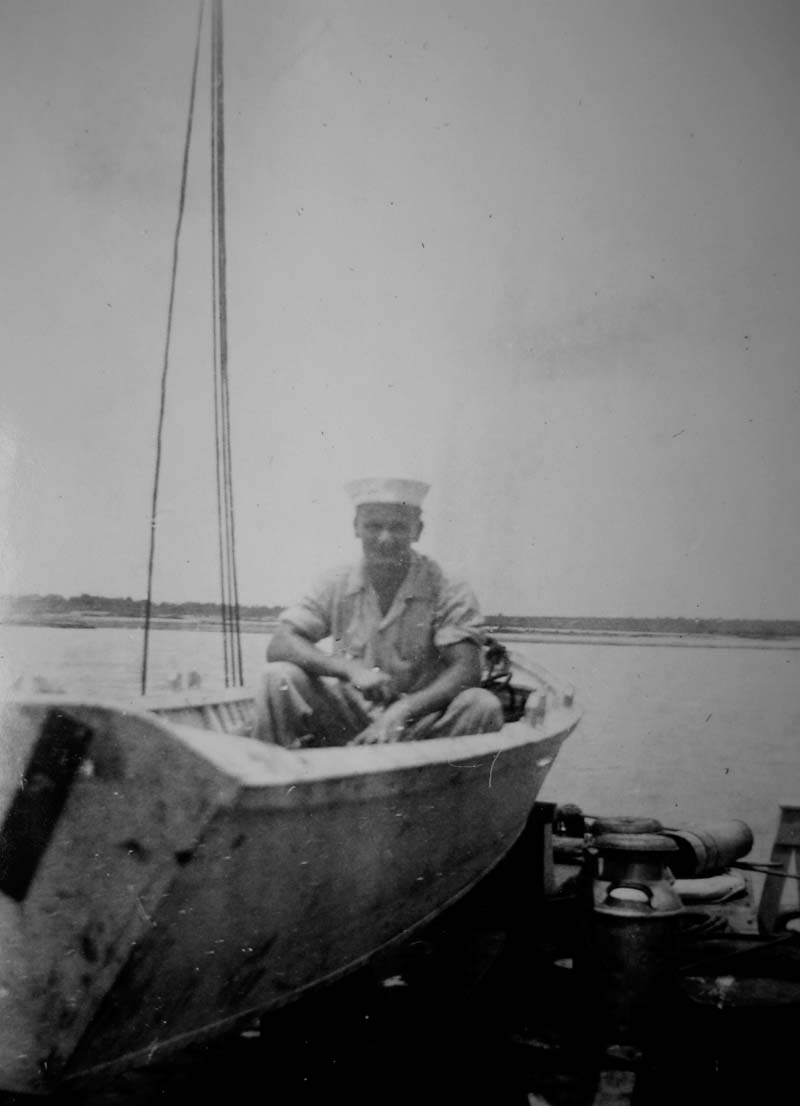
Buster.
The beer was drained to the last drop. The glasses clinked back on the glass table top. Now we were officially in!
Officially in, but we had not seen our boat yet. We left our bikes at the Union Office, and Leo took us across the Ohio River to Indiana, where the boat was docked - the Corregidor! The Coast Guard passes permitted us to enter Jeffersonville ship-building yards that lined the river.
Numerous shops of different sizes leaned on their scant foundations. We went through one of them on a direct route to the boat. The noise was deafening. Electric cranes ran overhead, and we ducked as a steel beam swung above. Yellow lines chalked off patterns on the great sheets of metal.
"Come on, Poppy," Doris tugged on my arm as I gaped at a man cutting along the yellow lines as though it was a simple dress pattern.
Around the office buildings, down some wooden stairs, and there we stood on the wharf. I gazed up and down for a little green-bottomed boat tugging at a rope, with a name splashed in white along its bow and a dirty little smoke stack puffing away, all ready to go. But nothing compared to my assumption.
"That’s it over there... the Corregidor." Leo pointed out. He was pointing at a big flat boat painted white with a shiny black stack. The boat had two decks topped by a pilot house. Wide doors opened into the engine in the center of the boat, and an awning covered the coils of rope and ratchets piled on the bow. Lifeboats, beams, first deck just a couple of feet above the water level, suspended rope railings, and cabins.
Leo announced, "She’s a brand new boat, just out a little while. Everything is spic and span on her. She’s got a good fair captain, and her cook is an old lady who really knows her business. Good food on that boat and plenty of it. She’ll see that you get fattened up all right. Well kids, come on and look her over." Stepping gingerly up the gangplank and over the coils of rope, we followed Leo onto the Corregidor.
"This is the bow up here. Come along this way to the middle. Here’s the engine room, go this way to the galley," Leo directed.
A young woman appeared, "Hello Leo."
"Hello Lucille. Here are the two new maids. Mrs. Lynch around?"
"Come on in, Leo. I’m in here. Have a cup of coffee."
We passed through the officer’s dining room with its tables and chairs, attractive curtains and pictured walls. We entered the galley. This was a unique boat. Everything shone with cleanliness! Painted flower pots lined the shelf above the sink. The cupboards displayed colorful china. Our conception of rough and tough river life changed instantly. The galley was large and rectangular. In the center ran a long table overhung with pots and pans. Several women were sitting at this table, but one had risen and came toward us.
"Mrs. Lynch," Leo said. "This is Poppy and Doris. They’re your new girls."
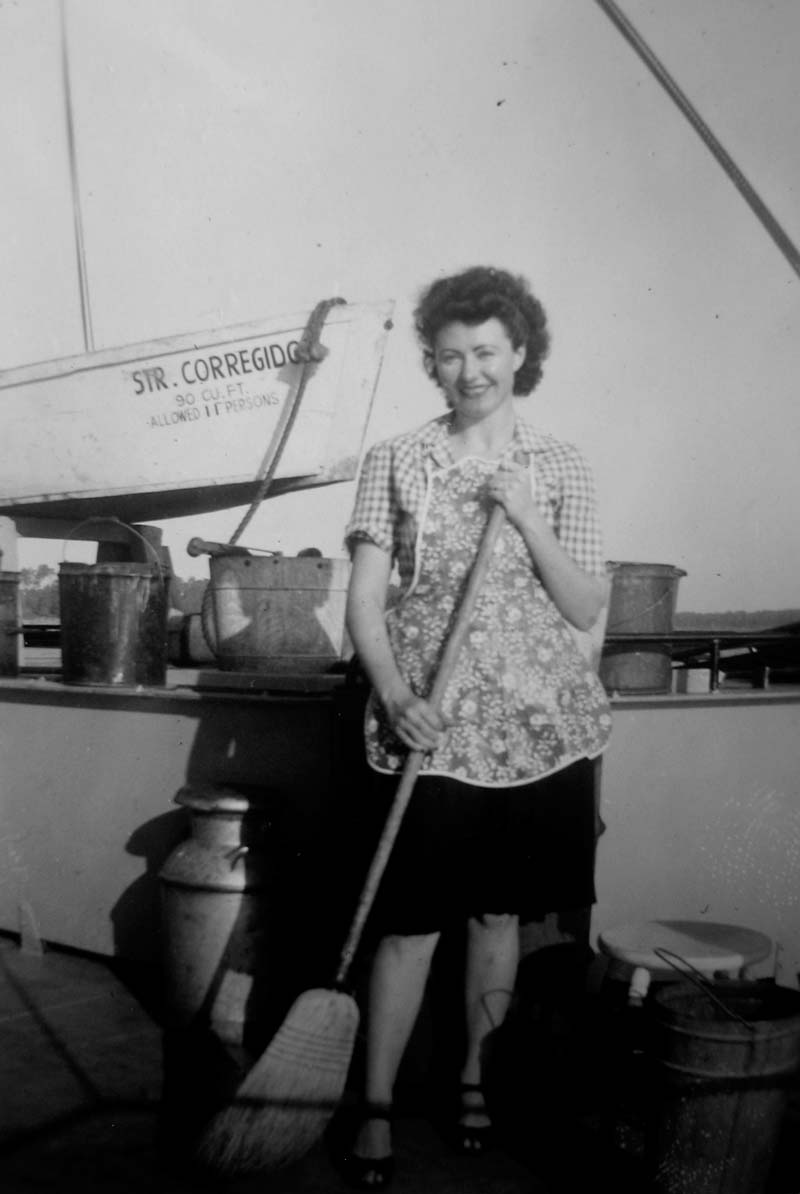
Lucille, Assistant Cook.
Mrs. Lynch, short, plump and gray-haired, had a slow drawl. "I’m glad to meet you girls. Just sit down here and I’ll tell you-all about your work later on. Have you had lunch yet? Here are two plates. Just help yourselves to what’s on the stove." We filled our plates and sat down at the table. Someone brought us tall glasses of milk and a plate of corn bread.
"Your first time on a boat, girls?"
"They’re all the way from Buffalo, New York," Leo informed them.
Mrs. Lynch settled on a stool next to us. "Never been on a boat before. Well, y’all just do your work right, and there will always be enough to eat and you’ll make out all right." She had a bowl of milk before her and she began breaking corn bread into it. Her uniform was a well filled large size. Gray hair was drawn beneath a hair net. "How are you making it, Leo?" she asked.
"Everything is just fine. By the way, these girls are all moved out. Is there a place for them to stay tonight?"
"I’ve got an empty room upstairs. It’s the second engineer’s room. We can fix them up there tonight. Anything else you want to eat girls? Here are their dishes, Lucille."
Lucille came forward. She was an especially attractive slender girl with long black hair, black eyes and a deep southern drawl. Obediently she took the dishes to the sink and began washing them.
Leo stood up. "Better take these girls up on the deck and get them signed up. I’ll be around later on. Thanks for the coffee."
We also thanked her for our lunch and followed Leo out on deck. "Leo, it’s so clean. This boat is more like a real home!"
"That’s the way it should be. These men work hard and deserve the best. Up to the second deck girls. We’ll see if the Captain’s in."
We stepped through a door with a foot-high threshold and climbed some steep steps to the Captain’s office. A man got up from the desk. He was rather short and rotund. There were no gold buttons or braid, just a white tee shirt covering an overwhelming stomach that shook when he laughed. A yellow straw hat slouched down over blue eyes and a ruddy face. One eye was crossed, and his eyebrow cocked down over it. There was a snub nose there, but most of all you noticed that expression. "Here was a tough man," you decided. "No one could get the better of him. You will stand in awe and let his will be right." But then you saw, under the rugged features, the twinkle of his eyes, the wrinkles of his smile. When he spoke, you felt the deep sincerity of his words and the spark of his humor.
This was Captain Stroube! We were to find that no better a Captain was ever on the river, no better a man walked on land.
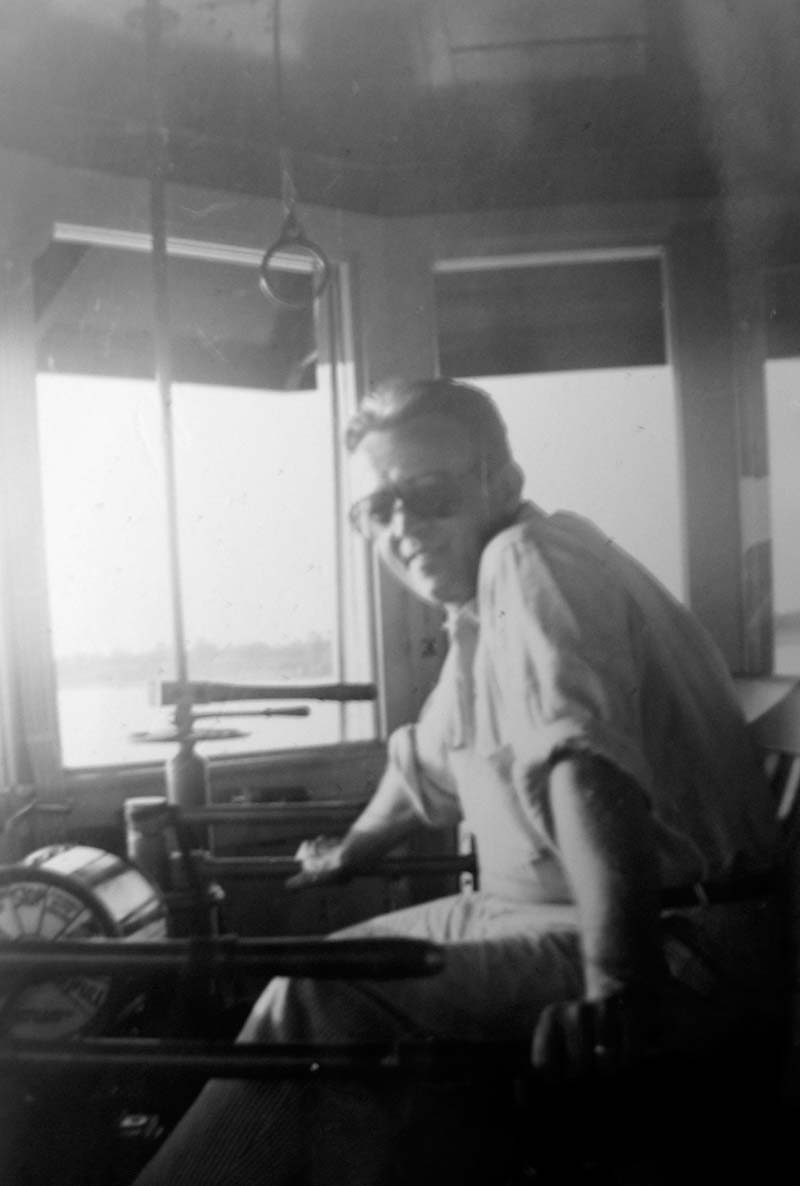
Captain Stroube of the Corregidor.
We filled out some papers for him and then... Doris approached him on a grave question. "Uh, Captain Stroube," she said. "We have something to bring with us if we may."
He looked up from the pile of papers, "What’s that?"
"Well, we came here on our bicycles and we can’t part with them."
The bulge around the belt shook and he chuckled. "We’ve had everything on this boat but bicycles, so might as well put them on, too."
We gratefully bowed our way out and followed Leo back down the stairs. Captain Stroube was all right, we agreed.
We went back to the Union Office with Leo to get our bikes. Since the beginning of our trip our bicycles had gone unnamed. We wanted them to weather their responsibilities and then dub them with some title that befit them. On the way back to the shipyards we rode silently, earnestly thinking. The river was uppermost in our minds. Although the bicycles had strained up more hills and had rolled along under outrageous trappings, still... the river won out. With all unfairness to the bicycles, we named them "The Corregidor" and "The Mark Twain." The Corregidor was still a strange beautiful boat to us, and Mark Twain seemed fitting because we were following the path he had piloted down the Mississippi River.
Now we approached the shipyard, pedaled past the guard and down to the water’s edge, where their carefree life was to be terminated for a long rest on the boat. The two newly named bikes were guided along the gangplank and onto the bow of the boat. "Hello. I’ll help you get your bikes up onto the second deck." A boy came forward. He was about 17. He had a beautiful deep tan, a brush cut, handsome features and white even teeth. He seemed rather shy and kept his blue eyes always on the bicycles.
Someone else also appeared. This new person was tall and thin. He didn’t walk; he jitterbugged. A pointed finger above his head shook out the time to his steps. "Hi ya there. Want some help? You the new girls?"
We introduced ourselves.
"I’m Jack. Just call me Hepcat. This is Leon." The good-looking boy nodded his head and smiled. "Here we go." said Hepcat, as he and Leon hoisted the Mark Twain up the stairs to the second deck. Then up went the Corregidor. They were leaned against the wall.
In the afternoon the former maid’s cabins were vacated. We gathered together the contents of our saddle bags and went down to the galley. Doors of the two cooks’ cabins and the maids’ cabin opened onto it. A black metal plate with the words "Maids Cabin" printed in white, was nailed over the center of the door. I turned the knob and stepped inside.
This was more than we had anticipated! We immediately popped open the cupboards and doors to investigate the expanse of our quarters. A wardrobe closet filled one corner and next to it was a cupboard with six deep shelves. Doris looked at it, then glanced at our small bundle of worldly goods and laughed. "For the first time we have more storage space than we need."
We stuffed our sleeping bags upright in the wardrobe closet and hung up two dresses. The hatchet, the mess kits and Mother Weed’s Noodle Soup were stored out of reach on the highest shelf. And on the very bottom shelf sat... the rubbers!
We divided the shelf in between and carefully laid out our underwear, socks, dusting powder and stationary. In the next corner was a white sink and shining mirror surrounded by more shelves. And between these two corners was a door leading to a red tile shower. Hot and cold water at all times on a Mississippi steamboat! Double decker bunks lined the third wall, and a screen door opening to the guard rail was in the fourth wall. I flipped off my sandals and dug my toes into the soft rug in front of the bed. The cool red linoleum felt good on my feet, too.
"Let’s get these beds made up so we can really relax," I suggested. We remembered where Mrs. Lynch had pointed out the linen closet off of the lounge. We walked around the guard to the lounge where we found four white paneled doors concealing the shelves of linen. Doris unlocked the doors, and I held up my arms to receive the clean supply. Down came four crisp sheets, two blue bedspreads, a pink and blue bath towel, two white hand towels and a bar of sweet-smelling face soap. I pressed my nose to the fresh heap. "Ummm. Nice, clean and cool sheets. No bag to zip up for a while. Room to stretch in."
We carried our precious acquisitions back to the cabin to make up the bunks. "Which one do you want to sleep in, upper or lower?"
The lower one looked cozy, but the upper one had the window at its head. From this window the whole trip could be seen, and too, there would be a cool breeze.
"Well, which one do you want?"
We looked at one another. There was only one solution. "Heads or tails?" The silver coin went spinning into the air.
"Tails!" Poppy was the winner. "I can think of more ways to get exercise. Why don’t we trade off once in a while?"
We agreed on changing bunks after a suitable length of time. In the meantime, Doris stretched to full length on the lower bunk. "How do you like this?" She reached up above her head and switched on a small reading light. "And over there is an electric fan." Bed light, fan, running water... hot and cold, pretty bed spreads, nice large window - all this on a river boat!
"You know, Doris, before another day goes by, we should write some letters. Do you have any overseas air mail stamps?"
We had a lot of news. Pencils were sharpened and we started in.
Dear Gordy,
Hi ya Soldier! Here’s the latest news from the two wandering mice. You can now call us Tugboat Roy and Popp.
Dear Tommy,
How’s my big broad shouldered G.I.? Tommy, we are now on a real river boat and would you love this setup! Plenty of food and a girl in every port - ports being only four or five miles apart.
Dear Art,
Your last letter was received in Louisville, and was it good to get! Next address, Memphis, Tennessee!
Dear Mother and Dad,
We are just fine! We have landed our jobs as maids on a boat named Steamer Corregidor. Everything is nice and clean. The cook is a motherly person and all of the members of the crew are fun!
Dear Stinky,
How’s the old sorority sister? Remember when you bet I’d turn back to the Chapter House and let the bike go to _______? Well, hold on tight to that psychology book of yours honey-chile, ‘cause your next present will be perfume from New Orleans!
The letters were stacked together. We would be in the clear again with no letter debts for at least a week. I rubbed my eyes and yawned. Doris began to pin up her hair.
"The ritual already," I asked. "Why so soon?"
"Already? It’s nine o’clock and I’m for a good sleep."
The bedspreads were turned down. The bed lights flicked off, but... a strange noise suddenly issued forth. It was a mixture of bass, tenor, teenage voice pitches, and some old grating sounds.
Doris, Poppy, give us your answer true. We’re half crazy all for the love of you.
The voices floated from the dark beyond. "Just out on the bank, all sitting in a row."
Oh, lay that pistol down babe, Lay that pistol down.
"Doris, Poppy." One of our serenaders was calling to us. They wanted appreciation. We gave them a timid hand clap. Then came a procession of "Bicycle Built for Two," some hillbilly songs, and a few popular tunes. Before they left we heard the range of pitch of the crew and the favorite song of each member.
From my bunk I looked down at Doris. "You know," I said, "I think we river mice will do all right on this boat!"
* * *
July 11, 1944
Five o’clock in the morning is an ungodly hour to arise. When associated with New Year’s or an exciting date, we both admitted that it was a good hour for retiring. But getting up before the night had been chased over the horizon takes a lot of courage. More truthfully, it took a lot of pounding on the door to stir us.
And so it was on the morning of July eleventh. Apparently not receiving any answer to her knock, Mrs. Lynch thrust her head in the door and called, "Doris... Poppy... it’s time to get up."
Doris, always articulate in her sleep, brightly said, "We’ll be down in a couple of minutes," rolled over and went to sleep again. Finally, fully awakened, I swung over the side of the bed and ran to the door, expecting us to be gliding along in the swift waters of the Ohio River. "Doris! Where do you think we are?" I stood looking out in awe. "We aren’t going anyplace. We aren’t moving!"
Looking out the window we saw the steps leading to the water and the same shipyard up on the bank. Remorsefully, we turned from the window. "And here we thought we’d be miles away from Louisville by this time."
"We’d better get down there right away! Mrs. Lynch called us long ago."
Cautiously we walked along the guard. A guiding rope hung suspended from the ceiling for safety. A permanent railing would have made it impossible to tie barges to the side of the boat. As yet we had not gained our sea legs, so we hugged the windows of the cabins.
Lights were gleaming in the galley. Breakfast had been in preparation for a half hour already. Mrs. Lynch was bustling about in her white starched uniform, turning the rows of bacon in the huge pan, whipping the pancake batter. Lucille was just as busy. Neither looked up as we entered, but Mrs. Lynch gave instructions as she worked.
"There are two dining rooms for the crew. We’ll work it this way. Doris take the officers’ and Poppy the crew’s. Lucille, you show them how to set up the tables." Lucille was the attractive young assistant cook. She took us into the officers’ mess first. A long oak table was surrounded by oak arm chairs. Grouped at either end of the white table cloth were various bottles of spices and seasonings. A little bell for quick service was in the center.
"The breakfast food is kept in heah," explained Lucille, opening the bottom of a serving table that stood against the wall. "The papah napkins y’all can keep in the top drawuh."
Then we went back into the galley and she showed us the dishes to be used. The cereal bowls should always be placed at the ends of the table, although the men invariably chose eggs or pancakes. Be sure that the jam bowls are filled, the ice is chopped for the water glasses, the cream poured....
Her voice had the liquid drawl of the South. Words ran smoothly together and I strained to understand.
"Pardon me?" we frequently questioned.
Lucille’s dark eyes sparkled and she would carefully repeat what she had said in her slow slurring manner. I understood some and guessed the rest.
Then Doris piped up. "Where’ll we put the dishes when we clear the tables?"
"Ma’m?" asked Lucille.
"I said, where should we put the dirty dishes?" Doris repeated slowly.
"Honey-chile, y’all have to put them right heah in the sink. Theah’s no room on the table heah for anythin’ but food."
"Pardon me?" Doris asked.
At this point I let out a whoop. Doris was speeding along, clipping her words short. Lucille’s words sounded like honey dripping from a spoon, always leaving some of it behind. Neither of them understood the other. It sounded like a code with a password, "pardon me?" and "Ma’m?" sprinkled through it.
"We’ll just have to slow down our speed of talking, Mouse," I laughed.
"You’d think we were speaking different languages!"
"Ma’m?" said Lucille.
We went into the crew’s mess. "This is more of a typical mess," I thought. There was the same long oak table, but the chairs had no arms. At either end of the table and all over the table cloth were spots of a variety of spices and seasonings. Lucille hastened to say, "This room y’all have to put the napkins ovah the soiled places. Can’t be puttin’ clean cloths on ever’ day for those men! That cloth was put on last night."
We had visions of the crew digging into a common bowl, spearing the bread, draining coffee from saucers.
The hands of the clock pointed to six. Lucille took up a bell from the corner of the cupboard and walked down the guard ringing it. It was the kind of bell that the country school marm uses to warn her flock that recess is over.
But this flock was different. They needed no warning. The screen door slammed, a sudden rush of men hurdling over the backs of the chairs, and the glasses were being filled, with fruit juice overflowing to the table cloth. No one waited for anyone else. They had worked since midnight and appeared to be famished.
I stood back in awe. A little old man wearing a clean blue shirt, with the few wisps of gray hair neatly combed over his head, stepped into the room.
"Good morning, Dad," I said cheerily. "What’ll you have?"
He settled into the chair at the end of the table. "Make mine two eggs over-light."
"Mine the same," came from across the table.
"Gimme a couple a’ pancakes with sausages."
"Two eggs blindfolded!"
They fired the orders and Lucille went out of the room repeating them, four eggs over-light... two eggs blindfolded... pancakes....
Mrs. Lynch had them all prepared in the egg dishes. "It’ll be easy for you after a while. The men have about the same thing every day. These are Freddy’s, they’re blindfolded! Carry in your coffee too!"
She carried in the three orders. New faces lined the other side of the table, tired faces, dirty faces, mischievous grins.
"Jist coffee," hailed one.
"Eggs sunny side up."
Water glasses refilled... steaming coffee served... an arm went across the table spearing the last piece of toast with a fork. I leaned over the table to replenish the plate of bacon.
A figure moved past the window. The door slammed. A burly fellow took me by the shoulders and swung me around. Impish eyes looked down. He tilted my chin up. "Hot coffee with cream." His voice was mellow and deep. It lacked the slur of the South and the crispness of the North. It was just nice.
"Morning Earl. No eggs for you this morning?" I asked.
One leg flew over the back of the chair, and he settled himself next to Dad. "Nope. No time this mornin’! Say, Alligator, how about giving those oil strainers a cleaning this morning?"
Alligator sat across the table gulping his coffee. His hair was shaved close to the scalp. The gap between his two front teeth gave him an eerie grin. Big smears of oil blotched his shirt. He was an oiler. "That’s Pop’s job. Let him do it on the afterwatch. I’ve been all night on."
I left the dining room to refill the water pitcher. "What’s the matter, no business?" Doris, pigtailed and fresh in the new white dress, stood near the officer’s door waiting. "Not yet. These officers must really sleep late."
"Doris," Mrs. Lynch called over, "be sure the captain gets the special syrup for his pancakes. Let me know as soon as he comes in."
"Yes, Ma’am."
"Are your cereal boxes out?" Mrs. Lynch asked.
"Yes, they’re all ready."
Then in came the first customer. So this is what an officer looks like!
The man who entered was rather old. He was tall and his good looks were reminiscent of a handsome youth. He was smoking an exceptionally long cigar. He sat down and stared ahead of him.
"Good morning!" Doris greeted him.
Something was mumbled in answer that sounded like, "One egg... pancakes."
Mrs. Lynch was waiting for the order. "Only one egg? Oh, that’s Jess."
Lucille explained. "Mistah Jess is Mis’ Lynch’s husband. He’s first mate heah."
The egg was whisked out to the sober, quiet first mate.
"Hello." Here was someone new. A tall, lean man, with a Will Rogers face and a shock of sandy hair was sitting at the table. He grinned from ear to ear. "Eggs blindfolded, Ma’am," he said.
This person was nice. That smile deserved good service. The order was delivered. "Here you are," drawled Mrs. Lynch, as she handed over one of the small oval platters. "This must be for Mike. He’s the only officer that has his blindfolded." Now a great commotion took place. "The Captain’s here."
"The Captain!" Mrs. Lynch bustled about the stove. "Doris, do you have his coffee poured? Does he have that syrup? Jest a minute now."
She dropped the eggs into the hot grease. The film became a firm white. She took the spatula and flipped the sunny side yolk over. "Here you are. Over-light for the Capt’n."
Captain Stroube was sitting at the head of the table. Although he sat quietly, patiently, you realized that he noticed everything that happened. The eggs were served carefully from the left side. His water glass was empty; it was promptly filled. Yes, there was the special pancake syrup. Mrs. Lynch had emphasized the fact: "Treat the Capt’n like royalty."
But there were more men at the table. Someone was sitting at the opposite end. He was young, about twenty-five, and big in size. His blue cotton suit was well filled out. He had a brush cut and good-natured blue eyes.
"Mornin’ Bob," the Captain said.
"Mornin’ there. Well, do you think she’ll move out today?"
"Late tonight, if nothing goes wrong. That engine still’s got some trouble. What do you say, Chief?"
The chief engineer sat next to the Captain, a big burley, somewhat bald, tough-looking man. His words were short and gruff. "Maybe," he answered. "Get some good workmen at it and stop this darn foolin’ around there... eggs over-light," he said, in the same gruff manner.
"Mrs. Lynch, eggs over-light for the chief and Bob," said Doris.
"Now Doris," Mrs. Lynch laid down the spatula, "learn to say it right! Two orders of eggs over-light. Then I’ll know what you mean."
"Yes Ma’am."
"Lucille," she continued, Take Doris and Poppy with you to ring the second bell." The school marm’s bell came out again. Lucille swung it back and forth. She walked along the deck with the suspended railing. "This is the way you-all will go every mornin’, Honey-chile." She stepped over the raised threshold and then went through the first deck and passed the crew’s cabins. Then up to the second deck along the officers’ rooms.
"The second shift are the men who work from midnight to six o’clock. They eat and go to bed now, so Honey-chile, y’all will have to catch their beds."
This was all very confusing. "Honey-chile," Doris drawled, "catch beds?"
"Yes, make beds," she explained, taking us into the pilot’s room. "The only time you can make up the second watch’s beds is when they finish working, at meal time. It’s hard to understand, but y’all will catch on."
Bob Clow and Cap'n Bill Watson.
She dashed to other rooms. Then she took up the bell again and proceeded back to the first deck. Now we stopped. Lucille was standing before one of the crew’s cabins. She smiled and winked. "This heah is Billy’s room," she said.
"Billy?"
"Yes. He’s one of the deck hands. Y’all will probably meet him later on."
We continued back to the galley. It was quiet now. The last member of the crew had carried out his dishes and put them in the sink. Lucille plunged her elbows deep in the soap suds that filled the huge tubs. Several layers of the heavy crockery were rinsing in one of them. We took up towels to assist in drying.
"No, girls, you get yourselves some breakfast now before everything gets cold," said Mrs. Lynch.
Doris and I immediately dove for the warmest pancakes and slices of bacon.
"You, too, Lucille."
"No ma’am, I’m not hungry this mornin’." And she returned to her scouring in the tubs.
Mrs. Lynch sat on a high stool in the corner by the stove, eating a hard cooked egg.
We joined her, and each of us started off with two eggs apiece.
"That pancake looks good, too, and just one little sausage!" I dug for a cold pancake while gulping down a tumbler full of fruit juice.
"Mouse, you have two more meals today, remember?"
But the cold pancakes had too much appeal, and I drowned them in golden syrup.
"That’s why all the maids you see are so fat," laughed Mrs. Lynch.
Now, armed with towels, we polished the blue and white dishes. Tiers of saucers rose, thirty plates balanced in a column, and shining glasses filled the cupboards. Doris put the cereal bowls in the cabinet. "Look here," she pointed to the shelves. "There is a frame of wood in front of all the shelves."
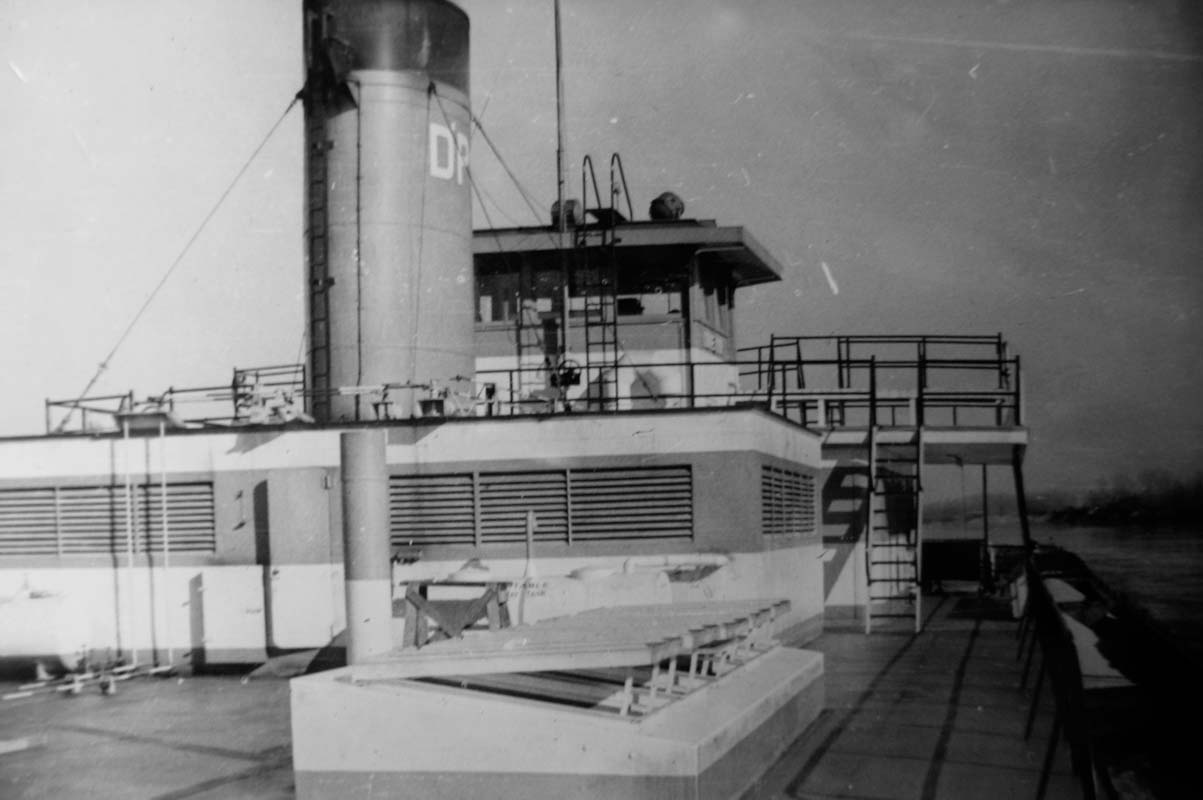
Pilot House and Bridge.
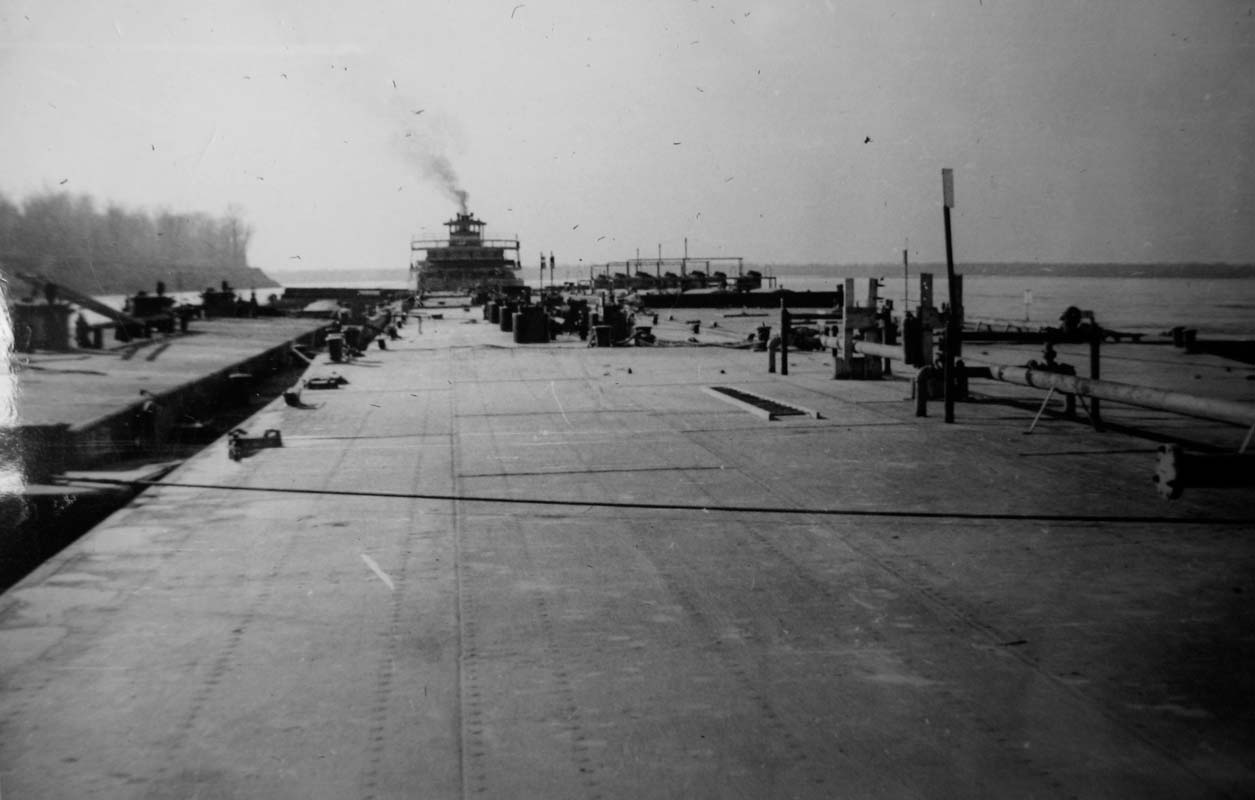
Pushing Tow down the Mississippi River.
Lucille looked up. "That’s to keep the dishes from rollin’ out when the boat pitches." More nautical discoveries!
The skillets were back on the stoves; the huge spoons were hanging from their hooks. Lucille scrubbed the cement table top.
Mrs. Lynch watched us as we finished working. "Come on over into my room, girls, and I’ll tell you about your work."
We followed her into the small corridor at the other side of the galley. Her room was next to our maid’s cabin. A bed stretched across the middle. There was a sewing machine, a basket of mending, some vases, and bowls. She had made her cabin into a bedroom, sewing room, and living room.
"Just sit down anywhere," she said. We chose the bed. With our hands folded in our laps, our posture sedate and attentive, we listened to her words of experience.
"Girls," she began, "I’ve been on the river for nearly twenty years with my husband, and I’ve seen a lot of things. If you ever have any questions, just ask me. You must remember that there are thirty men in the crew and only four women on the boat."
We nodded our heads. We understood what she was getting at.
"Don’t go out on the deck alone at night. Stay in the galley where you’ll be safe."
Our eyes widened.
"Don’t bother the Captain. Stay down from the pilot house and attend to your work. I never go up in the pilot house myself."
I began wondering what the pilot house looked like.
"Be careful, girls. It’s all right to talk with the boys, but don’t carry on too much. I want you to have a good time, but listen to my advice. Now if you go out to the galley I’ll be out with you in a minute, and I’ll show you what to do next."
"Yes Ma’am." We thanked her for her counsel and left.
Lucille was in the galley. She was on her knees scrubbing the red floor with all her effort. We sat down near her and Doris said, "Lucille, aren’t we lucky to have such a motherly, kind person to care for us as Mrs. Lynch?"
Lucille raised her perspiring face and looked at us. "Just wait, girls. Y’all will find out."
Dinner... trained and ready to go! The tables were set, the water glasses filled, the jam and butter placed at either end of the table. In the galley rows of bowls were lined on the serving table, brimming with steaming hot food. There were potatoes and string beans, spinach and corn, beef and corn bread.
Mrs. Lynch looked up at the clock. It was exactly 5:30 p.m. "Guess it’s time to ring the bell. Doris, do you want to ring it?"
Doris was delighted. She smoothed her apron, tucked under a dangling lock and took the bell from its corner of the cupboard. Down the guard she walked, swinging the bell, as a throng of men charged past her toward the mess. They needed little invitation.
The forward watch ate first. They were clean, well rested and ready to go on watch from six until midnight. A shuffle of feet and dragging of chairs was followed by an attack on the big bowls of food brought in.
Alligator lunged for the bowl of beans.
"Hey you guys, let the little lady set ‘em down on the table." Earl rose, gently took the bowl from my hands and place it on the table. "O.K., sweetheart. How’s about a cup of coffee for this fellow? Good and strong."
I whisked out into the galley for the coffee. This was going to take as much dexterity as serving at Walgreen’s. The guard door slammed as I returned, carefully carrying the teetering cup.
"Hey Buster, you git outa here. You can’t eat dinner without a shirt on!"
Buster tossed one of his golden curls back from his forehead and winked a devilish eye. "Ah, just want to give the lil’ gal a treat."
"Aw, git goin’." Buster escaped through the doorway just in time as a buttered slice of bread pummeled against the screening.
"Who’s he?" I asked.
"That’s Buster, the night watchman. That Romeo ought to have some of the gold taken out of his hair. His wife tries hard enough, doesn’t she fellows? Heh-heh."
Back in the galley, Doris and I refilled the empty bowls and stacked the cooking dishes in the tubs. Scalding water ran from the tap and turned the soap flakes into a bubbling foamy mass.
"Sorry, girls, there’s no cold water. You’ll just have to wait until that cools off a bit." said Mrs. Lynch from her perch on the high stool. A ring of a bell came from one of the other rooms. "That’s for you, Poppy," said Mrs. Lynch.
I dried the soap suds from my arms and hurried to the crew’s mess. I looked questioningly into the faces of the group around the table.
"That’s all right boys, now isn’t it. Thanks, sweetheart. We just wanted to see how fast you could make it."
"Can I get anything for you anyway, boys?"
"Yeah. Put your finger in my coffee," coaxed Buster. "I need some sugar."
Mrs. Lynch came to the doorway. "Don’t let them kid you, Poppy. They’ll run your legs off if you take them seriously."
The water had cooled sufficiently in the tubs and we started washing the dishes. Doris was washing them and I cleared the plates as the men brought their dishes in from the table.
"Those men sure are a crazy bunch. I think it will be a lot of fun, though," I said, polishing a plate and depositing it on the stack.
"Do you really think so?" That mellow voice whispered in my ear. It was Earl. A cup and a plate went into the dish water. "How about having a beer with me tonight?"
"Oh, hi! Don’t you think the boat will be ready to leave tonight?"
"Heck no. We’re still repairing the piston. How about it?"
"Um... well, I’ll see when we get through with these dishes."
"O.K., I’ll see you later on the stern."
I caught Mrs. Lynch’s glance over her shoulder. Earl bent over and whispered, "Don’t worry about her."
We continued our dish washing until thirty sets of dishes had been washed and put away, the floors swept and the dining room straightened. By seven thirty the two watches had eaten and we had no more work to do until the following morning at five o’clock.
Mississippi
River Scenes
"Now aren’t you glad you settled for a milk shake instead? I asked, as I trimmed off the chocolate foam with my spoon.
"Yeah, I am," Earl admitted, wagging his spoon up and down. "But wait till they get some beer shipped into this burg. I’ll really show you how to get rid of the foam." We were seated next to the window in a little ice cream parlor on the town’s main street. Jeffersonville was a small place deriving its activity from the operation of the shipyards and the commuters who crossed the river from Louisville. The night air was heavy and close. The reddened skies forewarned showers. A group of men leaned against the drug store across the street, chewing on their cigars, gesticulating with their arms.
Earl sat opposite me, his head leaning over the paper cup. He was handsome, with black curly hair and twinkling eyes. The corner of his mouth turned up in a merry way when he smiled at me. He thrust his arm out in a long stretch. His shirt spanned across his chest, tugging at the buttons. A silver emblem of the N.M.U. gleamed on the tip of his shirt collar.
"Say, what’s your job on the boat anyway, Earl? Someone said you were the Union representative, but what does that amount to?"
He drained the last drop of the shake and set the cup aside. "I’m a striker. One of the ‘grease monkeys’ down in the engine room. I’m the guy that turns the throttle and rings the bells. Sort of working under the chief. I’m striking for a higher rating."
"You mean you are an apprentice engineer?"
"Yes," he continued, "and as union representative, I see that the activities of the union and demands of the workers are carried out on board the boat. I attend the meetings and bring information to those who belong. My job is to help in completing unionizing the boat."
His eyes narrowed and the twinkle left his eyes. "By the way," he started, "I didn’t go for that glint Grandma Lynch gave you a while back in the galley. You just let me know if she says anything to you."
I crumpled my napkin and put it inside my cup. "What is all this mystery about Mrs. Lynch? She’s been perfectly swell to us so far. But Lucille says, ‘you’ll find out.’ The boys whisper about us and say not to pay any attention to whatever she tells us. We’re in the dark about it all. What’s wrong?"
"Well, just don’t listen to anything she tells you and you’ll be all right." "Oh, come on now. You’re acting just like everyone else. What’s wrong?"
Earl squared his chair and clenched his fist on top of the table. "Here’s the deal. This boat is nearly 100% unionized, and the union is working for the good of every person aboard her. Yet what is Lynch and her old man doing? They take the new fellows aside and rip the union apart. They try to steer them clear of signing up. Why, they belong to the union themselves. You have to join after you’ve been on here for thirty days. I don’t know what the hell’s wrong with ‘em."
I looked out the window. A stout wind had blown up and the men had left the corner store. People hurried to get indoors.
"This is a strange affair," I thought. "What is the Lynches’ motive? Who is in the wrong?"
Then a big raindrop splashed against the window. "Hey, we’d better get back to the boat before it really pours," said Earl. He grabbed my hand and we hurriedly walked down the street in the direction of the river.
Time passed, and Doris and I became accustomed to the routine of the work. The piston was still being repaired, and each day the Chief announced that we would soon be under way. The delay gave us a little time to investigate our surroundings more thoroughly. At the time, the Corregidor was the only steamboat tied up at the Jeffersonville Shipyard, but anchored only a hundred feet away were six newly launched LSTs.
Twenty-four hours a day the screaming crane rolled up and down its scaffolding, carrying the huge metal strips that formed the hulls of the ships. Lights blazoned from the thousand tiny windows of each section of the plant and auxiliary buildings. And on the piles that held the mud embankment away from the force of the rising river sat a crowd of workers dangling their legs over the side. Men and women, indistinguishable in their blue coveralls, sat laughing and joking together during their short lunch break. And then, at the sound of the bell, lunch covers were clapped on, the last crust hastily devoured, and dozens of legs hied over the hill. "You can really see the speed of war production from a grandstand seat here," I commented.
"Yeah, you can," assented Earl. "Seems like every couple of days they’re launching a new LST."
Evening had come. Duties of the day were concluded until the next watch, and Earl and I sat on the poop deck swinging our feet over the side and watching the workers in the shipyard. The Corregidor lay gently in the water. Only the soft lapping of the water against the side, made by a passing craft, moved the boat.
"I’d like to see how those boats are made, but I suppose that area is restricted." "Sure you can see it," said Earl. "You’ve got your Coast Guard pass. You can get by." Earl jumped to his feet. "How about it. Let’s go. Get your overalls on, and they won’t be able to tell the difference between you and the workers."
"Gee, that’s keen. How about Doris? She’d like to go, too."
"Sure, bring her along. Tell her to put on her overalls though."
I swung my feet up to the deck and ran off to the cabin. Breathlessly, I burst into the room where Doris was curled up reading. "Come on Mouse. Get your scrub pants on. Earl is going to take us through the shipbuilding yard."
Soon we strode along beside Earl, clad in our overalls, feeling much the same as one of the workers. It was 7:30, lunch hours were over, and everyone was settled at his or her machine.
"I’ll take you through this building because you’ve seen that one over there," he said, pointing to the building where we saw them cutting patterns.
The building that we entered was a mere shell put up in the whirlwind of war production to house the diversity of machines needed to manufacture parts. This particular plant was one huge room, and as we entered, we were confronted by rows of small machines, each one run by one man. Earl took us over to the nearest row.
"These are all lathes," explained Earl. "Each machine has a different tool to turn out a different part."
I wandered over to the next machine and watched the man at work. He bent over the wheel as it spun around and pressed a metal ring against it. Little chips of metal sent showers of gold and silver away from the wheel as centrifugal force impelled them. The worker took off the ring, measured its diameter and flung it into a box with a score of others. He took off his visor and looked up, squinting in the glare of the bright light of the bulb that hung from overhead.
"Can you tell the girls what you are makin’ here?" questioned Earl.
The lathe worker pulled out a big blue handkerchief, mopped his forehead, and stuffed it back into his overalls. "Sure, these are just rings for a part of the boiler. They have to be an exact fit, though. This measures it," he said, holding up the instrument we had seen him use. He looked at us and squinted again. "Say ain’t you the gals that works on the Corregidor? Thought I saw you walkin’ through here the other day."
"That’s right. We just came aboard the boat the other day," Doris answered.
"Your friend here," he said, nudging Earl, "doesn’t waste any time in showing the new ones the ropes."
He laughed and drew his blue shirt sleeve across his mouth. "Hey Joe," he called to a fellow worker. "Tell these girls about your tough job over there."
And so we went through the rows of machines, watching each one, and each worker generously expounding on his particular job.
"Say, let’s get outside and see some of the work on the hull before it gets too dark," suggested Earl.
Along the bank of the Ohio River was a series of runways. Tall cranes ran back and forth on the rails. Their huge arms swung down, snatched a massive piece in its pincers and transported it to another point on the assembly line. The great chains groaned and the steam whistles screamed.
"This is what I wanted you to see over here," Earl pointed out.
There, catching the gold of the twilight on their blades, lay the giant propellers of the ship. The thick shafts and the height of their blades gave the feeling of power and the energy that was bound in that mold of metal.
Next to them lay the inverted section of a hull. The skeleton of a great ship lay before us in various stages of development, but there in the water lay several that were almost completed. We walked along the piles and watched the giant torso being welded together. Amazing, the energy, speed and skill used in an effort to out-pace the enemy!
"These sides have to be painted by skilled men." Earl was pointing to the camouflage on the sides of the ships. Upon close inspection, they became a blurred mass of color superimposed upon one another in such a way that they disguised the ship.
"Come on," he said, "we might as well go inside one of them and see what they’re like." We climbed up the ladder onto the deck. Torches flared up all around us. Welders kneeled on the floor welding the metal strips into place. One worker peeled off the shield protecting his head. A flow of blonde curls streamed to the shoulders and the girl smiled at us.
Here men and women knelt together in similar disguise, knelt together to build. Figures crawled to the turrets, clung to the side of the hull, or stood in the great gape in the bow of the LST. Men and women, indistinguishable in their brown coveralls and metal shields. Men and women both welding their energies into one great effort to produce for a common cause to end this great war.
That night when I crawled into my bunk, I rested my chin on the pillow and looked out of the window at the head of my bunk. There it was, and it would never cease until the war was won.
The eerie green flare of the torches spouted from every cranny of the ship. The river caught the reflection and sent out streaks of wriggling, shimmering lines. One lone, dark figure stood in the yawning hole through which tanks and mechanized arms would roll. The figure - a man or woman? - stood for a moment looking out into the night, stretched and walked into the shadow of the ship.
* * *
July 12, 1944
The next afternoon Doris and I finished up the dishes and went out on the poop deck to write letters. The galley and the dining rooms were intolerably hot. We found two empty wooden scrub buckets and leaned them against the wall in the cool shadow of the boiler deck. No sooner had we been settled on the rim of the scrub buckets with a writing tablet balanced on our knees, than the door next to me was flung open.
"Well, honey-chile, you’re always at my service." Clouds of steam billowed out of the doorway, followed by a curly golden head. It was Buster in the laundry room. "How about one of you sweet gals getting me some laundry soap?" he continued. Buster, in his faded blue dungarees drenched from the steam barrel, and damp curls hanging over his forehead, stepped onto the deck. He brought his arm over his face and mopped his forehead, then settled on a scrub bucket across from us. "Gosh, I do pick the hottest days to stir that old steam barrel. Either of you gals want a job?" "No thanks," Doris said, and went on writing.
"Say, when are you going to get this boat into running order?" I asked. "I’m getting sick of this waiting around."
Buster curled his legs around and spanked the sides of the barrel. "Oh, I think I heard the Chief say something about tonight."
"Oh really?" Doris forgot about her writing and jumped up. "What time did he say?"
"Something like eight o’clock, I guess. I’ll let you know."
"Golly, Mouse, we’re really going to leave at last!"
That evening we rushed through dishes so that we would be on hand to see everything that happened. We watched the clock anxiously. At nearly eight o’clock the entire boat trembled as the engines were started. Doris and I rushed out on the poop deck and saw the first movement of the propellers in the water.
The water at the stern was churned to a creamy mass as the propellers spun. The deck vibrated with the power of the engine. The throbbing of the great motor below our feet thrilled us.
Then the Captain gave a long, loud blast on the whistle calling all hands on board. "Well, we’re really off," said Doris. And then the engines stopped.
* * *
July 13, 1944
We lay idle for three days, often wondering whether we should have just kept on our bicycles and followed the river to Cairo. On the third day, the report came again. "All hands on deck. We will leave this evening."
The evening was cool, yet a warm breeze wafted over us, bringing the odor of algae clinging to the old piles, along with that strange mixture of oil and decaying refuse that is never caught in the current of the river.
We sat on the guard, Doris still engrossed in Cakes and Ale. Across the river the lights of Louisville slowly appeared. Pinpoints of light in a continuous stream moved along the bridge spanning the river. Suddenly, a string of lights flashed on, arching over the bridge and directing the path of the moving lights below. The sky above the city had a rosy glow, reflecting the neon signs and gay life of a liberty town.
I would not be seeing Louisville again for a long time. Perhaps tonight we would start our voyage with the LSTs beside us down to the last inland port. The clock moved around, but we did not feel the newly recognized thrill of the throbbing engine. We waited until ten o’clock. Doris had retired to the officer’s mess to read her Cakes and Ale.
"Mouse," I said, disrupting her reading. "It looks like the same thing is going to happen all over again. The men are still working on the engine. Why don’t we go to bed?"
She looked up and rubbed her eyes as they changed focus from the page of small print. "I suppose we ought to," she agreed, and was interrupted.
"Hey sweetheart, you’d better get to bed if you expect to get up at five tomorrow!"
The screen door scraped open, and Earl thrust his head around the corner. The lights danced in his eyes, and he laughed deep down in his throat.
"Say, is this boat going to leave tonight or not? We want to stay up until it leaves." "But not if it doesn’t leave until morning," Doris added.
Earl stepped inside the room, crouching his tall form as he came through the door.
Settling himself in the captain’s chair at the head of the table, he spread out two long legs and slumped in a position of indolent authority.
"Well, the boys haven’t fixed the engine. They say it should be ready to go tonight, though."
"Oh, let’s go to bed, Mouse. This is just probably another false alarm."
"Nope. I’m not going to miss this. But how about waking us up, Earl, when they are actually ready to go?"
"O.K. I have watch from midnight to six so I’ll let you know."
Doris tucked away her Cakes and Ale and we went to our bunks hoping that the hour of departure would be near.
"Doris... Poppy." It was twelve thirty and someone was knocking at the screen door. I stuck my head out of the upper window and saw that it was the assistant engineer.
"Hey, are we going?" I almost shouted.
Doris bounced up from below. "Mouse, don’t talk so loud or Mrs. Lynch will hear us." Campbell, our informer, stood under the guard light now and I could see him better. "If you girls get out here quickly, you can see her start up."
Rather bleary eyed we grabbed up our skirts, tied kerchiefs around our heads and stumbled onto the deck. The shore was already moving away from us. The LSTs wavered slightly in the movement of the water as we pushed away.
The deck was vibrating now, and occasionally there was a choked jerking movement of the boat and sound of bells. "Bells... bells," I thought, "Earl is ringing those. He said it was his job."
There were no idlers now. Everyone was at his post. The engine room became a bright beehive of men scurrying up and down the catwalks, checking the various meters, and waiting for instructions from the pilot house.
As much as we would like to have watched the activity of the engine room, we had to stay away. So we assumed our usual post on the poop deck. And then an alarming voice said, "Look where we’re going, Mouse!" Doris waved her arm toward the shoreline. "We’re going toward Louisville. We’re going upstream!"
We both stood and gaped. It was true. We weren’t going toward Cairo; we were headed in the opposite direction. Buster and another deck hand pushed by us carrying huge coils of rope. We jumped aside.
"Hey, you dames git out of the way. We have to make up the tow when we get up the river a-ways."
That was the answer. They had to get the barges at a pier a short way up the river. Then they would turn and go downstream.
* * *
July 14, 1944
After the last member of the crew had left the dining room, Lucille came through the doorway juggling a stack of cleanly scraped serving dishes and an empty sugar bowl. "If those fellows would only keep the table cloth as clean as they do these bowls, it sure would look a lot better. Y’all should see that table cloth again, Miz Lynch! It looks li’ek a litter a’ pigs has been in they’ah again," she drawled.
I peered into the dining room at the remains of one meal. Corn Flakes and little piles of sugar were strewn where the bowls had been placed. A curly strip of bacon and a path of greasy drippings encircled a platter. Brown rings from overflowing coffee cups or saucers traced a pattern in the white table cloth.
"It certainly was an unkempt dining room," I thought, "but at least they enjoyed their meal, and they are the happiest men of the lot."
The breakfast dishes were finished at 7:30. Then we went to our cabin, put on our overalls, and wound our hair in kerchiefs. Out on the poop deck we searched for two buckets that would safely hold their capacity.
"There’s a couple of them that seem all right," said Doris, turning over two wooden buckets bound with steel ribs. "Boy! I hate to think of how heavy they’ll be when they’re filled with water!"
"Aw, don’t y’all worry about that," said a voice from the galley.
We twirled around, and there was Buster thrusting his head through the door. "Ah’ll fill ‘em for y’all and carry ‘em down."
We did not reject his chivalrous offer, and down the guard we marched shouldering a gray mop and following our brawny leader.
A guffaw issued from the engine room, a "grease monkey" bowed low as we passed, a face grinned from the crew’s cabin.
"Hey, leave us help you, Sir Buster!"
"How about sharing the honors!"
The water slapped over the sides of the bucket and soaked his dungarees, but Buster just turned and grinned at their chagrin. "Just a little service beyond the call of duty, fellows."
He set the buckets down in the rooms where we were to begin and we fell to work. The routine started with rescuing all comic books, shoes, shirts, old letters from under the beds and in the corners. Then one crawled to the upper bunks and made up the beds with a good share of stretching, pulling and shaking off of cookie crumbs or popcorn. Occasionally, one ran into a promising bottle, but it was usually empty. I was in the deck hands’ cabin powdering the sink with cleanser. The bowl was black with soot and grease, the mirror splashed with a variety of shaving creams. After they shone again, I swept the floor and began my attack with the mop and bucket. The red linoleum was scuffed with black heel marks, which required an excessive amount of cleanser and energy to remove.
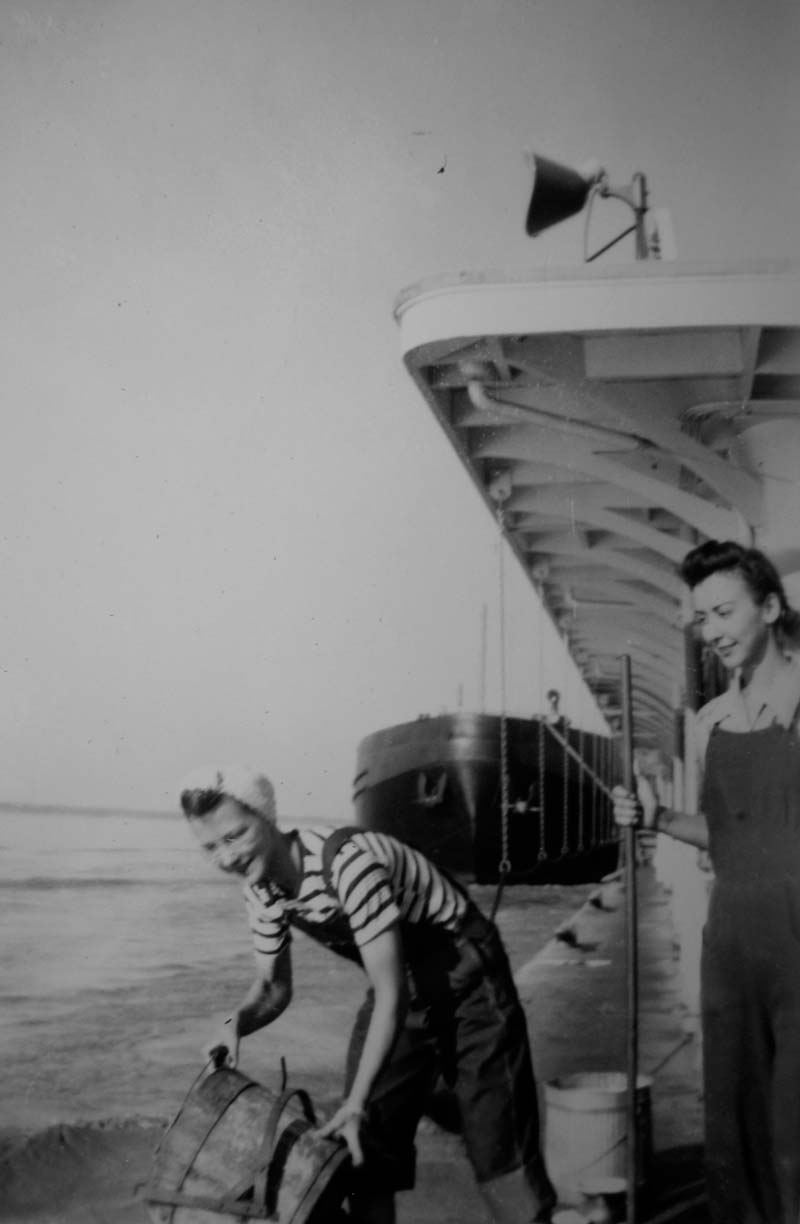
Mopping the Floors.
"Hi sugar foot. How are you this morning?"
Startled at the sound of the voice behind me, I popped up from under the bed and knocked my head against the iron bar. "Ow! Oh, Earl, you scared me. I was all right a minute ago," I said, rubbing my head. "Where did you come from? You’re supposed to be in bed, I thought."
Earl stood leaning against the door jamb, a towel flung over one arm. His face was shining from a fresh shave, and the shower had left his hair in short wet ringlets. "Well, it takes a fellow a little time to get ready, you know. Say, let me show you how to mop that floor." He hung his towel over the bed rail and took the mop handle from my hands.
"With pleasure," I said, standing back as he swished the mop in hard strokes with his long arms.
Earl was finishing mopping up under one bed when we heard the pounding of running feet down the guard. The screen door was flung open.
"Aw... you guys get to... Hey what’ve we got here?" asked Hepcat, standing astride with his hands on his hips and surveying the two of us. "Now ain’t we got a pretty new maid. Come on fellas. Out with the grease monkey!"
"Oh-oh, Poppy, out of my territory. I was just saying goodnight." Earl gave me a swift peck on the cheek and left the cabin, ducking under a brandished wet mop.
"Come on, let’s show this lady how it’s really done," cried Dummy, rinsing out the mop.
"And she gives rewards, too," winked Hepcat, rocking on his heels. He leaned over to my ear and said, "And what do I get if I mop the whole floor?"
"You get a chance to mop the room again tomorrow. That’s what you get."
"That’s one hell of a way to show gratitude. Hey, here comes Jess. We’d better beat it before he finds us off the job."
There was a scramble of feet. The mop handle fell to the floor with a bang. Someone kicked the bucket and sent a muddy wave of water over the side. The screen door slammed, and I stood in the middle of the floor surveying the mess as the lean shadow of Mr. Jess slumped by.
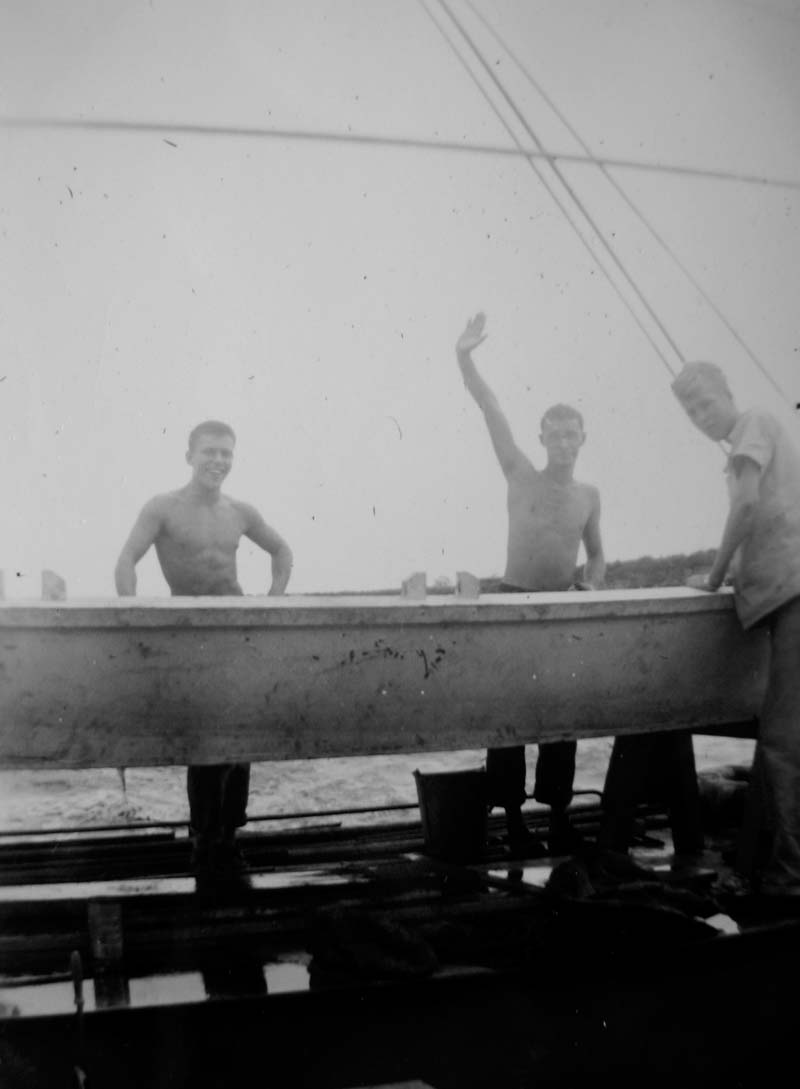
Tarzan, Hepcat, and X.
* * *
July 16, 1944
We were definitely on our way! Not far from Louisville we passed the first lock, and during the course of the day we passed through several more. There would be 12 more to go through before we reached Cairo. With my bunk right in front of the window, I could just lie there and see everything passing by.
PART 2
July 17 - Sept 2, 1944
Soon after Doris and I returned home to Buffalo, we decided to write a complete chronicle of our adventure. With great enthusiasm we wrote down our memories. That came to a halt as we pursued our jobs, married, and raised our families.
The following chapters represent the completion of this adventure using my log and family letters. As I reread the original manuscript, the energy and vitality of our youth emerges. Now that I am in my eighties, my format has changed, and my words flow in a different manner, the manner of one who has lived a full and rich life. I hope to convey in Part 2 the excitement and happiness of the greatest adventure of my youth and to recount the rest of the journey.
Arrival
In New Orleans
July 17, 1944
It’s Sunday, the day we have southern fried chicken, homemade ice cream heaped in soup bowls, and the daily corn bread.
One of the most pleasant recesses of the ship is the galley in the evening, void of the high temperature and Mrs. Lynch’s shrill voice. It seems to be the meeting place for deck hands and various members of the crew, and a time when the chill box is exhausted of its milk, oranges and bananas. Much to Mrs. Lynch’s distress, glasses are broken, water is spilled on the floor and funny papers are scattered. A reasonable facsimile for a night at the corner drug store!
* * *
July 18, 1944
We are on our way at last. The night was so exciting I found it difficult to sleep. Kept waking up to watch us go through a lock for fear I’d miss something. I can’t think of a more comfortable place to sleep than the upper bunk next to a window, where you can watch the river speed by as the gentle vibration of the engines put you to sleep.
Work goes a little more smoothly now. Mrs. Lynch calls us at 5:00 a.m. We set the tables, get out the cream, jam, fruit, ice and at 5:30 run out with the bell followed by the second bell 15 minutes later. We take turns walking along the guard and waking up the crew. The after-watch eats first, followed by the forward watch, so we have to reset the tables.
In between bells we scurry around making beds for those who just finished work and doing dishes before they stack up too high. Only then do we sit down and eat breakfast of eggs, sausages, fruit, hot cakes and milk.
A quick change into my overalls and I’m back in the galley again, mopping the crew’s mess. It’s great fun hanging over the starboard side and rinsing the mop in the Ohio! Then it’s off again to catch the beds I missed before and mop the floors every other day.
By 9:30 a.m. I feel as though I’ve put in a day’s work, and it’s back to putting my own room in order. But 11:00 comes around quickly, when we prepare for dinner. By 2:00 we’re usually through with dishes and I’ve made up the aft crew’s beds, so we have some free time until 5:00 p.m. Earl usually comes around when we’re finishing up dishes and throws ice down our backs or is a pest in some other way.
* * *
July 19, 1944
Today is the great day when we actually reach our destination - Cairo, Illinois. We passed Paducah earlier, a good-sized city, but when we reached Cairo, we could see only two small houses, a train and a couple of shacks. Our stop was so brief that there was no time to pick up our accumulated general delivery mail. One new crew member was taken on.
Doris and I were the most excited persons on the boat. We happened to be in the middle of washing dishes when we arrived, so poor Lucille was stuck with them while we stood on the boiler deck taking in the scene. There in the distance was the Mississippi River, a strip of muddy water cutting across the Ohio River. Then the dramatic entrance into the Mississippi! The Captain gave two long toots on the whistle when we approached it and a stern-wheeler named Cairo passed us going upstream.
In his book Life on the Mississippi, Mark Twain wrote, in his own inimitable style,
Going into Cairo, we came near killing a steamboat which paid no attention to our whistle and then tried to cross our bows. By doing some strong backing we saved him, which was a great loss, for he would have made great literature.
Suddenly, the green Ohio became purged with huge muddy, cloud-like masses floating on the water, which continued until the greenness was lost to the sand of the Mississippi. Standing on the boiler deck, we could see three states at once - Illinois, Kentucky and Missouri - with two great rivers merging. Having left the wooded hills of the Ohio, we have now entered the scene of a long desolate shoreline of continuous sand and willow trees. Rarely can we see a farmer cutting hay or an old shanty on the bank. The sandbars stretch like baked deserts with driftwood piled upon them. And where the shore changes, huge willows have fallen into the river, with young saplings growing in their places.
Now we are but a day away from New Orleans! As we travel along the deck hands point out the passing states. "That’s Mississippi, and the other side is Arkansas."
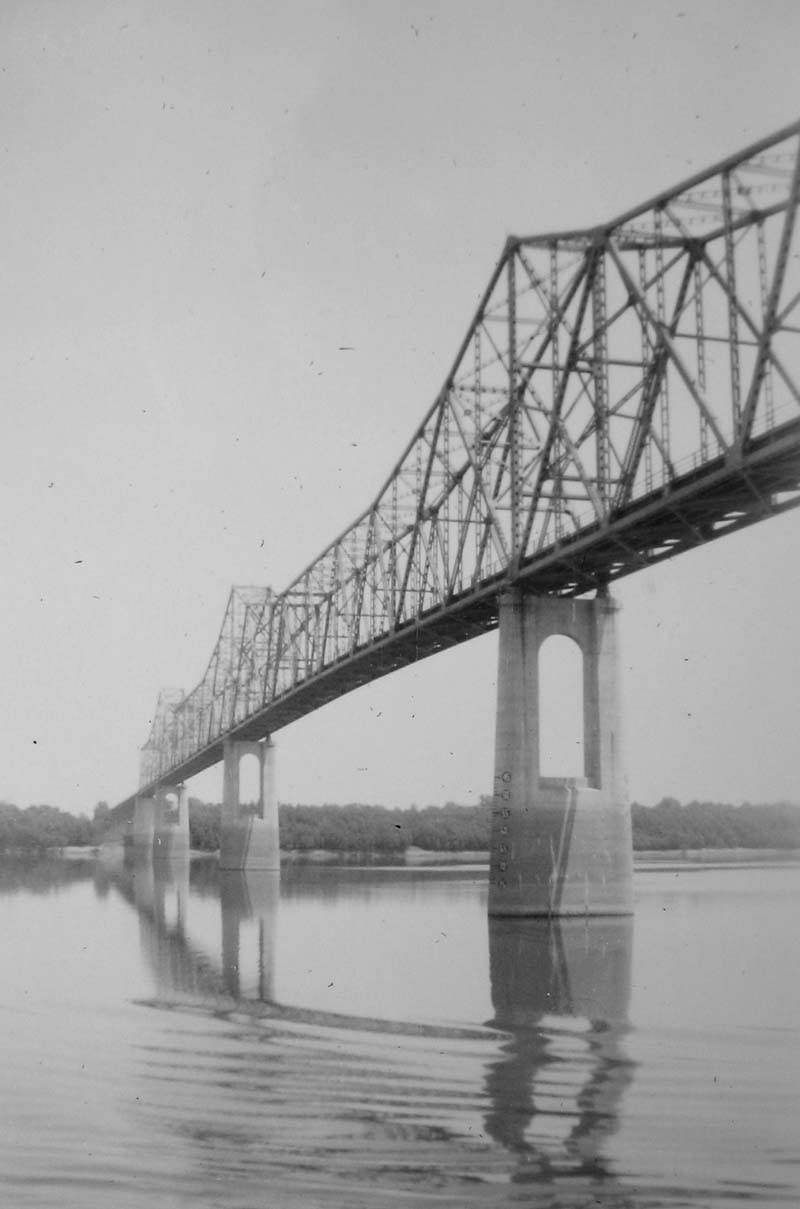
Under the Cairo Toll Bridge.
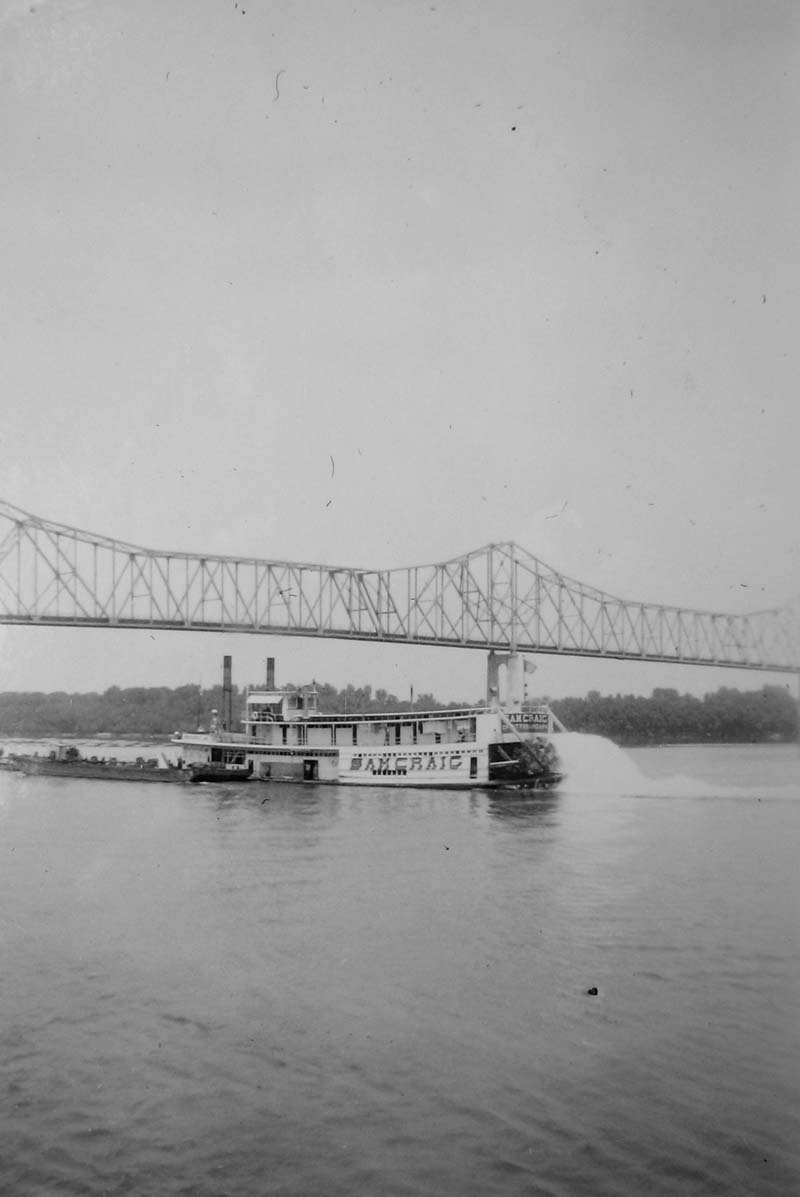
A Stern Wheeler.
* * *
July 20, 1944
The largest stern-wheeler passed us on the river, and last night we stopped in the middle of the river to answer another boat’s S.O.S. We all went out and waved to the crew on their deck. Mrs. Lynch, the cook, was so amusing. She said, "Too bad they aren’t a little closer. I’d like to run over and get a look at their kitchen curtains!"
We arrived in Memphis, Tennessee, to take on store supplies. After leaving our tow upstream, we docked up the Wolf River. We whizzed through the dishes to get our bikes and ride down the Main Street of Memphis. Once I was on the bike again I felt that our boat trip was almost a dream. After supper that night Earl and I went uptown for a Coke. On our way back we heard the shore whistle blow when we were about five blocks from the boat. We ran our legs off to get back on time. Earl is a lot of fun and a good fellow.
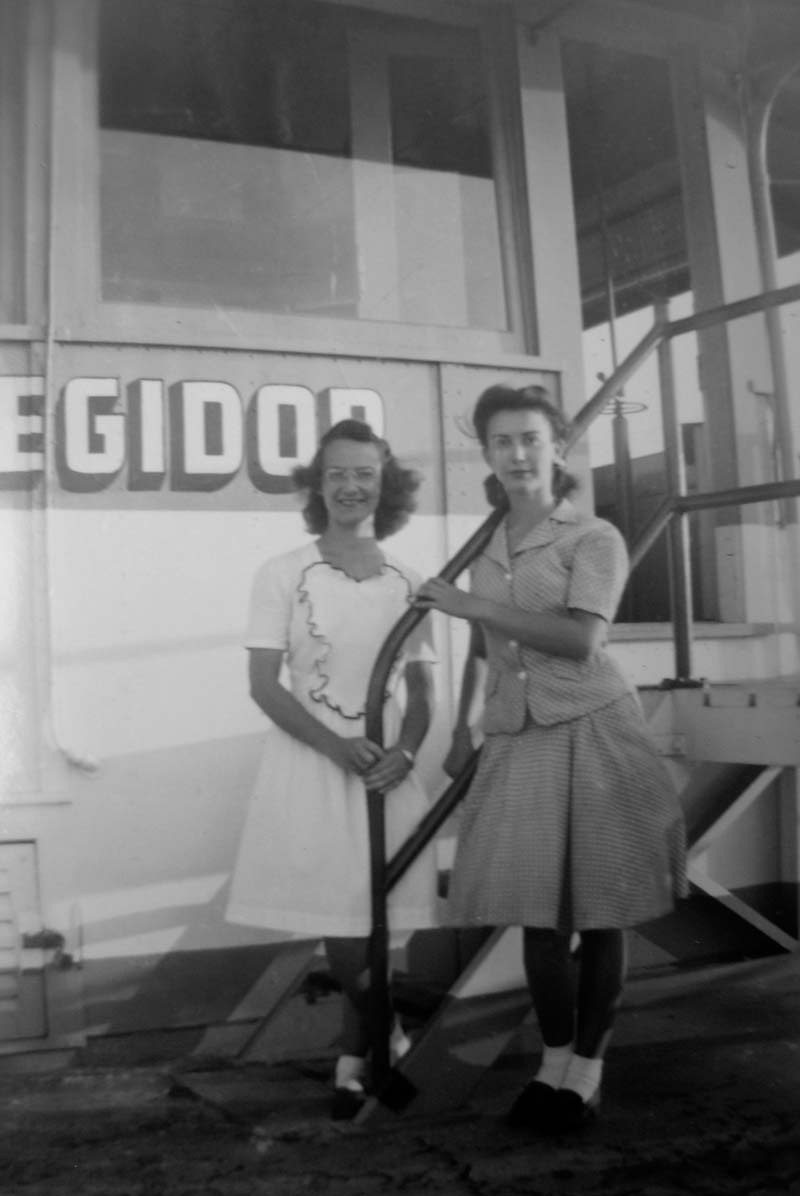
At the Pilot House.
* * *
July 21, 1944
Moving along on the swift current, today we have reached Louisiana and passed the capital, Baton Rouge. While up in the pilot house, Captain Stroube told us about the buildings on the skyline. The tallest was the memorial building to former Governor Huey Long, where a light burns perpetually on his grave. Huey Long was a political power becoming governor in 1928 and U.S. Senator in 1931. He wanted to "make every man a king" and share the wealth with the poor people. He built the first road system in the state of Louisiana and sought to improve education for all. His personal problem of alcoholism and political corruption destroyed his power. He was assassinated in the capital in 1935 at age 42.
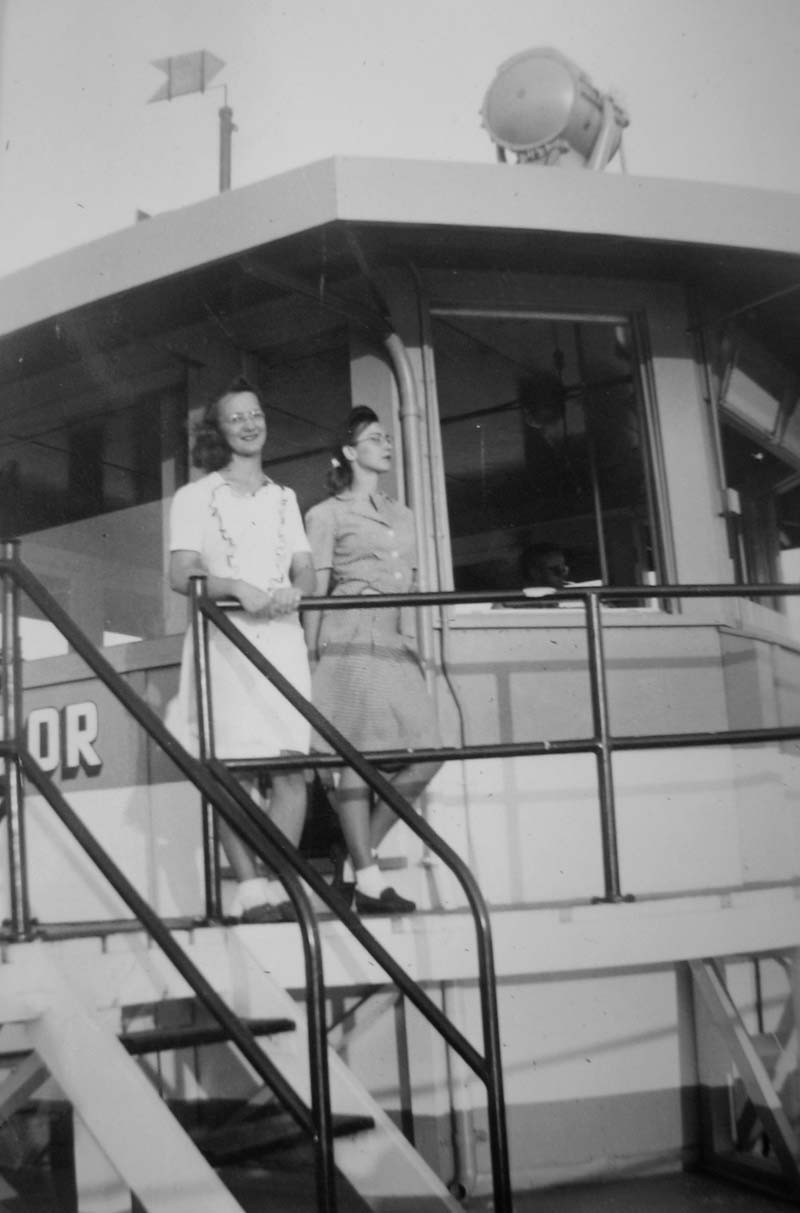
Another view outside the Pilot House.
* * *
July 22, 1944
Wrote a letter to my parents.
Dear Mom and Dad,
I’m sitting in a big leather chair up in the pilot house surrounded by glass windows. Golly, what a beautiful view! I can see for miles around, the bends of the Mississippi above, the field of rice and sugar cane on either side.
At 4:30 a.m. we had pulled into Algiers, a small town across the river from New Orleans after leaving off our tow. There we stood on the poop deck, with dish towel in hand, watching the New Orleans skyline go by. Up and down the shore were black, red and orange South American ships, sub chasers, huge American destroyers, a French aircraft carrier, and LSTs all ready to put to sea. And the Gulf only 85 miles away! Then came the awful news that we were only staying in New Orleans until 6:00 p.m. Here we had counted on at least two days. All this way with only four hours to see the place! Captain Stroube had invited us two fortunate maids out to dinner, but changed it to the afternoon. After speeding through the dishes again, he and Captain Bob took us across the river by ferry. It amazed me to see benches with signs saying "white" and "colored." An old rig loaded with watermelons pulled by a mule came aboard, too.
From the ferry ramp I got my first view of the famous Canal Street and Vieux Carrie or French Quarter. The street is very wide and used to be a moat around the city in earlier days. We walked down the narrow streets overhung with lacy iron grillwork on the balconies, past street signs bearing famous French names, such as Toulouse, Chartres, Bourbon, Orleans. The Absinthe House, where Jackson and the pirate Jean Lafitte plotted against the British before the Battle of New Orleans, was our next stop. Here an old Negro told us about the secret third floor, then played Southern tunes on his banjo. We were served an Absinthe Frappé, a famous drink from the olden days.
Walking down the streets we passed many antique stores displaying beautiful gold and silver ware, ornaments from old southern mansions. Then, as most sailors do, Captain Stroube had his favorite haunts, so our next stop was the Acme Bar for a sazerac - a good drink.
But the "Court of Two Sisters" was our favorite. It is a patio with stone floor and fountains in the center surrounded by tropical flowers, palm trees, huge oil jugs in the corners all surrounded by those beautiful iron balconies. In this setting we sipped our mint juleps.
The four hours flew by and we had to get back to set the tables. We wondered afterward whether we should have gotten off and stayed a while, but we still did not have enough of the river.
Lovingly, Thelma
P.S. Next address is New Orleans again. Please send my blue shorts with the red and white stripes. I don’t have the sugar ration book, remember?
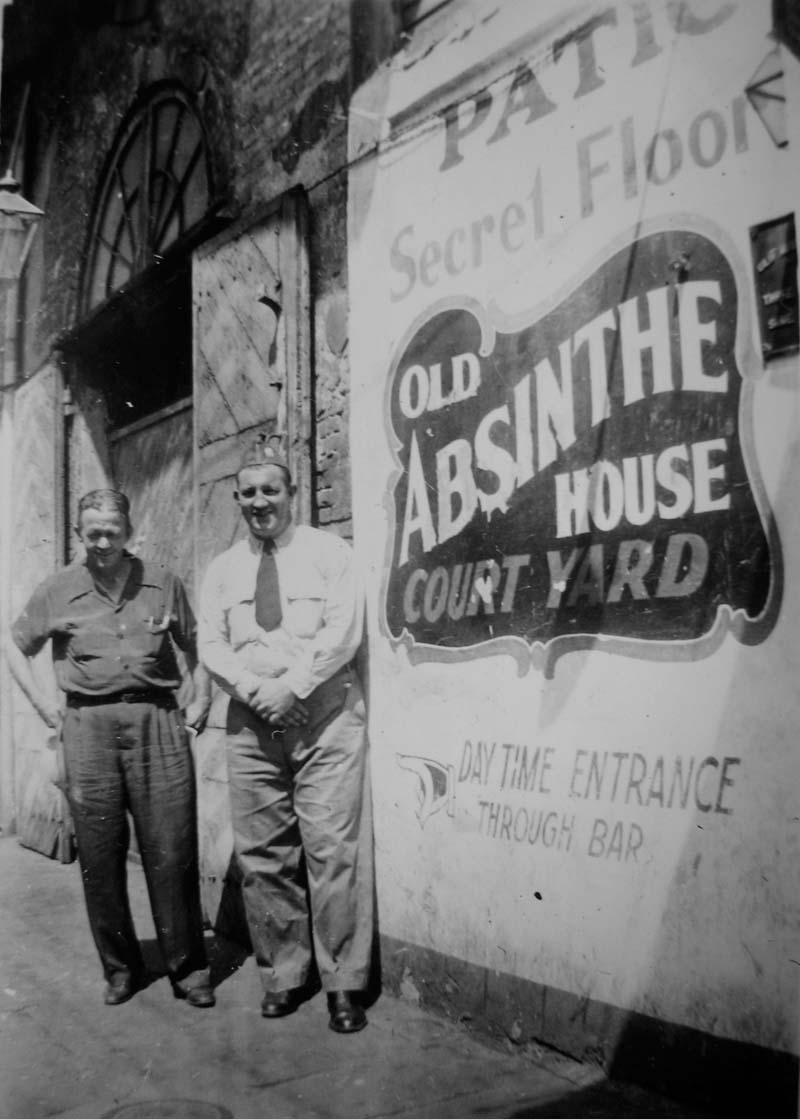
Can'n and Bob.
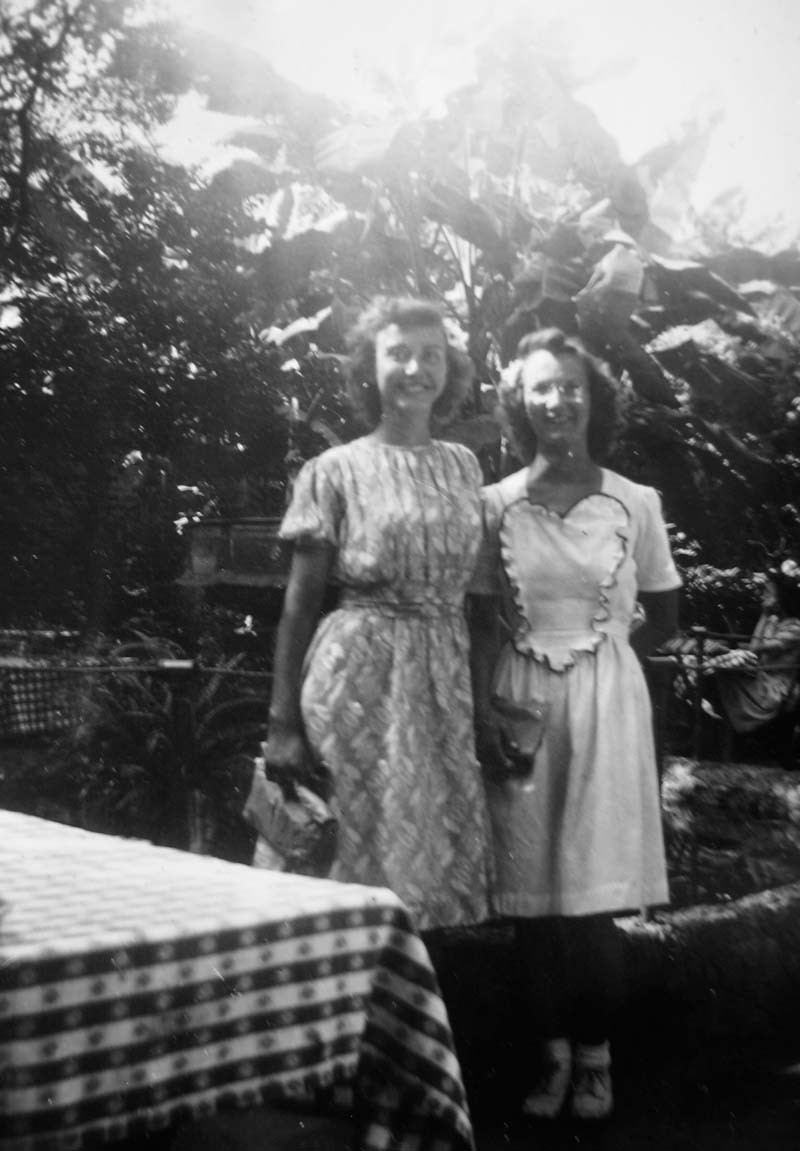
In the Court of Two Sisters, New Orleans.
* * *
July 23, 1944
We have a new tow now to take up the river - 15 barges loaded with sulfur and $5 million worth of grain alcohol to be used in the manufacture of synthetic rubber in Virginia. The going is very slow now; in fact, just five miles an hour pushing the heavy tow against the swift current. We’ve decided to bicycle to Florida when we return. Nothing is impossible now!
Yesterday Doris and I got the most mail on the whole boat. I received 12 letters and two packages. What a grand relief to receive two dresses from home. I’ve worn my one green and white striped dress almost every day for a month and a half. I also received three letters from Gordie in Camp Forrest, Tennessee, saying he’ll try to get a leave to see me wherever I am. That will be difficult to do!
We have a new assistant cook on the boat, as Lucille is taking a leave. We dislike the new cook, because she orders everyone around and we have to do all the dishes ourselves. Give us Lucille back! We were upstairs cleaning when Mrs. Lynch hauled us down and gave us a basket of potatoes to peel. We sat on the poop deck with the basket between us and having a great time singing every camp song we could think of, but she got mad and we shut up. Then we proceeded to carve figures out of the potatoes. Aren’t we devils?!
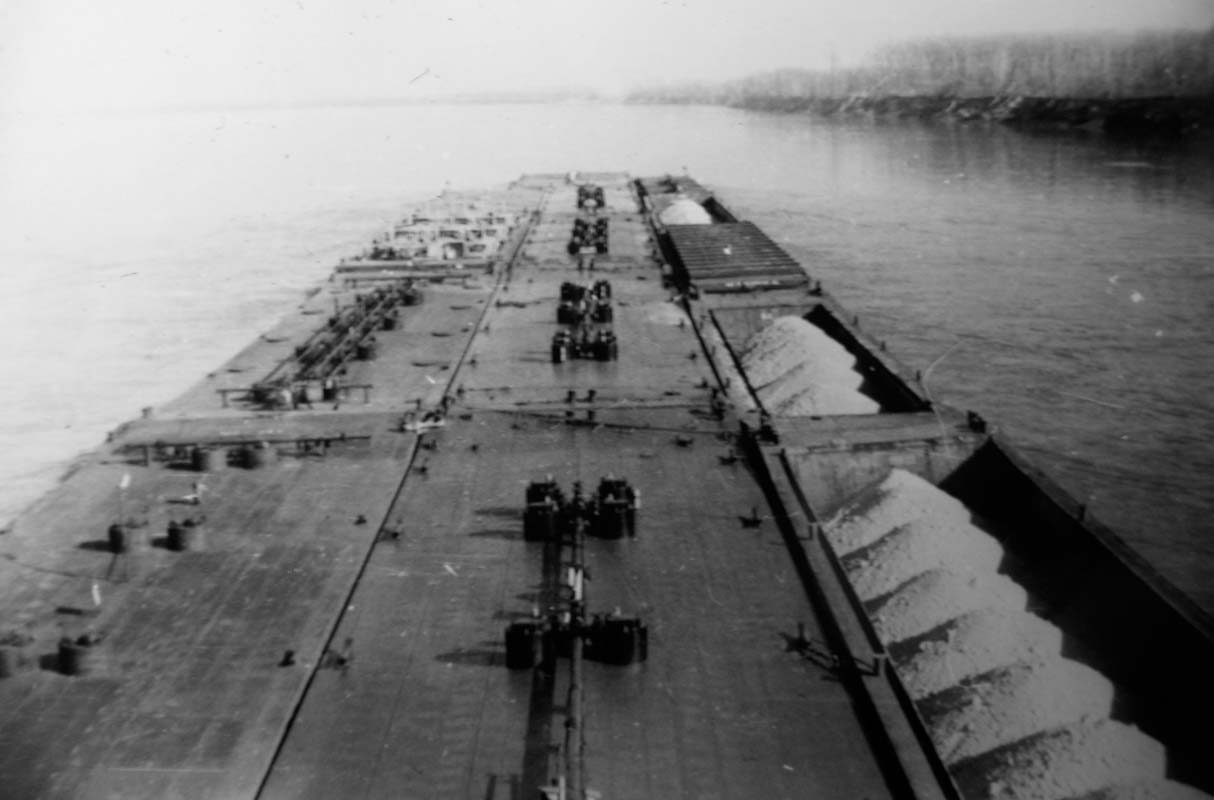
New Tow: 15 Barges Loaded with Sulfur, and 5 million dollars worth of grain alcohol to make synthetic rubber in Virginia.
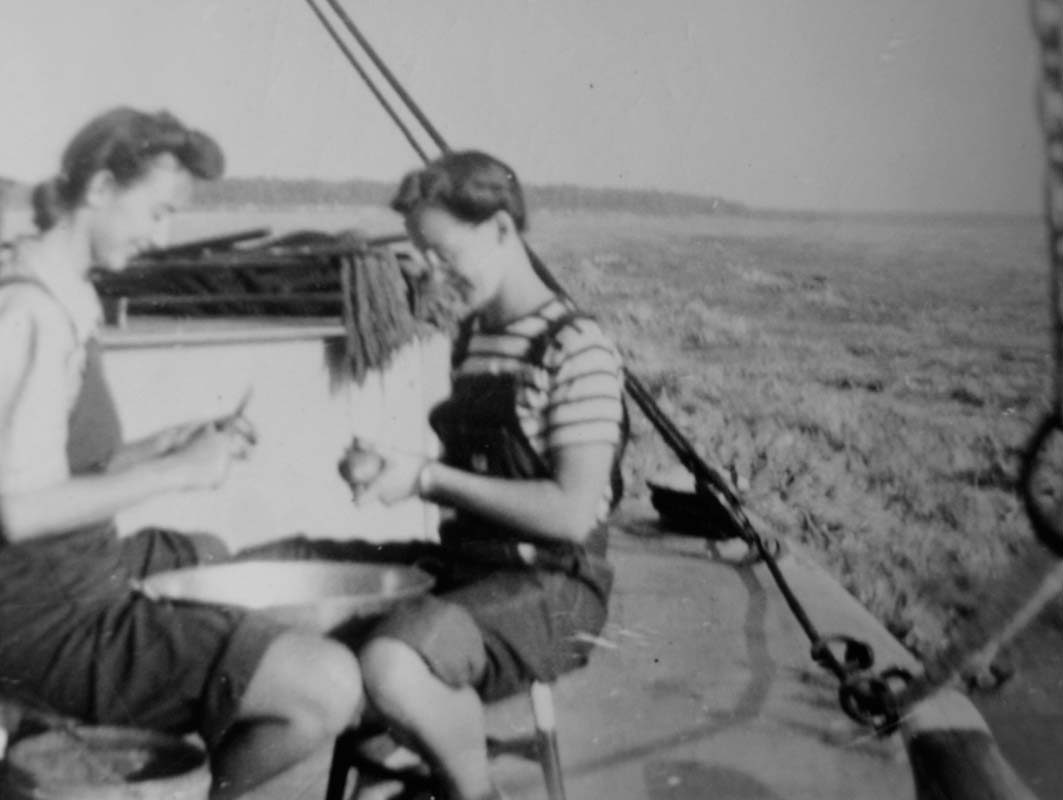
Peeling Potatoes on the Poopdeck.
* * *
July 24, 1944
The river is very slow in passing now. You can’t miss a thing on the bank; it seems to be in sight for 20 minutes. Today I went up to the pilot house to write letters. No more luxurious place could be found anywhere, huge glass windows, green walls, large leather lounge chairs, and a cold water tap - what more could one ask for? How fortunate we were to serve under such a superior pilot. Captain Stroube explained the vital statistics on maneuvering the Corregidor. The pilot has two levers to control each rudder, a pull from the ceiling which blows the whistle, and two levers for the large searchlights used at night. It would seem that a pilot’s job would be boring just sitting there and pulling a lever all day, but it is far from simple, as the river changes every day, and the pilot must be knowledgeable of every sandbank, snag, towhead and changes occurring during a storm.
He has a fine set of directions, which are made out by the Coast Guard every two weeks. They have to keep sounding the channel, because it changes constantly. Each point, bend, sandbar, towhead and snag has a name. There also are lights along the bank at certain points for navigation purposes.
The boat must stay to the right of the red buoys in the water on the way downstream and to the left of the black buoys. Also, the boat going downstream blows its whistle first to signal the other boat on which side it should pass: two blows, pass on starboard; one blow, pass on port.
The Old Straw Hat.
Inside the Pilot House.
Captain Stroube was an expert storyteller and had a tale to tell about many interesting events that have taken place along the Mississippi. One morning, while up in the pilot house, he told us the story of old Captain Mac Harry. Just as we were passing a high bluff, Captain Stroube brought out his binoculars. There on the heights of the bluff stood a tall cement tombstone. It was the grave of old Captain Mac Harry, who wished to be buried standing up so he could see the river!
* * *
July 25, 1944
There are always little feelings or sensations associated with events that help one to remember experiences more vividly. Perhaps I shall always remember the vibrations of the engines and the sound like a train riding the tracks, the smell of certain closed rooms above the hot brig, the shrill voice of Mrs. Lynch above the engine noise, and Tommy’s listless face at breakfast after only five hours sleep.
And I’ll remember the luxury of taking a handful of cookies, dipping up a tall glass of milk and eating a whole cantaloupe. I’ll remember trying to understand the southern accent, chopping ice in the chill box, scrubbing black marks from the red linoleum, counting soiled linen in the lounge, and seeing the rigging bared against a sky full of stars!
I’ll remember how our bikes looked on the boiler deck; how the deck hands were always painting; the stuffed feeling around the belt after Wednesday’s and Sunday’s dinner of southern fried chicken, followed by two soup bowls of ice cream; our rush to the guard in our excitement to see anything new that happened, followed by a severe lecture from Mrs. Lynch; and the bliss of having electric fans in the summer heat.
And, too, I have seen the factions and bargaining developed by the union aboard ship, heard the many tales told by Captain Stroube in the pilot house, and listened to his words of wisdom founded upon years of river boating. The ripple of a full moon’s reflection upon the Mississippi, the churn of the water by the propellers, the heat of the engine room and the sweat pouring off the men’s backs, and perhaps most of all, the sound of the throttle bells as the speed of the boat changed. I’ll remember making up sooty beds and folding black towels, putting dishes away in the wrong place, and finding a pail that doesn’t leak. I’ll remember the desolate shores and the sandbars, the tow caught there, the shanty boats and the willows, and Alligator shaving his hair. I’ll remember taking the second bell for meals and catching the beds in between. Yes, there are many things to remember. It will be impossible to forget such a wonderful trip.
Personalities
Shipboard
There are also personalities on a boat who determine the standards and the management of the boat. More interesting to us is their difference from those we have always imagined.
Starting with the deck hands, I find them a most amusing and flexible group of fellows. Due to World War II, that division of the crew is made up of 16 to 18-year-olds, and each one is a definite personality. "Shorty" was the first one I met over a beer in "Tiptoe Inn" in Louisville while we were waiting for the Union office to open. He’s a stunted fellow, a bundle of muscles and extremely good natured. I always depend on his opinions as being wise and of good judgment. I hope Preacher Shorty remains the good guy he is.
Then there is Tommy O’Bannon, 15 and the galley boy. Poor Tommy. Life is just one big problem of homesickness and strange new experiences. Tommy turns the ice cream freezer, carries the coffee to the pilot house, fills the cooler, and gets lectures because we talk to him too much - listless Tommy, who doesn’t get enough sleep; he’ll be back to the river some day.
Lloyd is one of my favorites. He’s sort of a Moby Dick in between. Just 16 and floundering around for adventure, he has a good head and the makings of a gentleman. His amusing cracks and intellectual idioms make him quite a character. Sorry he shaved off his beard. Wonder if he ever kept the "pressing engagement" with the ironing board!
Jack, Hepcat, is strictly a screw and so much the sailor type. "And I mean strictly" is his favorite expression. How many times have I picked up the pinup girls from his bed?
Deck Hands Shorty, Hepcat, Billy.
Leon, the young Tarzan of 16, is quite the man. What a physique can be developed with basketball and football! He can really handle those ropes.
"Buster the Stretcher" with his 15-year-old wife and baby is nicknamed for his perpetual stretching. At 23 his life seems to have been lived for no further purpose (but women). He sure is a dickens, but I’ll miss him mopping floors for me. For Billy I feel very sorry. As a consequence of coming from a house filled with grandmas and aunts, besides parents, Billy must have his coffee weak, sweet milk and mayonnaise on bread. Still a spoiled child at 18, the river is teaching him a big lesson in one summer. A week ago he married the assistant cook, who is 25, married four times, and has a child of 8. How trivial and insignificant the step means here. That covers the deck hands, with the exception of Freddy, who fell overboard and was drowned. He also lived his life too soon, having married and divorced twice before he was 21.
Two main figures who worked on the ship for many years were Mr. Lynch, an engineer, and his wife Mrs. Lynch, the chief cook. Two people never had such a difficult time as they in watching other people’s morals. Mrs. Lynch is very amusing up to the point where she brings out a cleaver to resolve an argument! She has a very clever method of indirectly telling us of our faults by describing some other people. We have concluded that she is jealous of the easy way in which we get along with the crew and, in particular, the Captain. "No maids ever went up to the pilot house before!"
A boat would never be stable without a few old standbys like Doc and Dad. Doc is a second mate, and Dad is a daylight man. Dad is the good old boy who mops the lounge and always includes two of my floors in his rounds. A pat on the shoulder, a happy disposition and a chew of tobacco, that’s Dad.
And then there is a striker called Earl with impish eyes, mischievous smile and a little too much around the middle. Doris and I met him the first time in Louisville in front of the Union office, where he put a nickel in our bells and took a ride on our bicycles. Among our many character analyses we have failed to understand this one. Perhaps if we knew more about his background we could understand his radical feelings toward the National Maritime Union, his hatred for the stiff shirts in the pilot house, and his indifference toward becoming an engineer. However, we did have fun with him learning to sing his hill billy songs of the South.
I finally found a record of "STEAMBOAT BLUES."
I was born in Dixie in a shanty boat shack
Just a little shanty on the river bank.
Now the chuggin’ of the engine was my lullaby
And the steamboat whistle taught me how to cry.
I got those steamboat blues
Lordy, Lordy, Lordy - I’ve got them
In the bottom of my ramblin’ shoes!
So when the whistle blows I gotta go -
Oh Lordy - I guess I’m never
Goin’ to lose these steamboat blues.
TALKING BLUES
If you want to go to heaven
Now I’ll tell you how to do it
Just grease your feet in a little mutton suet -
Slip right over the devil’s land
Right on over to the Promised Lan’
(Make it easy) - (Go greasy)
Now out in the wild wood sitting on a log
Finger on the trigger and my eye on a hob,
Now I pulled that trigger and the gun went zip
Fell on that hog with all my grip
(Jumpin’ gulleys - dodging bullets too)
Down in the henhouse the other night
It was dark and I had no light
Scrambled around - got hold of a goose
Now the white folks say you better turn him loose.
(Yeah - jumpin’ gulleys - partin’ bushes - dodgin’ bullets too)
Now it’s down in the hen house on my knees
Thought I heard a chicken sneeze.
But it was only the rooster saying his prayers,
Givin’ out hymns to the hens upstairs.
(Takin’ up collection - payin’ off in eggs)
Now I greased my feet in a little mutton grease
Went slippin’ and slidd’n cross the mantel piece
(Huntin’ matches, cigarette butts, chew’n tobacco too)
Now there ain’t no use in my workin’ so hard
When I got a girl in the white folks yard.
She kills that chicken, she saves me the feet,
She thinks I’m working while I’m walkin’ the streets
(Havin’ a good time - Talkin’ about her - to other women!)
Finally, our story book Captain, the master of the boat was Captain Owen L. Stroube. We were so privileged to have such a kind man introducing us to this new world of river boating and guiding us through all the adventures to follow on the Mississippi.
Years on the river, from the time he was an ornery deck hand on his father’s boat, have given him the large supply of yarns, good humor, and much understanding. Perhaps two maids never knew a Captain so well or spent so many hours in the pilot house learning about the river. His kindness helped smooth many rough periods in the galley. His lovely wife, who was also a school teacher, would come aboard occasionally from time to time to join us for a few days of her holiday.
* * *
July 29, 1944
Dear Mother and Dad,
I’ve just finished mopping my floors and making beds, and it’s only 9:00 a.m. I’ll probably be waking up at 5:00 a.m. from now on. And I’ve just had a nice tall glass of milk and orange juice from the refrigerator. Umm - this is my paradise, eating leftover applesauce, pie, custard, etc. How I’ll miss it when we get on our bikes again and each bottle of milk will cost 15 cents!
Considering the weight of our tow, we seem to be making good time up the river. By Sunday night or Monday Captain Bill said we’d be in Memphis again. That’s the one awful thing about this boat. Everybody gives you a different time and nobody really knows definitely. I sent a telegram during the early part of the week to Gordon when Captain Stroube said we’d make Memphis by August 1 or 2. Now that’s changed and I haven’t heard from Gordon, so it’s rather confusing.
Yesterday we had our first rain storm on the boat. Doris and I were the only ones who appreciated it. The wind blew up the river bringing a cloud of sand with it. We had to hang onto the guard rail because it was so slippery when we walked. The boat never rolls. I was up in the pilot house in the afternoon and Captain Stroube let me blow the whistle when another large barge was sighted. The boat going upstream blows the whistle once if he wishes to pass on the port side and twice for the starboard side.
Today we saw the Arkansas River flowing into the Mississippi. At this point, in 1541, Hernando de Soto stood with his Spanish explorers becoming the first European to discover the Mississippi River. In 1542, near the city of Natchez, he fell ill with a fever, died and was buried in the river.
This afternoon they’re putting out the yaw and going to Helena. The motor boat gets there before we do and gets the mail. Several of the crew are leaving.
The entire boat is being painted, and it seems that every time you touch a door you get wet. But we look so neat and clean I hate to step on the deck. The engine room looks like a surgery. One part is pure white, another is gray blue, with a turkey red floor.
I’ve been wearing the dresses you sent. It’s so nice to have a change, but in a week’s time I’ll have to ship them all home again! Time seems to go so fast now and night comes swiftly. On this balmy evening moonlight and stars, framed by the rigging cast light on the smooth waters and lend a picture of calmness and peace in this war-torn world.
Enjoy your vacation on the farm and in the old swimming hole!
Love,
Thelma
Tragedy
Aboard
Steamer Corregidor - August 1, 1944
Dear Mom and Dad,
Since I mailed the last card to you many unhappy events have occurred. I was in such a happy mood then, as we had such a pleasant afternoon with the Captain. We were docked in Memphis where the water was calm and the fresh smell of fields was on the breeze. But that didn’t last, for soon we left and went up into the unpleasant fragrance of the Wolf River again.
At 2:00 p.m. Captain Stroube met us at the Wm. Lenn Hotel and took us to see the movie The Adventures of Mark Twain. The story was a bit too colorful and over played, but do go to see it just for the view of the Mississippi, the stern-wheelers, the sounds of the bells, and the Negroes singing out "mark twain." Did I tell you I named my bike "Mark Twain"? I wish I had asked you to send my book Life on the Mississippi. I’d love to read it again right now!
We came back to the dock by taxi. We were supposed to leave by 6:00, but an unpleasant scene confronted us. The boat was in an uproar. A Union meeting was called and we all assembled in the crew’s mess. Doris and I had great fears of being removed because we have not joined the Union. But it seems that Earl, the Union Delegate, had been putting too much pressure on managing the crew by having some worthy people put off the boat.
Earl was voted off the boat and a new delegate elected. Three other members of the crew were also sent packing. Hot words flew and Grandma Lynch came out of the galley with cleaver in hand! It was interesting to see how the common laborer fights for his rights. Now we were shorthanded and supposed to leave at 6:00. We finally left at 8:00 to pick up our tow on the Wolf River. You should see the new crew. They’re practically all kids - one fireman is 15 and a striker 16!
Then this morning I was mopping a room when I heard a shout "man overboard." So I went to the door and saw that Freddy, one of the deck hands, who was standing on the guard pumping oil, had slipped and fallen in.
There are two large propellers in the rear under the poop deck which cause quite an undertow. I was so happy when I saw that he managed to pull himself safe from that current. In the meantime, a life buoy was thrown to him and the crew started taking down the yaw. But the current was so swift that he couldn’t reach the life buoy, or perhaps he never really saw it, because the Captain watched him through the glasses and said that he never turned to look at the boat.
It seemed like an eternity before they got the yaw down and then the motor would not start. Meanwhile, Freddy seemed to be sinking and rising all right. Finally they got the motor started, and just as they got within about 15 feet of his head, he sank out of sight. The muddy water and swift current made any further search useless. I can only think now of how helpless I felt standing there when it seemed so easy to swim, especially with the current. They claim he was a good swimmer, too, and probably hit himself when he fell in for he never looked at the boat.
Then I had to go back and make up his bed. It doesn’t seem possible that one life can be snuffed out of existence. He was an awfully nice boy, too, although like most of the boys that are here, he lived his life too soon - 21 years old and divorced twice!
I’m off to get a few winks of sleep. Hope we don’t have any more excitement of this sort again.
Love,
Thelma
Oh, yes. I spent a whole $1.33 sending a telegram to Gordon at Camp Forrest, Tenn. to meet me in Memphis, but he couldn’t come as he was unable to get his leave. He sent a telegram to the boat.
The Boiler Deck Aft.
The Wake.
* * *
August 2, 1944
I spent much of the afternoon reading The French Quarter. It is such a colorful history of New Orleans, with its pirates, voodoo charmers and loose ladies. There will be so many places to visit when we get back there.
This evening, while I was up in the pilot house, we had to pass the Progress in a very narrow channel; therefore, they had to sound the bottom. Quoting from Chapter XII in Mark Twain’s book Life on the Mississippi he wrote:
When the river is very low and one’s steamboat is "drawing all the water" there is in the channel - or a few inches more, as was often the case in the old times - one must be painfully circumspect in his piloting. We used to have to "sound" a number of particularly bad places almost every trip when the river was at a very low stage.
So I had a chance to witness the crew "sound bottom." This is done by measuring the depth of the water with a weighted line. The lead line is a rope marked off at intervals with tape, mark twain equaling 12 feet. A large bar of lead is attached to the bottom end. "Mark twain" was the pilot’s call to indicate the water was two fathoms deep. A fathom is a unit of measure equaling 6 feet. It was quite a thrill to hear Tommy call "Mark twain" or "quarter twain" over the microphone from up at the head of the barge.
Passing "Progress." Had to Sound Bottom" 12 Feet.
* * *
August 3, 1944
Today was another eventful day. The Attu, the boat with which we were to exchange pilots, was grounded on a sand bar at Columbus Point. So we had to break up our tow and go down to assist the Attu. The tow usually consists of up to 12 long barges carrying tons of cargo bound together with steel cables. A difficult job to break up.
Doris and I were watching from the guard railing until we got another lecture from Ma Lynch. So we went up to the pilot house and spent the rest of the time watching from there. It was amusing to see their maids just finishing the dishes, too.
* * *
August 7, 1944
When I rang the breakfast bell this morning, I found that we were tied up at the stone levee of good old Cairo. Above the stone wall you can see the old stone business buildings of the once active Commercial Street. There on one sign in big letters it says "Cairo Boat Store." We finished our work early so we could step ashore for a bit while the Coast Guard carried on a formal investigation of the drowning. Doris and I climbed up the levee wall and took some pictures of the Corregidor. Then we headed for the Post Office. So this is Cairo - just an old river town we had marked as our destination - "The Gateway to the South." But we were a little late in arriving to collect the package of cookies Mom had sent last June... stale! And just the day before, the Post Office had returned all our mail.
We did some shopping, picked up the Captain’s pants at the cleaners and ended with a fresh peach sundae at 10:00 in the morning. Another amazing thing! We actually purchased three rolls of film, which have been almost impossible to get during wartime. By 10:30 the boat left on the river again, with 17 more watermelons added.
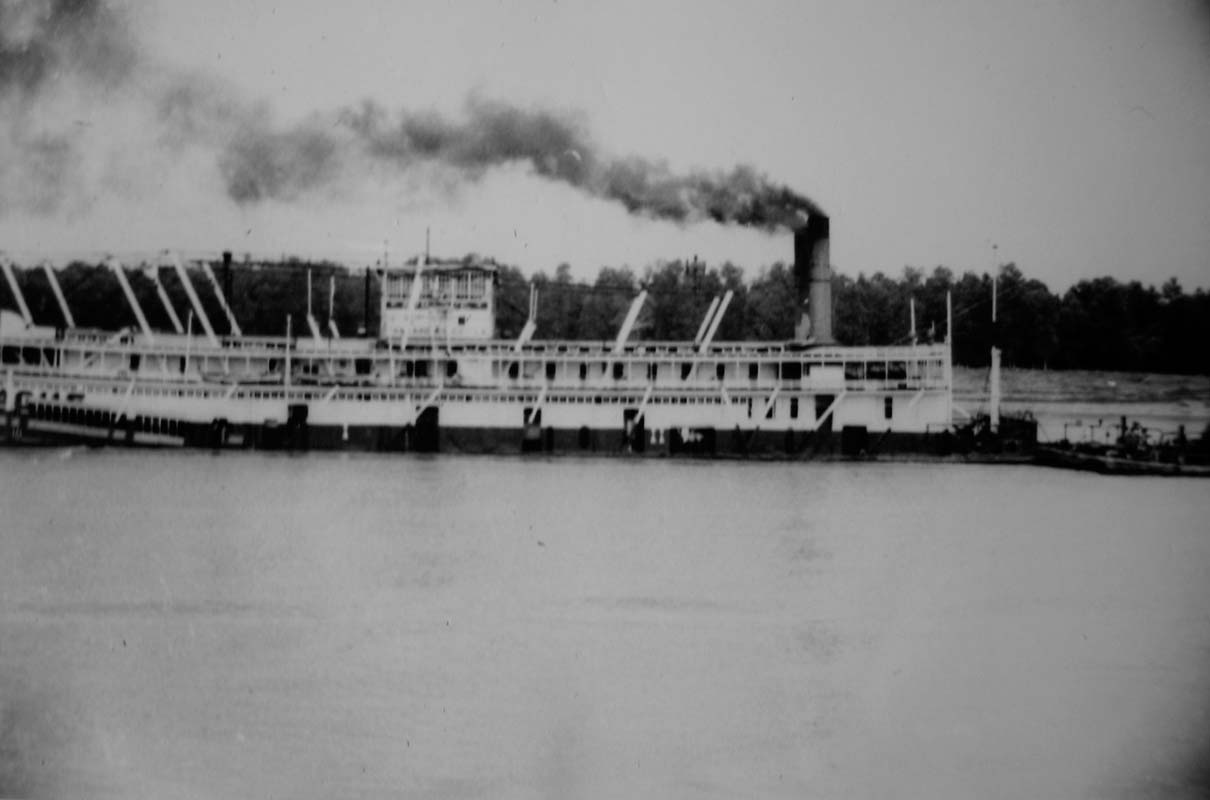
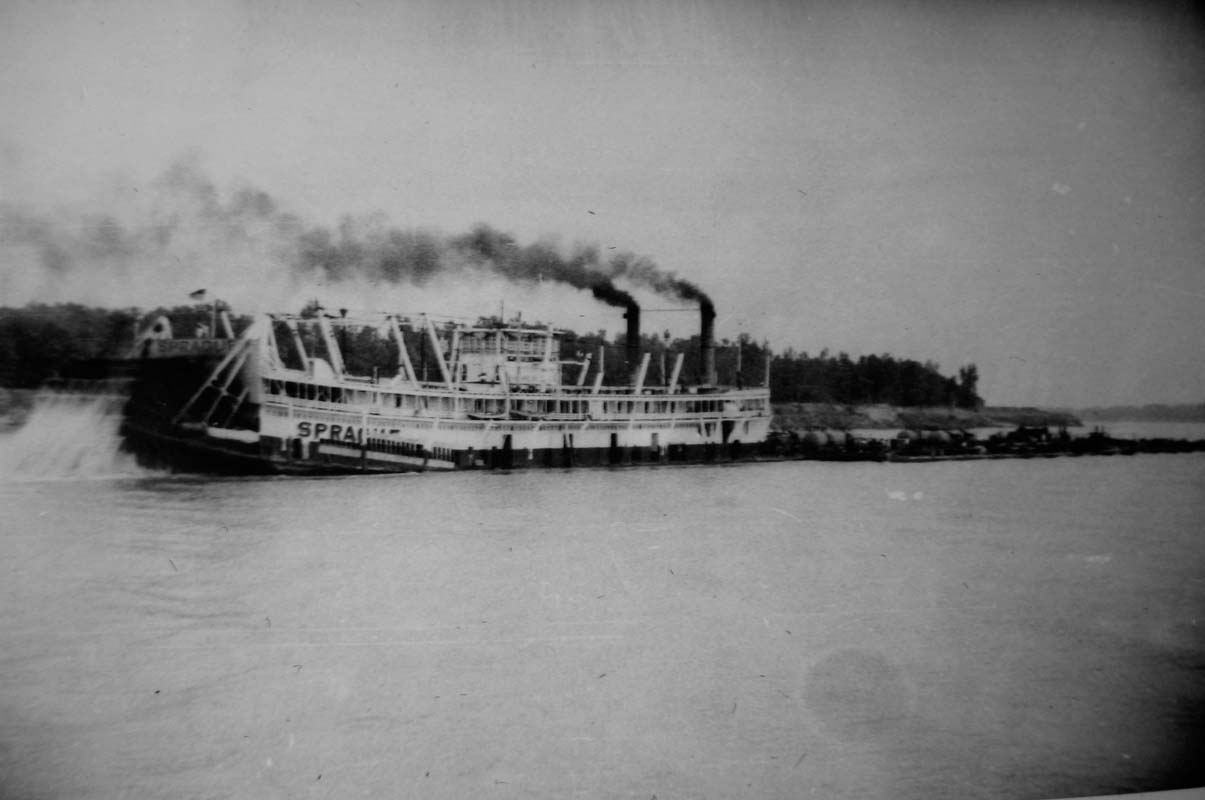
The Sprague Sternwheeler.
* * *
August 8, 1944
Captain Stroube’s wife came aboard at Cairo and will stay with us until we return there. She is a very charming person and a school teacher, too! Today some amazing news broke out. Lucille, the kitchen assistant, married Billy in Memphis. This will be Lucille’s 4th marriage at 25, and she has an 8-year-old son. Billy is 17. How insignificant the step seems.
Just now the throttle bells have sounded and the engine stopped, for we are approaching a lock. Because we have such a large tow, we must double lock, that is, the deck hands must break up the tow and send half through at a time. The whistle has just blown to announce our approach. Sometimes it takes an hour to go through the locks.
This has been a remarkable day for a Sunday, about the most difficult day I’ve been through. In the morning I cleaned the rooms so well that I plopped on the bed and slept a half hour before dinner. Just try serving breakfast, washing all the dishes, scrubbing the galley chairs and tables, mopping the galley floor, peeling a bucket of potatoes and THEN changing all the linen on 22 beds and mopping 8 floors! You can bet those two soup bowls full of chocolate ice cream will taste good for dinner. By tomorrow we should be in Evansville, not too far from Louisville, and then we will turn back to New Orleans. Doris and I were talking tonight about writing a book about this adventure. We think it must be a dream many have had, but we have actually been able to put it into reality. Some day I’ll wonder how we ever did this. I wish that each day was so very long that summer would be endless. One thing - I’ll miss the corn bread we have every day!
* * *
August 9, 1944
We were almost as far as Louisville this morning, when we finally met the Patriot who was to turn us. We tied up to the bank and exchanged tow. Now we only have 9 barges, but will still have to double lock.
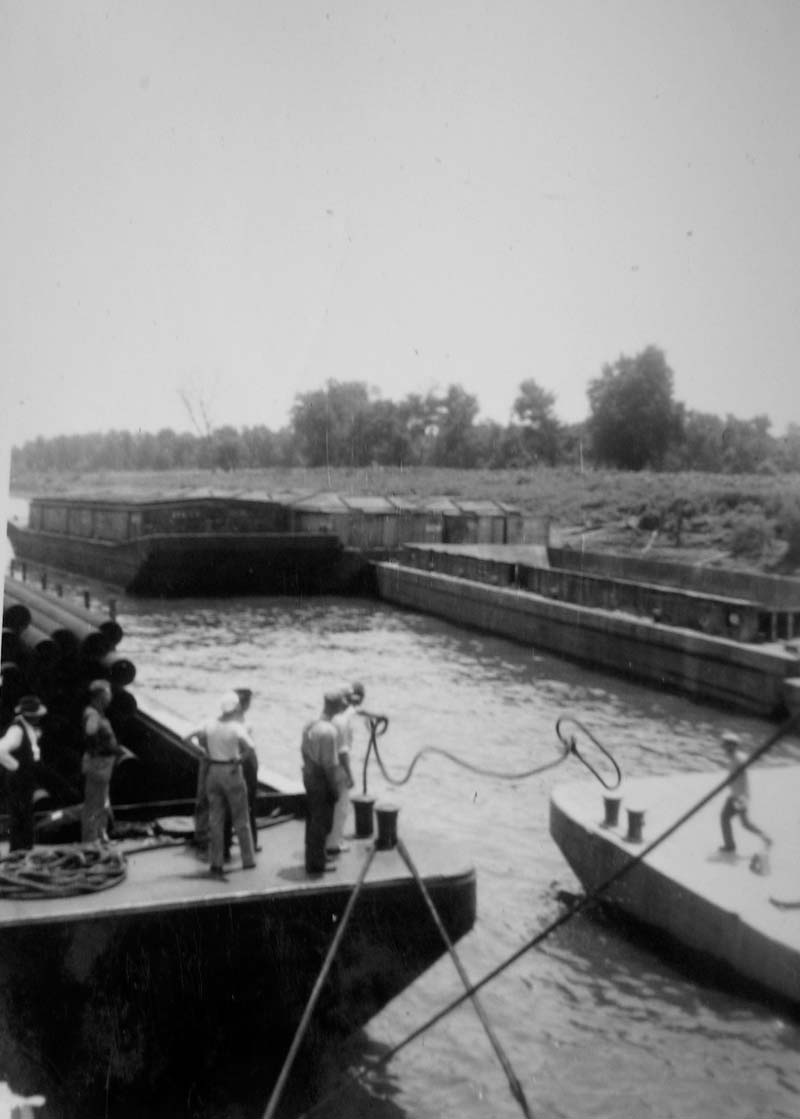
Met the "Patriot" and Exchanged Tow. Around we go Back Down to New Orleans.
Oh happy day! Around we go, back down to New Orleans. The calendar yawns in my face. After returning to New Orleans we plan to bike to Florida and then up the East Coast to New York. Why did I ever sign that school contract? We could travel the U.S. by wheel!
The Patriot brought some mail, a letter from Dad and one from Earl. Earl is in New Albany, Indiana, waiting for another boat. He sent a pretty mother of pearl leaf pin with my name in gold on it. I’m surprised that he even wrote.
* * *
August 10, 1944
This morning we passed through Lock 53, the last lock on the Ohio River, then passed Cairo, and now we are on the Mississippi again. It’s amazing how the river’s fast current pushes us at a great speed south.
Ma Lynch began her sweet singing and hinting, which meant something was wrong again. When we were assigned our jobs on the boat, we were given a 30-day limit as non-union members. Yesterday was our last day. Mrs. Lynch informed us that we may get bumped in Memphis if we don’t join the union. We weren’t about to do that with only a few days left until we return to New Orleans.
Up to the Captain we went with our problem, but he offered no solution. We don’t want to strain any relations between the Captain and the Lynches. After all, she has been on the boat for 25 years, and her husband is First Mate. At first she was so sweet to us, but others warned us that she would change. She claims we don’t listen to her, and I imagine we are a bit independent. It amuses us, but perhaps it wouldn’t if we wanted the job permanently. She uses the oddest devices of making us feel bad by talking about former employees and how they did their work. Then, too, we are very interested in the functioning of the boat and, therefore, spend much time in the pilot or engine room, or run out to see them break up tow. She doesn’t like this and gives us a lecture each time. She told us we’d better get off as she doesn’t want to be responsible for what could happen to us! We are concluding she is jealous of us and how easily we get along with the crew. And then again, I guess two maids never got around as much as we do, especially going out with the Captain! We are so fortunate in being on a ship with a crew and Captain such as this. The Captain could not be finer, and he helps us out with our problems. He loves to talk, telling us stories of the river, and so when work is done, we spend many fine evenings in the pilot house listening to him.
With no suggestions from the Captain about the union problem, we decided to write to our good friend Leo Boekbinder of the Union Office in Louisville and ask his advice. Perhaps he will help us out. It would be a long way to bicycle from Memphis to New Orleans!
* * *
August 11, 1944
A big day, which means changing the sheets and counting the linen. Rather difficult, too, when you find that the deck hands had a fight with pancake flour in their rooms last night!
To prepare ourselves for the possibility of having to leave the boat, Doris and I put our bikes on the boiler deck and gave them an overhauling. I cleaned every spoke with sandpaper and kerosene, scrubbed and oiled the metal and oiled the wheels and gear. Borrowing turkey red paint used for the engine room floor, I repainted the rear brace, which holds the sleeping bag and the bell. Just a few tightening of screws and air in the tires and we will be all set to roam again.
We passed through the last lock (#53) on the Ohio again, picked up potatoes in Cairo, and now we’re headed down the Mississippi again. Spent the evening in the pilot house talking about New Orleans and the lower Mississippi, planning our tour of the place.
* * *
August 12, 1944
We arrived at the dreaded city of Memphis again, dreaded because so many unhappy things arise here besides the smell of the Wolf River. Doris and I felt confident, for no known reason, that we would not be "bumped." But no sooner was the gang plank down than Sherlock the Union Representative, came aboard. He called for us right away and did not bother with the deck hands who had been on longer than we had. We thought it must be a "put up" job.
Sherlock said, "After you have been aboard for 30 days as, stated in the agreement, you have to join the union. That period is up." There was nothing these two dejected maids could do but start packing. We were not going to join the union for just a few more days on the boat. However, we found one good bit of news. We will get 9 days of vacation with pay per month, so maybe we’ll get a whole week’s extra pay when we leave!
We brought our bikes down and started packing. Finding a strong box, we filled it with our dresses and accumulated junk to be sent home. And being aware of the lack of good corn bread and delicious meals ahead, we did a little scrounging, too! We packed some potatoes, jam, bread, cereal, crackers and packed a lunch. We took our last shower, put the bikes on the stern and waited.
Then, good old Captain Stroube came to the rescue. He came blustering down to the galley saying, "If the Union doesn’t send two maids by 6 o’clock the boat will leave without them!"
Time for a prayer! Meanwhile, we served dinner and kept watching the hill. Soon Captain Bill went to the pilot house; the shore whistle blew for everyone to come aboard. Then we waited an eternity of twenty minutes more, but still no maids appeared. Finally the engines started and we were off! We almost collapsed with anxiety. What a narrow escape! We’re really going to New Orleans now!
* * *
August 13, 1944
More good news! We received a stack of mail today. I received 12 letters and a package. A nice letter from Gordon on his leave in Louisville. Sorry we couldn’t meet up there. He even stayed at the Brown Hotel, where we had applied for jobs while waiting for the boat. We sat on the top bunk and spent an hour just reading. A package from Earl was a pillow cover for each of us from the Navy Post. So nice of him!
The pilot house seems to be our haven now. It’s nice to have Captains Bill and Bob back again. Captain Bill brought us some papers on the history of Natchez for us to read.
That evening, out of the leery eye of Ma Lynch, we watched the Mississippi slip by. Captain Stroube says we’re due in New Orleans on Tuesday morning. Confidentially he said, "We’re going half speed at intervals, not because of shallow water, but so we get in New Orleans in the morning and can spend a full day there." All the group in the pilot house are taking us out again!
Today I gave the floors an extra good mopping, for it will be the last. I’m sad about leaving the river, but we’re tired of the antagonism in the galley. We’ve figured how many miles we’ve come from Louisville - exactly 3,654.5 miles!
Farewell
To the Corregidor and Mississippi
August 15, 1944
The last day on the Corregidor has arrived. It was a wonderful feeling to serve breakfast and make beds for the last time. As we entered the harbor in Algiers across from New Orleans, we sat up in the pilot house to watch the procedure. It was a sight to see the ships of every nation tied up to the wharves. We found our slot next to the Casablanca.
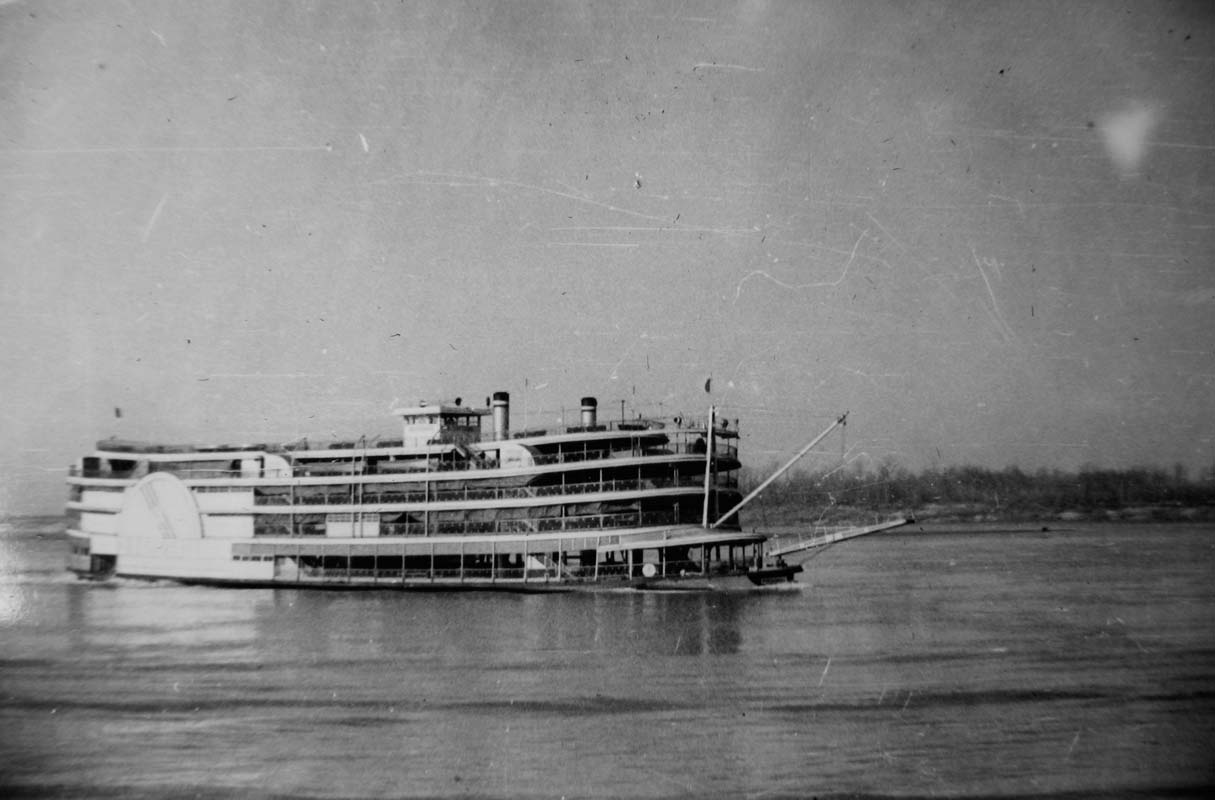
The President Pleasure Boat in New Orleans Harbor.
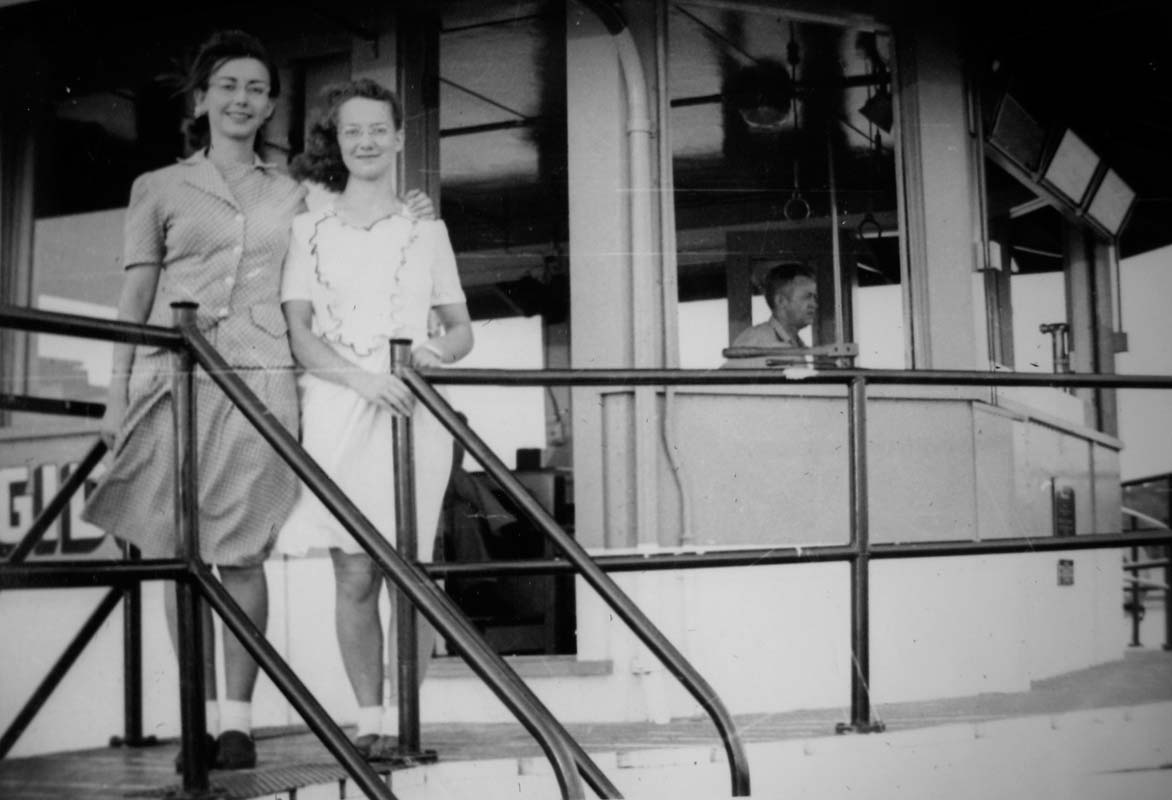
Last Day on the Corregidor, August 15.
After dinner we completed packing our bikes, including a small bottle of Mississippi water sealed with wax. Then we made a circuit of the boat and bade farewell to all the crew. It was difficult to say goodbye for the crew were all so wonderful to us. They put our bicycles up on the dock and we rolled off to the ferry.
What a thrill it was to roll down famous Canal Street in New Orleans on our faithful bikes. We left a great adventure behind us, and the land was ours once again. We checked the YWCA for overnight accommodations, and they directed us to a rooming house in the French Quarter on 931 Chartres Street.
The streets are so narrow and the buildings so close together that you can hear other conversations. Wisteria vines embrace the iron works on the galleries, and tropical plants bloom in the courtyard below.
We showered and dressed in haste (in our usual bicycling dresses) to meet Captain Stroube and Captain Bill Watson for dinner at Maylies. The restaurant was an interesting place having a large wisteria tree growing in the center of the room through the roof. After sipping an Absinthe Frappé we had a delicious meal of New Orleans specialties of great proportions, consisting of shrimp cocktail, soup, salad, red fish, chop suey, chicken, pie, claret, Chartres (the nectar of the gods says Captain Stroube) and demi-tasse.
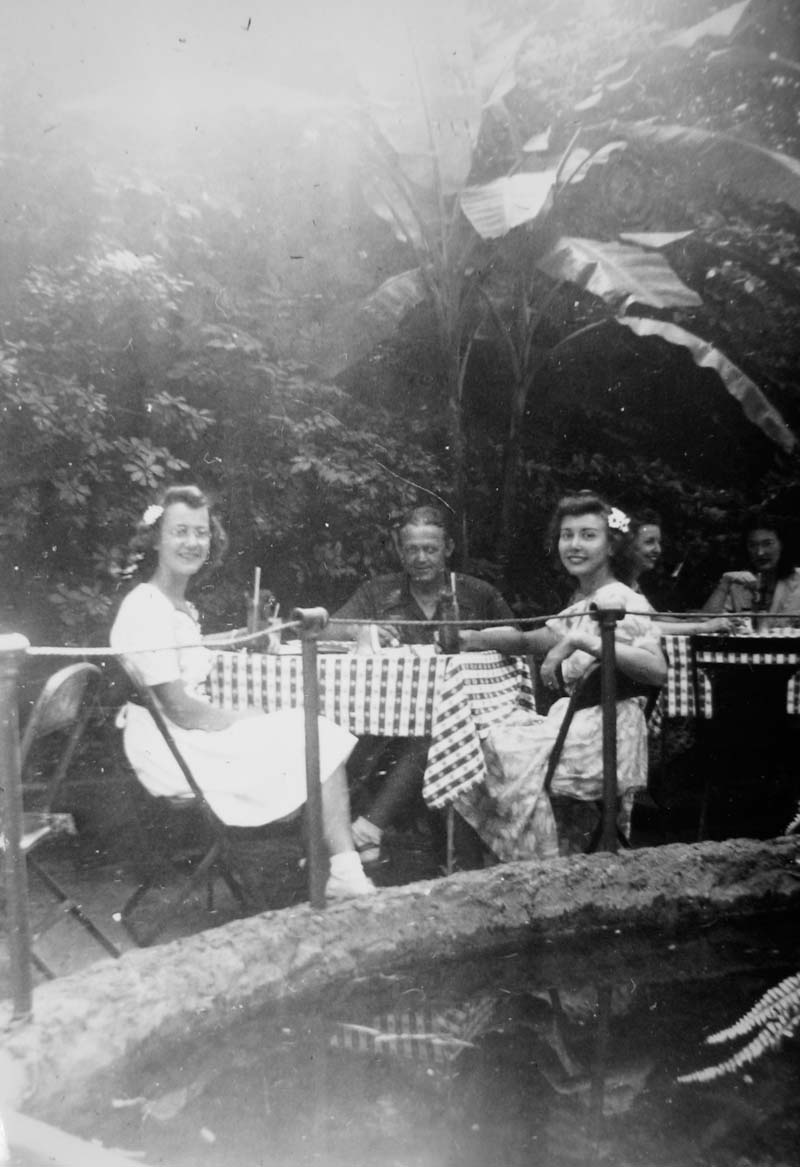
Mint Juleps and Absinthe Frappe, and Dinner at Maylies with Capt. Stroube and Capt. Bill.
Then off in a taxi to Club Forrest, a gambling casino that was legal in Louisiana. We entered a beautifully decorated room and heard the clicking sounds of silver dollars, the spin of the roulette wheel and call of BINGO. Captain Stroube gave each of us $5 to play at the table. As I was unfamiliar with the whole setup, I just watched. The tensity of some players’ faces, the stacks of silver dollars and the ease with which they parted amazed me. The two Captains played for quite a while until Bill broke even and Bob lost $80.
Into the cab again and off we went to Flynn’s, decorated with an Irish theme. The Dixie Music Bar, with the sailor playing "boogie," the colorful mural on the wall and our last mint julep I’ll not forget.
The streets were very quiet and dark now as we walked to the French Quarter for café au lait and their famous beignets. The rest of the evening we had a long conversation with Captain Stroube about the crew and events on the boat. He had such good common sense and understanding of our relationship with the crew. The Captain is very fond of us, and we will miss his wisdom and guidance.
Finally we took the ferry to Algiers, and he boarded the Corregidor. We stood on the wharf; he came out on the bridge to wave. Pilot Bob immediately started the engines, and the Corregidor left. We stood there watching until the last bit of smoke disappeared, our eyes brimful and ourselves feeling just a little small with our bicycles 3,000 miles from home.
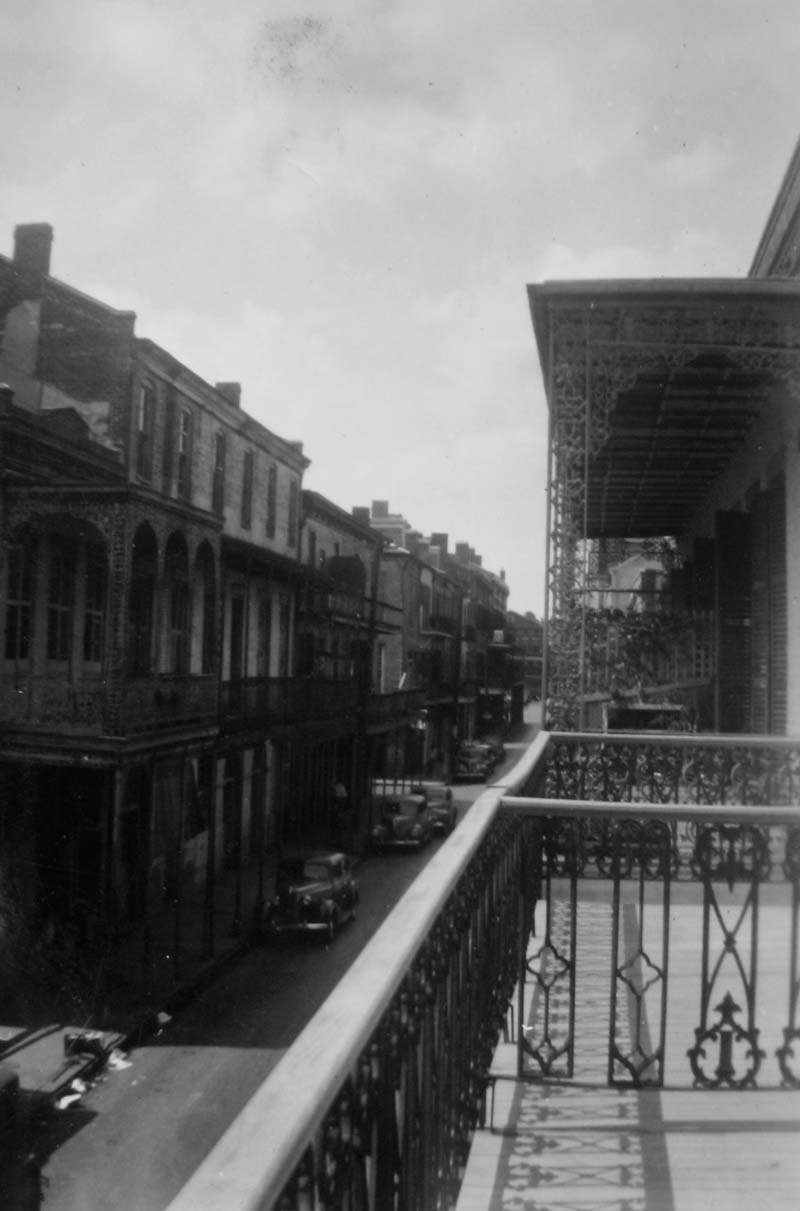
Chartres Street from our room in Vieux Carre.
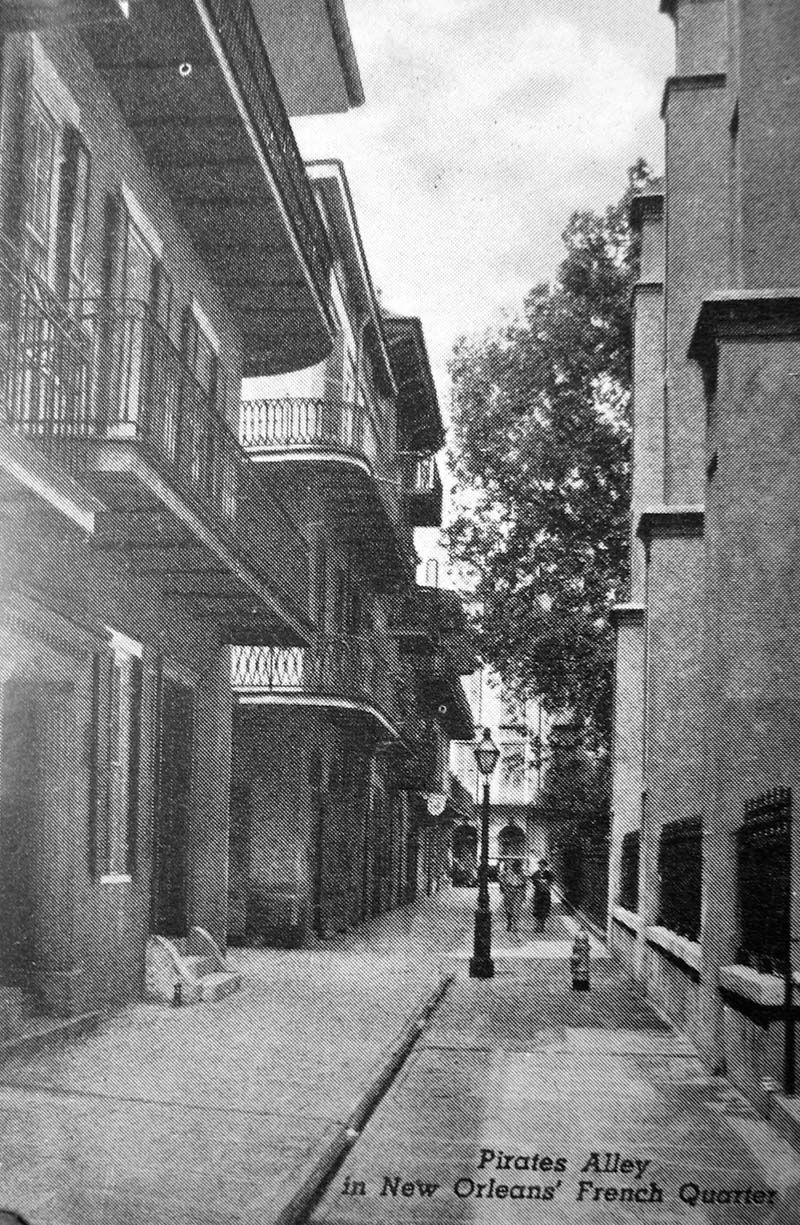
Stayed in Room with Balcony.
We’ll remember Captain Bill’s favorite song as we travel on.
My Home in San Antoine
Haven’t got a nickel, haven’t got a dime,
Haven’t got a thing to call my own,
Though I’m out of money
I’m a millionaire
For I’ve still got my home in San Antoine.
Wearily, after the most exciting night I can remember, we went back to our French Quarter room.
* * *
August 16, 1944
To wake up in the morning hearing someone’s radio blaring at full blast and a street brawl going on under your window is a bit of a shock, especially having had only three hours sleep! Another shock was the telephone ringing. It was a phone call from Captain Stroube notifying us that they were waiting to add another barge before they could leave. He invited us to lunch at the Kit Kat, along with Captain Bob. More New Orleans special food. We enjoyed the first crab cakes we’d ever had. Then we all went to see the movie Going My Way, starring Bing Crosby. Next was our last dinner together of shrimp and steak at Felix’s.
We all took a taxi to the Jacksonville ferry and now it was goodbye for good. The Corregidor lay on the opposite shore all lit up - and with two maids, too! They sent us home in the taxi, making a grand conclusion to our "Life on the Mississippi!"
New Orleans
History of a Unique City
August 17, 1944
Now on our own, we got on our bikes and started out to see New Orleans in a different manner. After a delicious breakfast of pecan waffles at "The Green Shutters," built in the 1750s, we opened up our guide book and maps to plan the exploration of the city.
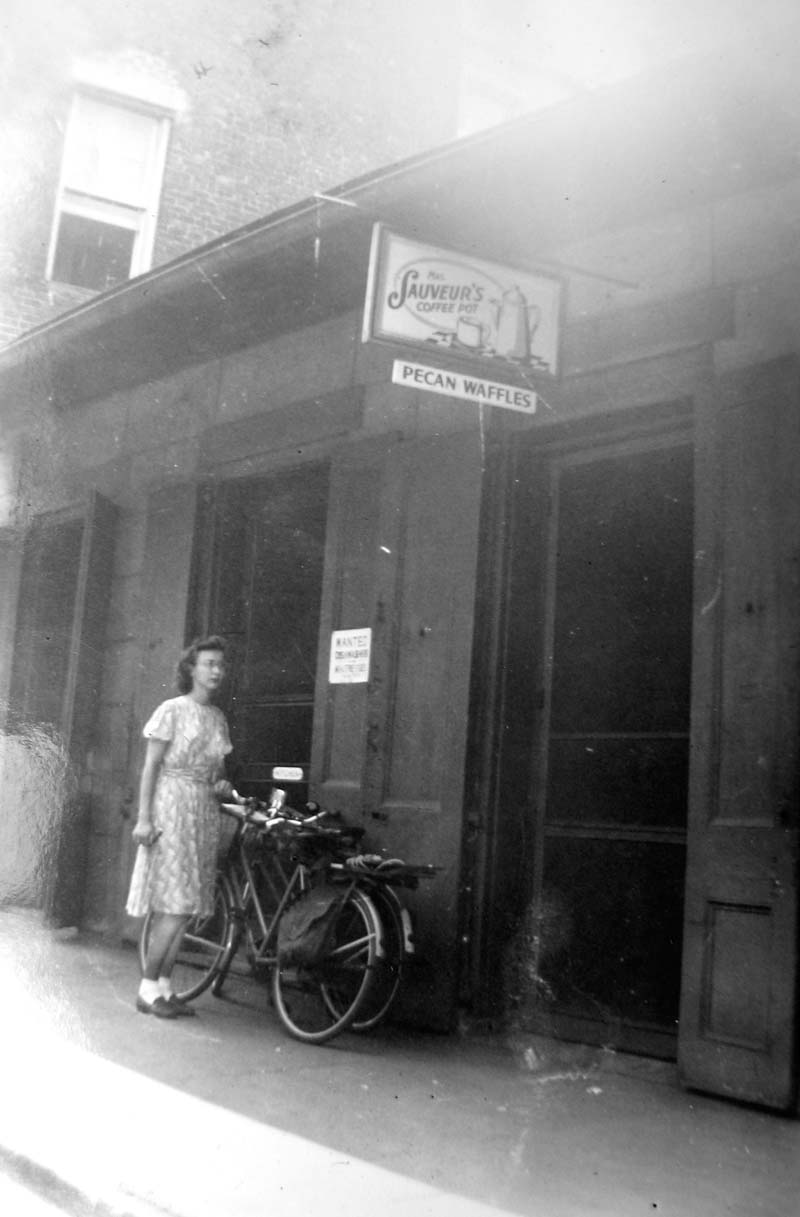
Pecan Waffles at the Green Shutters.
First we read about the historical background of the area, which greatly influenced the expansion and settlement of America. In 1674 LaSalle, a Frenchman from Canada, made an expedition through the Great Lakes and down the Mississippi. At the delta, he claimed for France all the lands west of the English claims that drained into the Mississippi. He believed that the Indians living there had no laws and therefore were not sovereign. The territory was named Louisiana in honor of Louis IV, king of France.
The site of New Orleans was named after the Duke of Orleans, who was Regent of France ruling for the underage Dauphin. The crescent shape of New Orleans is defined by the flow of the mighty Mississippi as it bends and twists through the city on its serpentine path to the Gulf of Mexico, which lies 110 miles to the south. The settlement was built on land 5 feet lower than the river itself, causing frequent flooding, mosquito infestation and malaria, and making colonization unsuccessful. The original location was laid out as a walled rectangular fortification now called the Vieux Carré (old square). Ditches were dug around it to drain off excess water. In years to come, levees were built and pumps installed to prevent the town from becoming inundated.
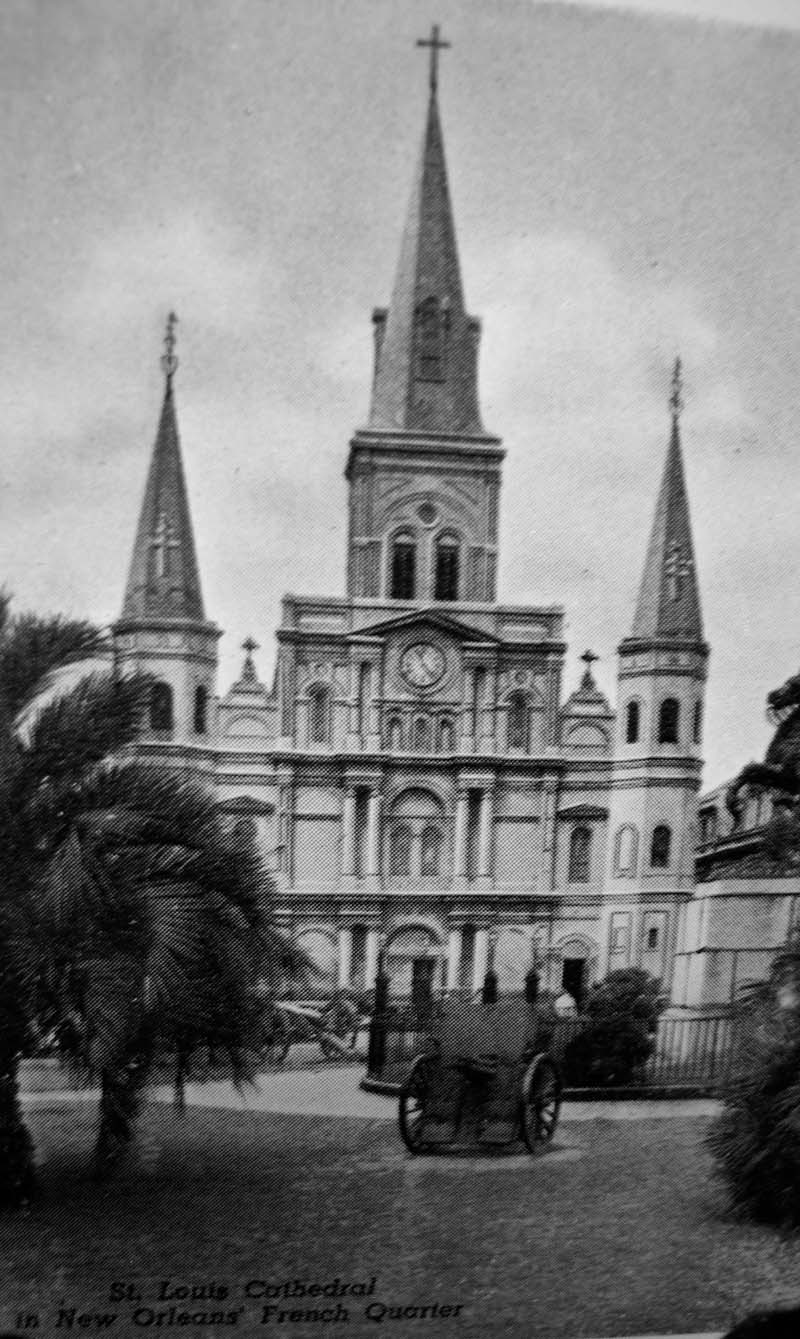
Jackson Square, Place de Armes, New Orleans. St. Louis Cathedral.
From 1721 to 1731, slaves were brought from Sierra Leone and Cape Verde to assist settlement. The slaves had many skills. They were boat builders, rice planters, and iron workers. They had skills and muscles for building, and their crops were suitable for this land. The French wanted slave labor to grow tobacco on their plantations.
Eventually, the French lost the Seven Years War in which they were engaged in Europe and had to cede Canada to Great Britain. Then, in 1762, King Louis VI of France secretly gave Louisiana to his Bourbon cousin, Charles III, because it was unprofitable. At that time, Spain had Mexico, Texas Territory and Florida. In 1800 Napoleon forced Spain to cede it back to France.
In 1803 Napoleon needed money to carry on his empire-building. Under the Presidency of Thomas Jefferson, he sold France’s claim to the Louisiana Territory to the U.S. for fifteen million dollars, an average of four cents per acre! It secured for the United States the vast territory between the Mississippi River and the Rocky Mountains, from the Gulf of Mexico to the Canadian border. By 1812 Louisiana was admitted to the Union as a state.
With this bit of history reviewed, we biked to the French Quarter, the original layout of the settlement. Place d’Armes (parade grounds) or Vieux Carré is the heart of New Orleans, where all the pageantry of the years has been celebrated. St. Louis Cathedral, built in 1794, faced the green square with its landmark statue of General Andrew Jackson on horseback, hero of the 1815 Battle of New Orleans. The original brick apartment houses line each side of the square. A curious monkey looked over the balcony watching us.
A flagstone mall in front of the church is the gathering place for sidewalk artists, portrait painters, fortune tellers and lively jazz bands. To join in the fun we bought "Po-boy sandwiches," consisting of a small loaf of French bread enclosing a slab of cheese, ham and tomato. Pralines plus a quart of milk made a memorable lunch while sitting on a bench under the palm trees in the shadow of St. Louis Cathedral. "Po-boys" were created in 1914 during a street car strike and sold for 10 cents, when the poor street car workers couldn’t afford more. Ours cost 25 cents in 1944. The architecture of the French Quarter is unique and carefully maintained in this historic district. Built in the 18th and 19th centuries, the majority of the brick buildings are two and three stories high, with galleries of fanciful iron work and an occasional carriageway leading to secluded courtyards planted with banana trees, bougainvillea and azaleas.
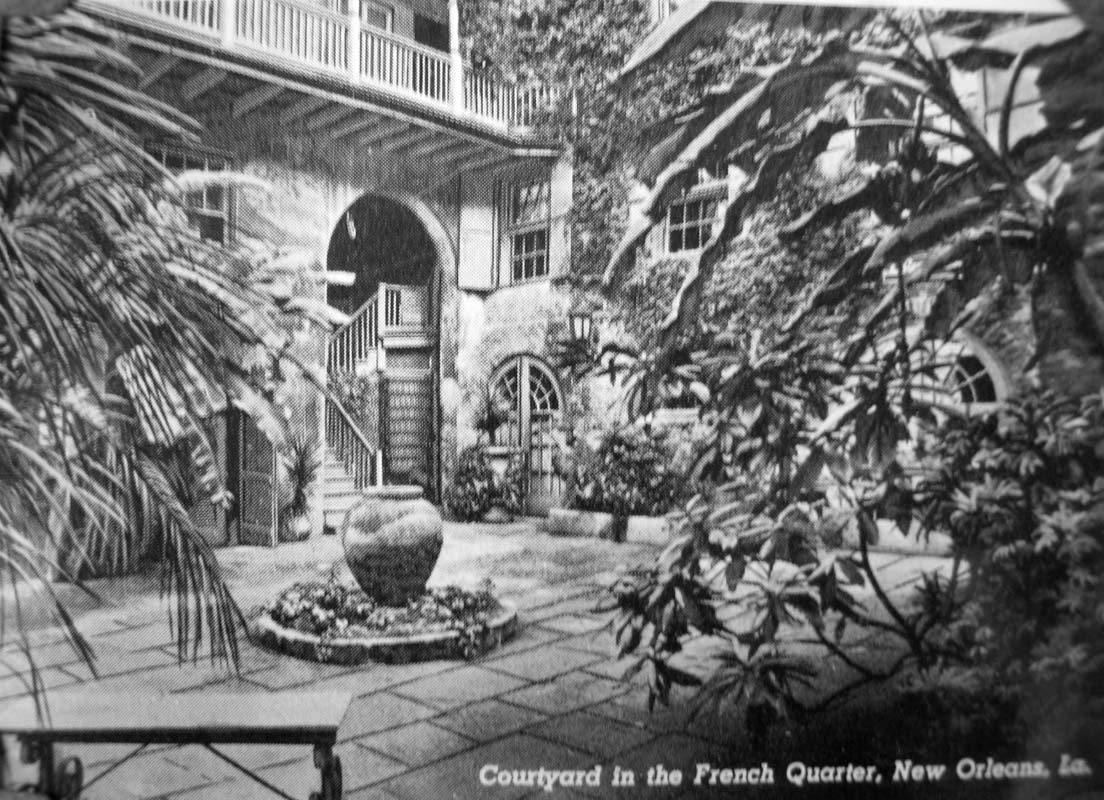
Secluded courtyards in New Orleans.
We visited the Quadroon Ballroom with its three-inch-thick wood floors, now a convent of St. Mary’s and boarding school. Sister Conception, a Negro nun, responded to the doorbell. Sister was very kind and interested in us. She took us into the chapel where she asked us to make three wishes. The nuns were industriously engaged in doing the laundry, dusting and cooking while dressed in their black habits. When we took our leave, Sister bade us good wishes and asked to hear from us on our return home. We gave her some money to light candles for us. What a pleasant experience it was!
In biking around the city we became aware of the strong influence of the original French settlers. Surnames and street names, restaurant menus and language have the subtle flavor of French origin. However, the Spanish settlers also had an influence. A Creole was a descendant of a French or Spanish settler born in the colony, not in Europe.
Old Stairway, Patio Royal in New Orleans.
The late-coming Anglo-Saxons, arriving from the North after the 1803 Louisiana Purchase, were called "Americans" or "foreigners." They came from Virginia, Pennsylvania and New York, bringing with them a puritanical work ethic, good business management, academic skill and a public school system.
The Creole society (French, Spanish, African) preferred to "Laissez le bons temps rouler" (let the good times roll). They didn’t like the Americans coming to settle, speaking of them as vultures coming to make their fortunes and then go back East. But, by 1852, New Orleans was an American city.
We now headed for the old St. Louis Cemetery with all of its tombs above ground. On the average, all of New Orleans lies five feet below sea level, so that everyone was buried above ground. Rows of white marble tombs of beautiful design are lined up like a small city street. Bodies can only be interred for a year and a day. Then the bones are pushed to the rear and a new casket is put in - "all in the family together" - otherwise they would all be under water.
Eventually, levees were constructed, then pumping stations built to prevent inundation of the city. Through modern engineering, ocean-going vessels now ride higher than the town! Flags of many nations fly aboard the ships lined up along the levee.
Next, we visited the famous Cabildo, former capital of Spanish Louisiana. Over the years ten flags have flown over the state. The museum exhibits the signed document of the Louisiana Purchase, as well as relics of wars and the period of slavery.
* * *
August 18, 1944
We woke up to the tune of "I’ll Get By," played on the radio across the street. Buildings are so close and streets so narrow that privacy is limited. The architectural designs of New Orleans homes from colonial times in 1725 were brick between-post style, with no hall and many doors. They adapted to the climate by building roof overhangs and long windows. The style of the West Indies and Plantations is French colonial, adding two galleries with large pillars below and small columns above, two rooms wide, with galleries considered as exterior hallways. In other areas of the city are "shotgun houses." These homes are four rooms deep with rooms going straight back and no hall. A camelback is a double shotgun with another story on top. Many beautiful Greek Revival homes of perfect proportions and understated elegance were built in the 1820s, followed by the Italianate with its arching slender columns and rounded windows. The impact of the Industrial Revolution introduced the Victorian period of exuberance, fantasy and no sense of classicism.
We had sad thoughts of leaving the luxury of the French Quarter today, but Doris jumped out of bed and flippantly said, "Let’s go to Florida!" So off we started. First our last breakfast of waffles at the Green Shutters and stopping at the Doll House on Canal Street. Why hadn’t we seen this before? Here were handmade dolls corresponding to various figures in history. I bought a little nun, a Sister of Charity, and named her Sister Conception, after the pleasant nun at the convent. Starting at the north end of Royal street, we went shopping for gifts. At Rene’s little shop we found New Orleans magnolia perfume. Such a lovely shop, with pink satin curtains and gift tables. Next I found a lovely pair of filigree earrings in the shape of butterflies for Mom’s birthday, a print of a staircase on Toulouse Street, and a tiny Mammy doll for Madeleine’s collection.
We passed by the St. Charles Street Car Line, the oldest operating street railroad in the world, operating since 1834. It is a charming tradition of the city, rich in folklore and of special significance in Tennessee Williams’s book A Streetcar Named Desire. This line takes its name from Desire Street, which a prominent citizen named in honor of his daughter, "Desiré."
We made brief stops in the City Park filled with palms, azaleas, dropping Spanish moss, magnolias and swans gliding in the bayous. A docent in the Museum of Art told us much of the history and pointed out the "Dueling Oaks" in the rear of the building.
Huge Lake Pontchartrain lay before us and a five-mile bridge crossing it! Fortunately, a very friendly man transported us across. Then we discovered that Doris had the first flat tire! Out of a crowd of men standing around waiting for a bus, one little dark man was kind enough to put on a temporary patch.
Soon we will be entering the state of Mississippi and the Pearl River Swamp. Our biking continued through a swamp area on a built-up road. The weirdness of the place makes it stand out in my memory. The air seemed lifeless and stagnant. Pearl River appeared motionless with ghostly moss-draped oaks reflected in it. Beautiful orchid swamp flowers grew in patches in the hollows. Most interesting were the unpainted shacks built on stilts with picket fences closing in the mud-baked yards. The people of this Coney Island swamp make their living by gathering the Spanish moss that hangs from the trees. It is used as a packing and stuffing material. We stopped at a gas station for a drink. They are such friendly people, and they all wished us good luck, but added one admonishment: "Do you have protection?" We assumed that meant a gun. The sun sets quickly here in the South, forgetting about twilight, and for once we had a little fear of being caught in the swamp without lodging. As we bicycled as fast as we could, I heard Doris’s tire patch blow out! Good luck again! Two gasoline trucks came along and picked us up on their way to Picayune, Mississippi, their first stop. They were going to Biloxi after delivering gasoline in Poplarville, so we decided to leave our bikes at the garage and ride with them to see some of the countryside.
We were now in the state of Mississippi. Mississippi is an Indian word meaning "Great Waters," the river forming the western boundary of the state. It has other nicknames, too - "The Magnolia State" and "The Bayou State," because of its many picturesque, slow-moving streams. As we rode over the great fertile Mississippi river plain, we passed vast cotton fields, piney woods and along the coast where shrimp and the wealth of the sea are harvested. Groves of pecan trees and persimmons lined our way. And, adding to the charm of it, was the occasional historic mansion with its moss-draped oaks and the fragrance of the oleanders, wisteria, magnolia and azaleas blooming in the colorful gardens.
We returned to Poplarville and waited for the gas tanks to be emptied. During our two-hour wait, I picked up a tung oil nut from one of the many trees growing nearby. I learned that in 1905 the U.S. Department of Agriculture introduced the culture of Chinese tung trees along the Gulf Coast. Consequently, there are many tung plantations in Pearl River County, and Picayune has the largest tung oil mill. Tung oil is a fast-drying oil derived from the seed of the tung tree. It is used in paints and varnishes for a more water resistant finish. A souvenir nut to add to my collection!
After the tanks were emptied, we returned to the garage only to find the boy had blown up the tire tube and no others were available! So, we tied the bikes on top of the trucks and rode on to Biloxi. After whole heartedly thanking these kind truck drivers, we said goodbye. We found a lovely room at the Hotel Riviera right on the Gulf of Mexico.
* * *
August 19, 1944
At Hotel Riviera we had a luxurious bath and a good night’s sleep. Breakfast with milk at 60 cents a quart is quite expensive, but the room service was wonderful, and we found a place where the bike could be fixed.
In the meantime, Doris and I enjoyed the luxury of a swim in the warm waters of the gulf. What a thrill to stand in the white sand on the very tip of the United States and know that beyond the salt water is South America. We were reluctant to leave the warm, soothing water, but off we must go to Mobile, Alabama!
What a wonderful feeling to bicycle along the road again with the wind in my hair and the ecstatic feeling of freedom, happiness and thankfulness for having such a dear friend to travel with and meeting the wonderful people across America. I shall always remember this beautiful sun-filled day as a spiritual, uplifting experience. It seemed that love and goodwill have followed us every day. Perhaps it is our happiness that is absorbed by others.
We cycled past acres of yellow pine trees used in paper-making, some with troughs attached to catch turpentine. Soon the sun was low again, and we were far from town. We got permission from a very pleasant lady to sleep in her yard. Out came the old sleeping bags on the front lawn. Sleeping outdoors here is difficult because of few barns and many biting insects. We spent the night battling the mosquitoes. It’s just too swampy around here.
* * *
August 20, 1944
Feel rather weary after a very dewy and mosquitoey night. The people next door invited us for a cup of coffee. More Southern hospitality!
This is really a tough day. It’s Sunday and few trucks on the road. We finally got a ride all across Mississippi to Mobile, Alabama. We lost all our tan on the boat, so now we’re getting sunburned all over again.
We stopped at a house to fill our canteens, and the gentleman gave us some fig jam from the fig tree in his yard. What a treat! Pecans and persimmons grow everywhere. Inquiring about a room at the YWCA, we were sent to 755 Government Street, a very nice place. We did all our laundry and plopped into bed after writing to Captain Stroube and Captain Bill. I have a homesick feeling for the boat. Wonder how the new maids are doing?
Florida
Biking East
August 21, 1944
Off to Florida today! Started at 9:00 a.m. and had to get a truck ride in order to pass through Bankhead Tunnel under Mobile Bay. Then we continued riding our bikes through a hilly section, beautiful with its tall, slender yellow pines and red soil. Scooped up some of that red soil in an envelope to take home!
Time is slipping away from us as September will soon be here and I am to begin my first year of teaching beginning September 4th in Middleport, New York. And here we are as far south as we can get!
We hailed our favorite kind of truck, one with slats on the sides. This one also carried three sailors! We all got in the rear and had a windy ride to Pensacola, where they were stationed. If our parents could see us now! As we came to the state line division between Alabama and Florida, we took a picture of the fellows at the sign.
So here we are in Florida! We left the truck and bicycled down the palm tree lined street into the main section of town. Our stomachs signaled hunger, and so we treated ourselves to a delicious stuffed crab Creole-style dinner.
Some planning had to be done to map our route north. A woman at the AAA office mapped out Route #29 to Atlanta, Georgia, changing our plans to go to Jacksonville, Florida as time is limited. We hated to miss seeing the orange and banana trees there. This type of landscape was so new to us.
With Sailors, on the Road to Pensacola, FL.
Fortunately, we got a ride outside of Pensacola, a short lift of 45 miles, as it looked like rain approaching. After a brief lunch in Flomation, we continued bicycling on. Then, after another short lift to Brewton, the short summer twilight left us in a small southern town with no place to stay. Everything was filled! Just as we were getting a bit anxious we thought of another adventure. Perhaps the jail would have an empty spot for us! I never thought it would be so difficult to stay in jail. "No," said the policeman, "the town people would talk." Moreover, a very nice sailor from the Navy Shore Patrol, named R. C. Bell, squelched our good idea. Then, making us feel like homeless waifs, he found a room for us and insisted on paying for it!
We left our bicycles in the Police Station, and Bell took us to the tourist home in his Navy truck. The home is beautiful and the room huge, with a great bay window. After a luxurious bath and laundry done, we crawled into the big four poster bed. Bell said he would call for us in the morning.
Shore Patrol - Navy Man R.C. Bell, who picked us up and got us a room at the Tourist Home.
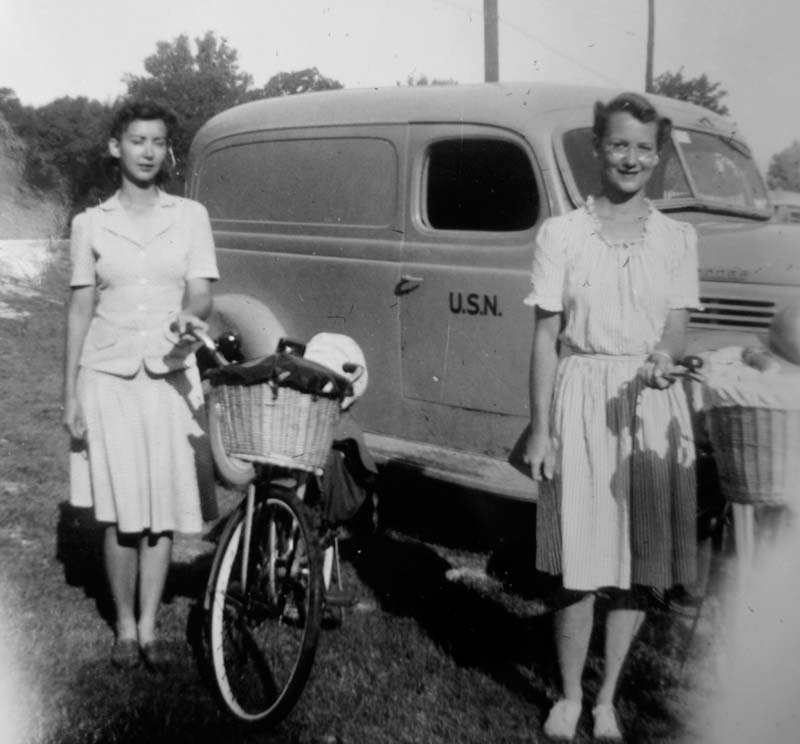
With R.C. Bell's Car.
* * *
August 22, 1944
What a surprise to find the Navy knocking on the porch door at 6:00 a.m. We dressed in a hurry and went back to the station in the Navy truck. A group of townspeople was standing around. I bet we manufactured some gossip!
Then Bell took us out to breakfast, which included those delicious southern grits. We talked for an hour about our family histories. He was on the police force in his home town of Jackson, Mississippi, for 11 years. After taking his picture and exchanging addresses, we bade farewell to one of the kindest and most thoughtful people we have met yet. We can be so proud of the citizens of our country. Never encountering fear, we have had so many enjoyable contacts that our spirits soar as we pedal along.
Sometimes I wonder if I’m dreaming all this. Here in the deepest South we’ve been so fortunate, but as the Captain said, "we must not crowd our luck," for much lies ahead of us.
The woman from the AAA must have given us a wrong steer about traveling Route #29, because we met only lumber trucks hauling pine logs. Consequently, we wasted an afternoon pushing up hills, covering only 46 miles headed for Andalusia. Then it happened! I got my first puncture, and luckily we got a ride 15 miles to Andalusia. We passed fields where we saw the first cotton being picked by Negroes and also saw tall shocks of peanuts. The driver pointed out the velvet beans, which were planted in with the corn and wound around the stalks. When the cows were turned loose in it, they ate the whole thing. A form of inter-cropping.
When we arrived at the gas station, the truck driver bought some patches and fixed the tire. More very kind people. We found that this gas station was the only one that stayed open all night and many trailers stopped. The manager suggested that we try to get a shrimp truck going up the East Coast to Washington. Now we are learning the tricks of trucking - ways to get rides straight through.
We settled down to almost the comfort of home. The kind manager supplied us with candy bars, hamburgers and cokes at sufficient intervals. Even stationary and a desk were at hand. Now to spend a long night writing and waiting!
Poem composed en route to Andalusia, Alabama.
I’m going to a better place
Than I have ever passed,
Where all the roads go downhill
And the pavement’s smooth as glass.
Where the folks are always friendly
An’ your tire never blows,
Where the hay is soft as cotton
And you never change your clothes.
There you’ll never get a sunburn
And cows will graze at large,
So you can have a glass of milk
No bottle - free of charge!
To Florida, Alabama, the Gulf of Mexico
You’ll find it easy pedaling
Whatever route you go.
With a true friend beside you
And a bike that’s shining bright,
You’ll find the day a long one
Looking for the night.
* * *
August 23, 1944
After waiting until 2:00 a.m. with no shrimp truck passing, we decided to take a lumber truck to Montgomery, Alabama, the capital - a good lift of 100 miles. As the sun rose, the driver left us off on Route 80, where we might catch another truck. The first one we hailed stopped and took us on to Tuskegee.
Now over 50 years later, as we read the news and watch the television reports of abductions that take place today, we wonder. Were we courageous or just naive? Or was it our outlook, our spirit, the happiness we exuded that carried us along in safety? We really never considered that anything formidable would happen to us. After eating breakfast we spent an interesting morning visiting Tuskegee Institute. A pleasant woman in the office gave us a booklet about the Institute, which guided us over the lovely campus. As we walked about we felt out of place for the first time, as the students and faculty were all Negro.
At the Tuskegee Institute, Booker T. Washington and George Washington Carver, two dear friends, are buried side by side. Together, these two outstanding citizens contributed greatly to developing the skills and well being to the future of black society.
Booker T. Washington was born a slave on a plantation in Virginia in 1856. He labored in the salt works and coal mines of West Virginia, going to school at night. He graduated from Hampton Institute in 1875. With his exceptional ability, he was chosen to organize a similar school for Negroes in Tuskegee, Alabama. From its beginning in 1851 in an old church, it expanded to become the famous Tuskegee Institute, contributing to the technical and vocational training of the black community.
In 1897 Booker T. Washington hired George Washington Carver from Iowa Agricultural College to become Director and Instructor of Scientific Agriculture and Dairy Sciences. Carver’s primary aim was to lighten the misery and poverty of the South, to substitute the destructive one-crop system of cotton for an agrarian economy of peanuts and sweet potatoes. In years of experimenting, he produced 118 products from the sweet potatoes and 300 from peanuts!
Pedaling on to a gas station, we were informed by a man there that we could visit a cotton gin a block away. The gin was not running, but we walked into the wooden structure to survey the machines used in removing the seeds and baling the cotton. We gathered a few specimens from the various stages. Another lesson from the Old South!
By 9:00 a.m. we stationed ourselves at a gas pump again. This time we secured a ride headed directly to Atlanta, Georgia, with two fellows driving a chicken truck. Now we’ve had about every variety of vehicle! They tied our bikes on top of the chicken crates.
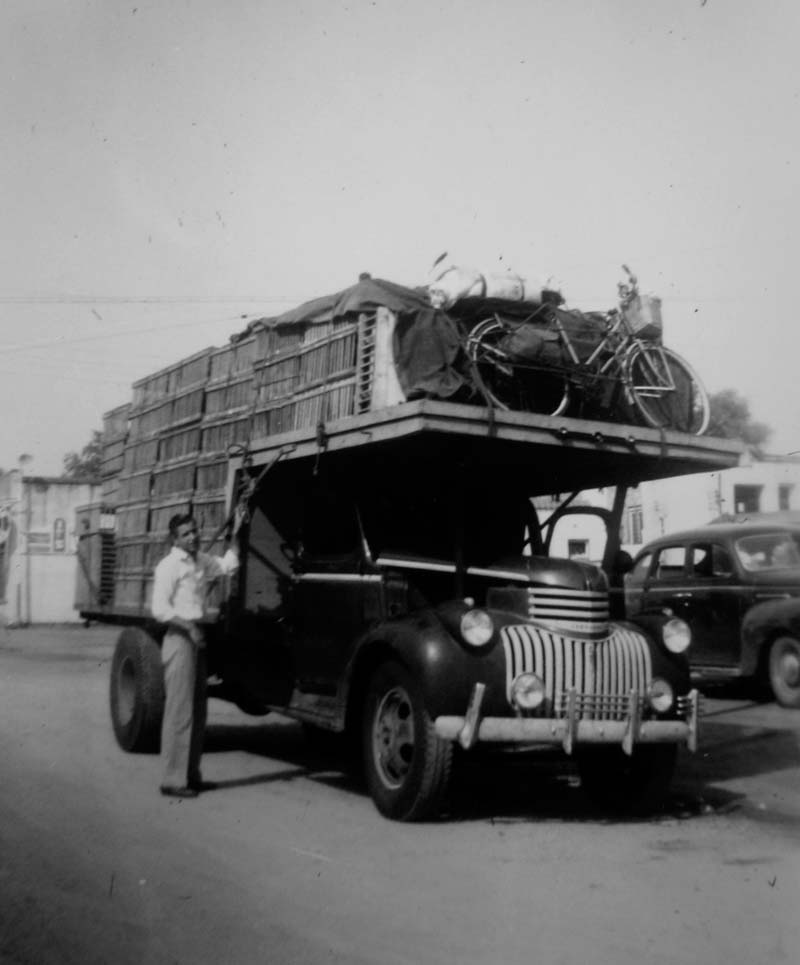
A Ride Aboard a Chicken Truck, Headed for Atlanta.
The ride to Atlanta was rather crowded with the four of us, yet enjoyable. As we sped by the cotton fields, we noted that the cotton became less ripe the farther north we went. We passed several cotton mills.
The approach to the city of Atlanta proper is very long. We passed Ft. MacPherson, one of the oldest camps from the First World War, named after a Civil War general. The fellows dropped us off at the YWCA, where it was recommended that we go to the Marion Hotel. After a good dinner and warm shower, we went to bed at 6:00 p.m. Two days had passed since our heads hit a pillow!
But first - a surprise! The telephone rang. It was the Atlanta Journal calling. A newspaper reporter wanted an interview at 9:00 a.m. tomorrow morning! Nothing like this has happened yet - so exciting!
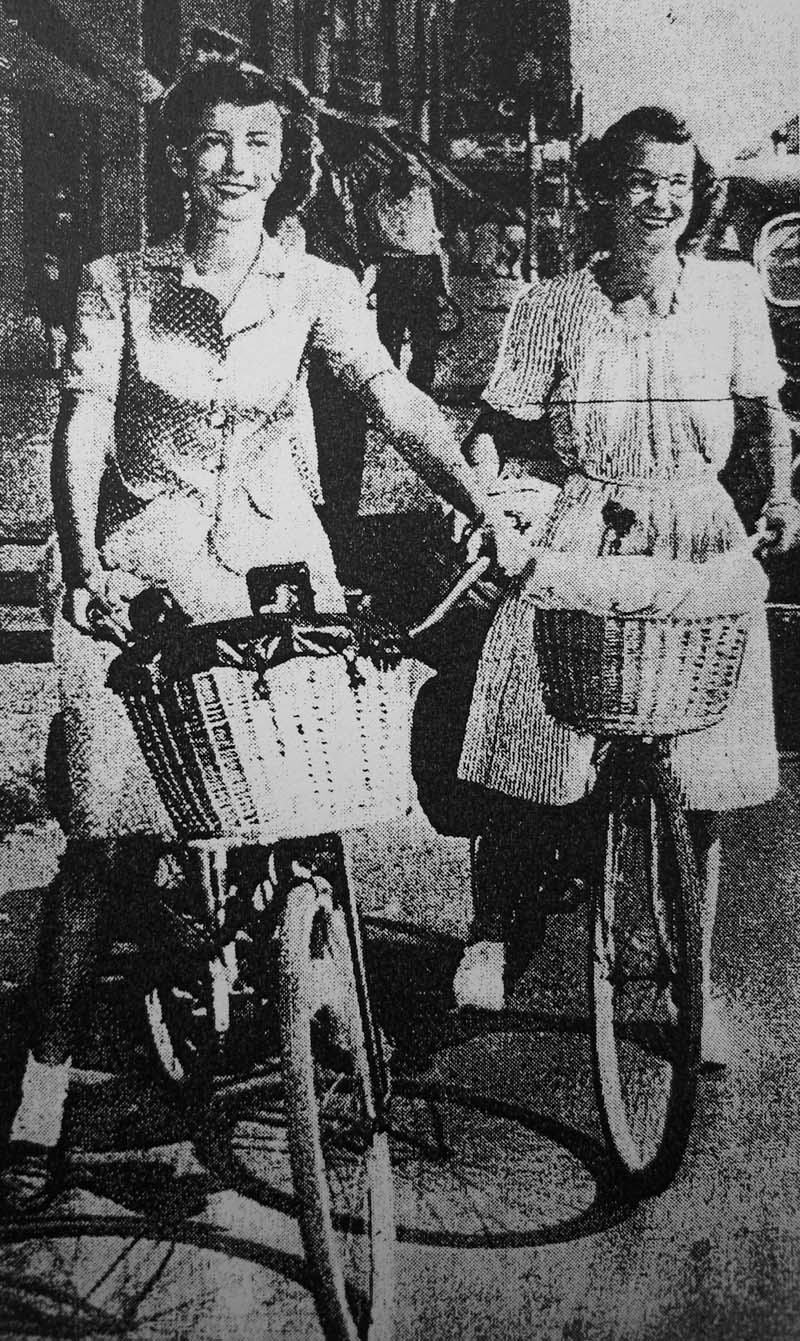
"Cyclists Tour East" Appears in the Atlanta Journal Newspaper.
Appearance
In the Atlanta Journal Newspaper
August 24, 1944
Thirteen hours of sleep and still not quite rested! At 9:00 a.m. the young reporter came to the hotel, and we sat on the porch as he reviewed every detail of our trip. Then along came the photographer, who urged us to walk our bikes up to famous Peachtree Street, where he took our picture under this significant street sign. After leaving our bikes at the hotel, we took a bus to Grant Park to see the Cyclorama of the Battle of Atlanta. A lecturer told the entire story and pointed out the various generals and their campaigns. The painting was made in 1885, when many veterans were still alive who could add vivid stories of the actual events. On our way back to the hotel we passed an historical site on the corner of whitehall and Alabama Streets. We took a picture of a lamp post with an ever-burning flame marking the site where a shell went through its base during one of the sieges of Atlanta.
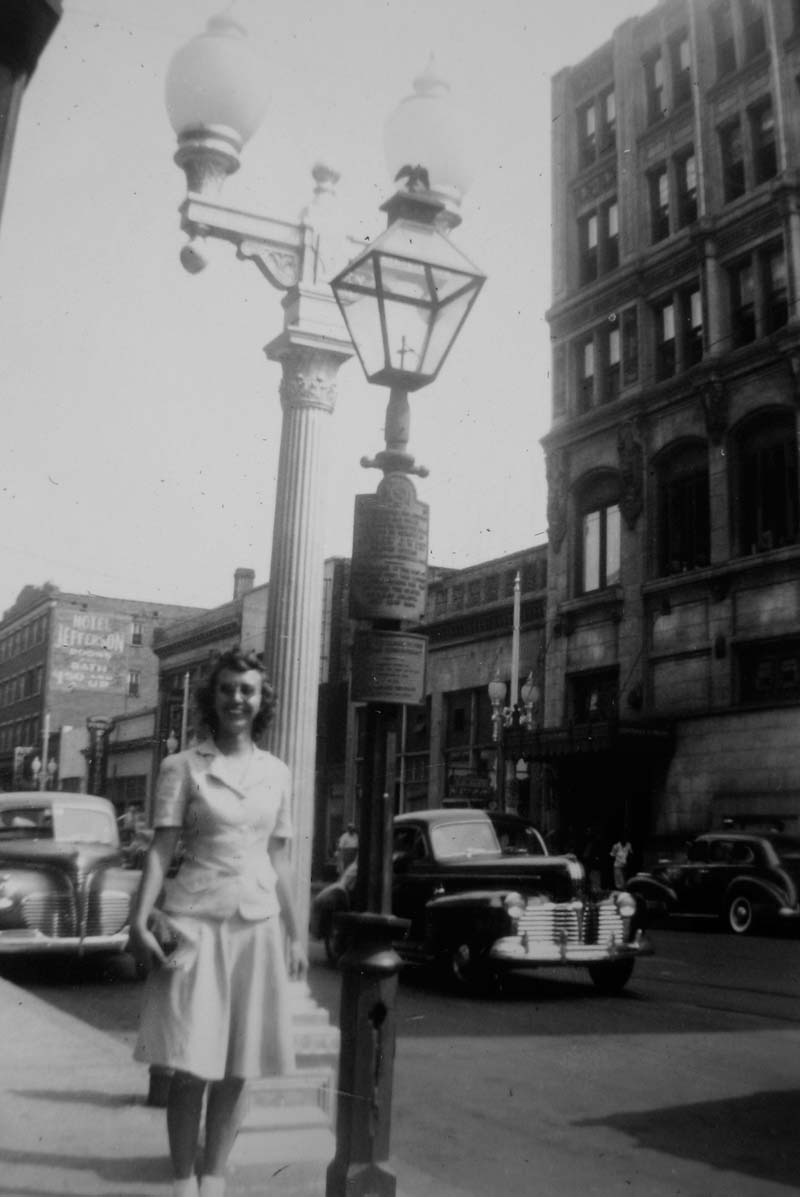
Ever Burning Light, Corner of Whitehall and Alabama Street, Atlanta.
Then, passing a news stand, what could amaze us more than to see ourselves on the front page, right next to the War News in the Atlanta Journal! The reporter had a big write-up of our interview. We were so elated that we bought 12 newspapers to send home!
Now we decided to be systematic about getting our next truck ride, so we went immediately to a transfer company, because we wanted to get started this night. Again we had good fortune. A very nice man named Clarence offered to take us directly to Washington. He was hauling furniture to Wilmington, Delaware, but wouldn’t be starting until tomorrow.
We walked into a gas station and heard a radio report about the two girl cyclers following the news flashes! Then, as we biked down the streets, cars honked and people called out, "Shuffle off to Buffalo." This was exciting! We will stay one more night at the hotel.
* * *
August 25, 1944
Dear Mom and Dad,
We were ready to go very early this morning, but the truck had to be repaired and packed, so we went over to the park to sit and write letters. A lady, Mrs. Allen, came across the street and invited us to come in and have a cup of coffee. It seemed that the whole neighborhood turned out to hear our story over coffee and toast. We had such a good time talking to them. They were all rather wacky and lots of fun! Then Lewis Childre, the "Alabama Singing Boy" of WAGA, came in and said he would sing our favorite song "Steamboat Blues" for us over the radio at 1:00!
Then Mrs. Allen called up Major Burgess of Lawson General Hospital and asked if we could visit them! We still had plenty of time before the truck left, so we biked out to the field, passed the MP, and down past the barracks. Gosh, these bicycles have been more places! There we were taken to the Recreation Center.
Two boys met us, Felix and Larry, one in a wheelchair and the other on crutches, each minus a leg. Each had a red rose for us. I’ll never forget that. These boys escorted us around. First, we went to their ward, where all their mates had similar injuries. Most all of them lost their limbs on Anzio Beachhead invasion in Italy. In the Physical Therapy ward, they were exercising muscles so they would be conditioned to using artificial limbs. Then to the place where they made the prostheses and witnessed a fellow being fitted to an arm and hand. As we pushed the wheelchairs around, we were surprised to see the good fun and cheerfulness the boys had in spite of their life-changing experiences and challenging future ahead of them. We took them outside and took pictures.
On the way out after leaving them, we met some young interns and I got a ride on the handlebars of a G.I. bicycle! One of the Cadet Nurses took us back to the women’s barracks, where we met the nurses and drank Cokes.
The visit at the hospital was unforgettable. We came face-to-face with the horrors and consequences of war. These young men, our generation, have given their lives to a handicapped future, and yet they have survived with an infectious spirit of camaraderie among them.
After a grateful goodbye to the soldiers, the repaired truck came to pick us up. After the struggle of trying to fit our bicycles in with the furniture, we were off at 6:00 p.m. Another long, sleepless night ahead, but we were bound for Washington! Don’t worry about us. With so many wishes for good luck that we’ve received, I’m sure we’ll do fine. At least I know what Heaven is now - I couldn’t ask for any more. Lovingly,
Thelma
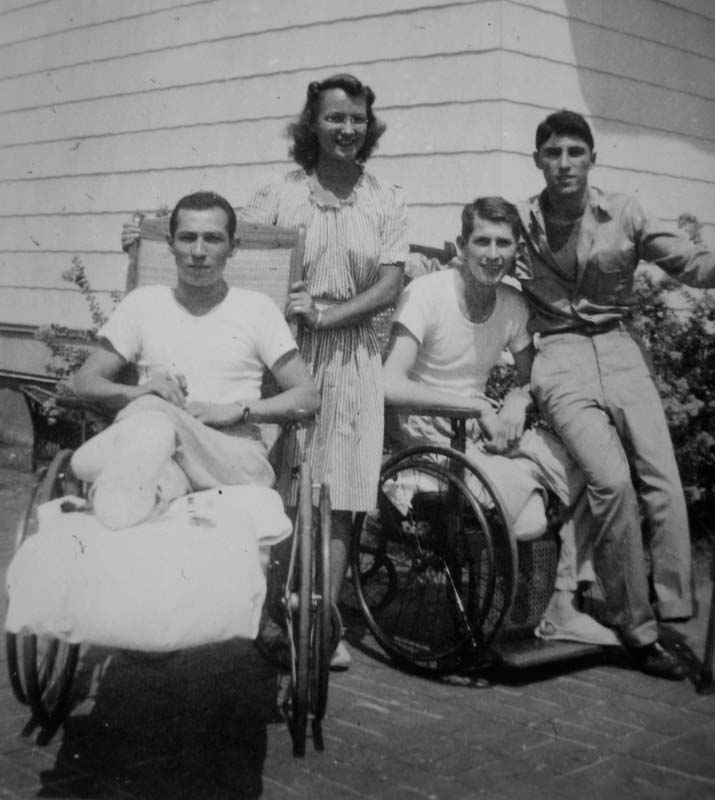
Visit to Lawson General Hospital - Atlanta. Such Young Men.
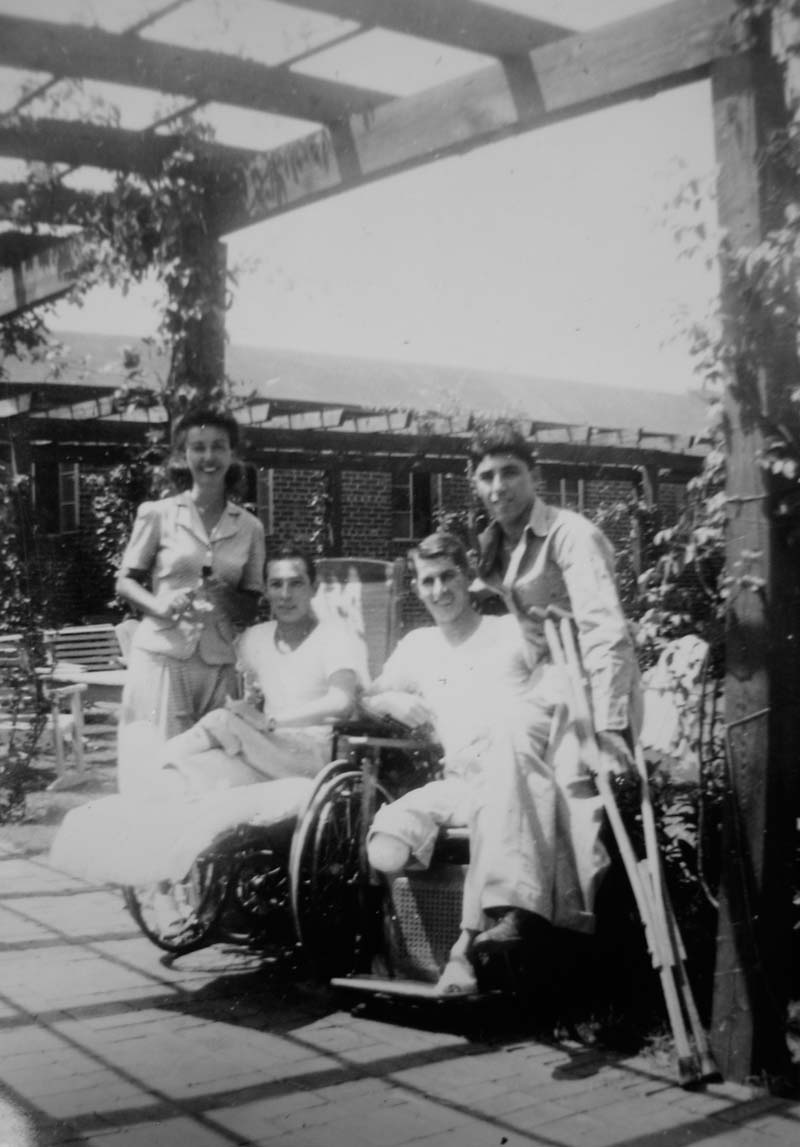
Doris with Soldiers, at the Lawson General Hospital - Atlanta. Felix and Larry in wheelchairs.
* * *
August 26, 1944
The night of short snatches of sleep, cups of coffee in the trucker’s station, and tight quarters came to an end when we entered Charlotte, North Carolina. This was one of Clarence’s headquarters, so we had a chance to scrub up and stretch our legs. We were so fortunate to have an amusing truck driver with his funny quotes that I had to record. "I don’t know which one of the children I am," or "straighten up and fly right," and often complaints of having "a dark brown headache four feet wide." We spent the day looking over the city and wondering why we couldn’t get started sooner. Our time is getting shorter, and September 4th is looming closer as the day I am to start my first teaching job
Truckers
Our Saviors
August 27, 1944
Two nights with little sleep. We are tired! In the morning we stopped at a trucker’s terminal where they have bunk beds and café. Now we had a chance to stretch out in the truck over the entire front seat and get some real sleep. We sure have learned a lot about a trucker’s life and their cargo. Some have sleepers on them, some are refrigerated.
After eating in a diner we started on our way again. The drive now was on a beautiful four-lane highway. We seemed to whiz through Virginia and probably missed so much because we weren’t on our bikes. On bicycles we become attuned to the freshness of the air, the sounds of the birds and fragrance of the fields, the people in the dooryard or at work on the land. How we miss the luxury of the freedom and communion with all of nature. But, thanks to these generous people along the road, we will make our goal on time.
Our first glimpse of Washington down in the valley was quite different from what I had imagined. Its low profile, lack of tall skyscrapers and roads laid out radiating from the Capitol building in the form of a wheel were the plans of Charles L’Enfant, a French engineer responsible for planning the city. He chose a flat-topped hill above the Potomac River, now known as Capitol Hill, to place the Capitol building. George Washington laid the cornerstone in 1793. Since then many changes and extensions have been made in the architecture, but all have maintained the basic integrity of the original structure.
Now we looked forward to actually bicycling down those streets as Clarence, the truck driver, let us off at the trucking terminal. We were so appreciative of his kindness for transporting us for so many miles over the past two days. Perhaps we lightened his boredom, too, of having to drive such a long distance alone. We proceeded on our bikes to the YWCA, where we found a lovely room. At last a bed! We were quick to retire.
Washington
Tour of the Capital
August 28, 1944
A most unwelcome visitor today was the rain, but we could not waste time waiting for it to stop. Off we went on our bicycles, down 14th Street, past the White House, and up Pennsylvania Avenue to the Capitol. As we were parking our bicycles a policeman befriended us. He thought we were quite an amazing pair when he heard our story. Along with the other tourists we took a guided tour through the Capitol building. The building itself reflects the architectural direction of two Virginia gentlemen schooled in architecture, George Washington and Thomas Jefferson. The Great Rotunda was impressive, with many statues and paintings including four by John Turnbull. These are unusually valuable, since he painted the scenes of the Revolutionary War from life and used Washington and Jefferson as models.
The fresco in the canopy of the dome was painted by Brumidi. Like Michelangelo, he lay on his back on a scaffold to paint the masterpiece during an eleven-month period - signed 1865. Constantino Brumidi was also responsible for the delicate paintings of birds, flowers and animals on the corridor walls and ceilings of the Senate. The Rotunda frieze, 58 feet up and with 8-foot-high figures, captures the exploration and settlement of the New World. While working on the first quarter from Columbus to Penn’s Treaty with the Indians, Brumidi died as a result of a fall from that point. About 30 feet remained bare until an artist, Allyn Cox, completed the frieze in 1953.
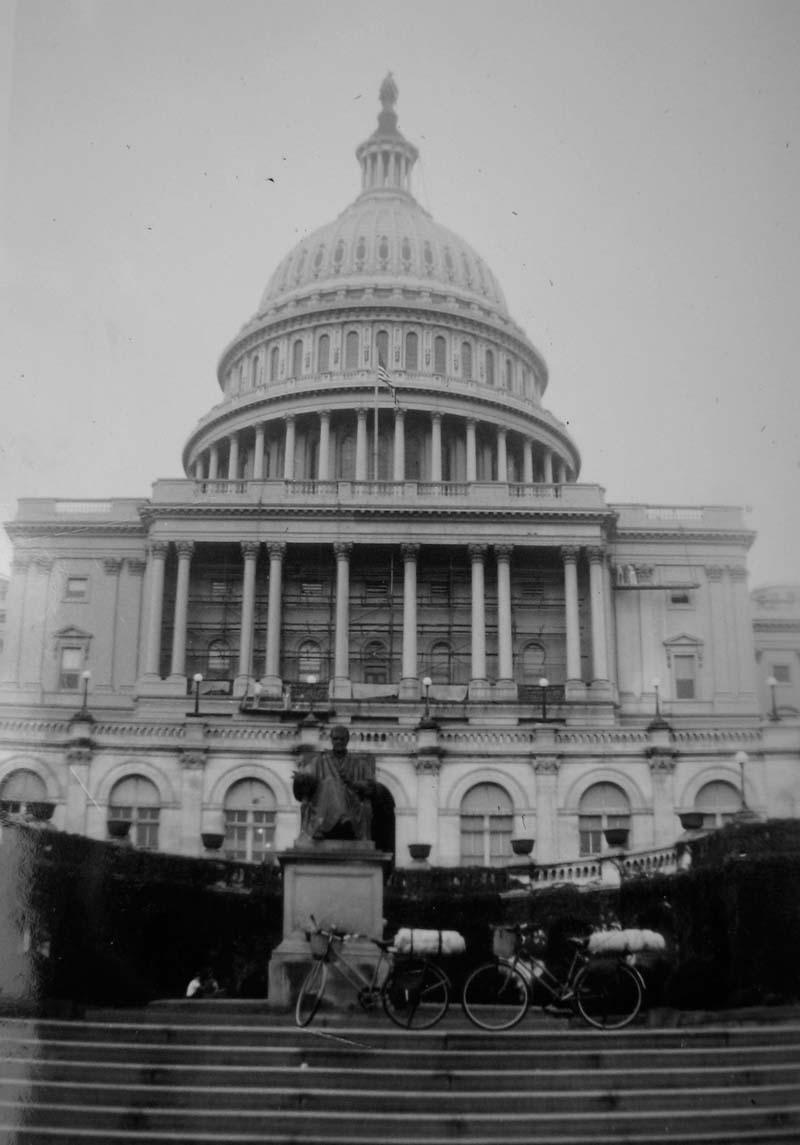
Parked at the Capitol Building, Washington D.C.
The tour was entirely too swift for us, so we went back and to get a more thorough survey of the place and also to experiment with the "whispering gallery." We wished that we could be here when the House and Senate were in session to witness the debate of laws that are passed here by the people we elect. These are the chambers where history is made and altered.
A Memorable Experience
As we left the building, we met the same policeman again outside. He asked if we would like to go up to the Capitol Dome to see the view. No visitors were usually allowed there due to wartime regulations, so it was a special privilege for us to walk up there among the pillars and get an aerial view of the Mall.
Painters were at work on the center section of the Capitol Dome as it could not be sand blasted. We asked a painter if we could paint a window sill. Imagine! Painting a part of the Capitol Dome! He promised not to go over our paint job again.
We had a clear view of the statue of Freedom high atop the Capitol Dome. It was sculptured in Italy by an American, Thomas Crawford. It was placed in position amid a proud salute of 35 guns (one for each state) during Lincoln’s first term in 1863.
* * *
August 29, 1944
We got off to an early start at the Mellon Art Gallery, another magnificent building. In 1937 Andrew Mellon, the former Secretary of the Treasury under President Harding and Ambassador to Great Britain, gave his remarkable art collection to the United States with funds to erect a building in Washington to house it. Beautifully displayed works of art, covering all ages and styles, made this place another text book for me. We spent several hours there, and I managed only to get through one wing!
The sun came out, and we enjoyed biking around the Reflecting Pool and Tidal Basin to the Jefferson Memorial, taking more pictures. It was very difficult getting film during the war, so we were very selective as to choice of subject we would capture on my trusty "Brownie" camera.
Washington, D.C. is a magnificent city in its low profile buildings, well laid out streets and its ability to hold within its heart the monuments that declare the strengths and weaknesses of the past. However, the profuse use of pillars and white marble make one wonder if America doesn’t have a style of its own.
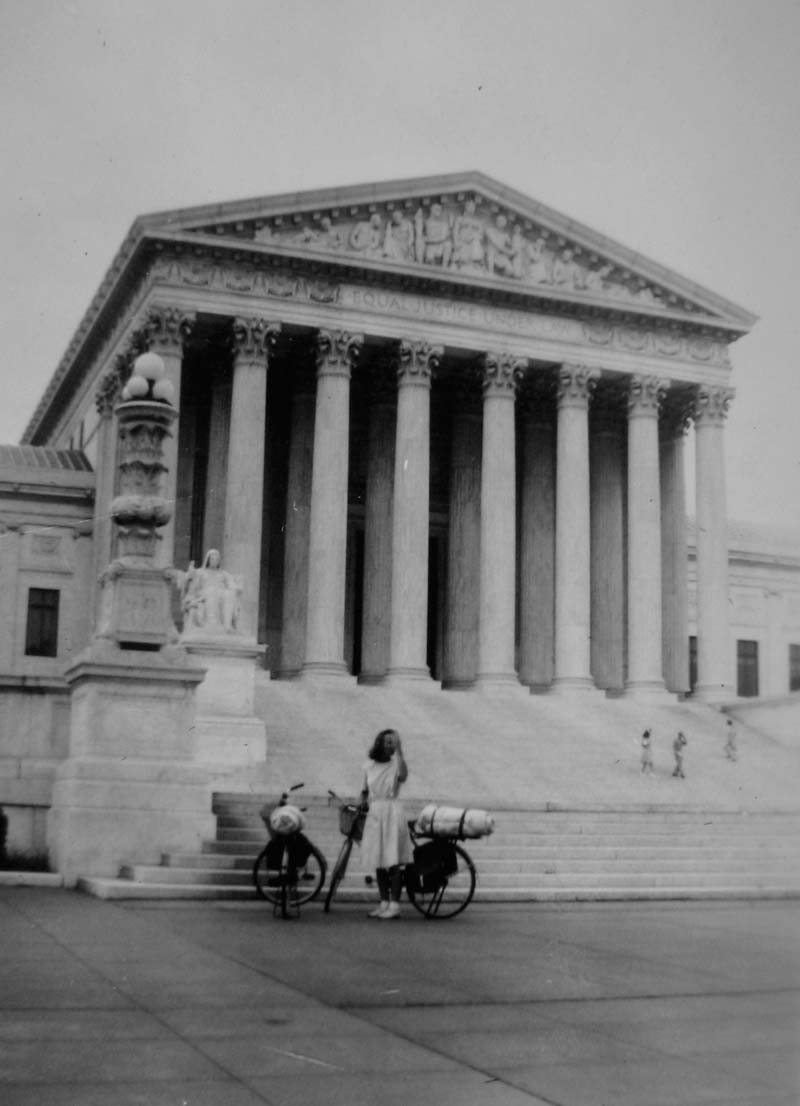
Parked at the Supreme Court, Washington D.C.
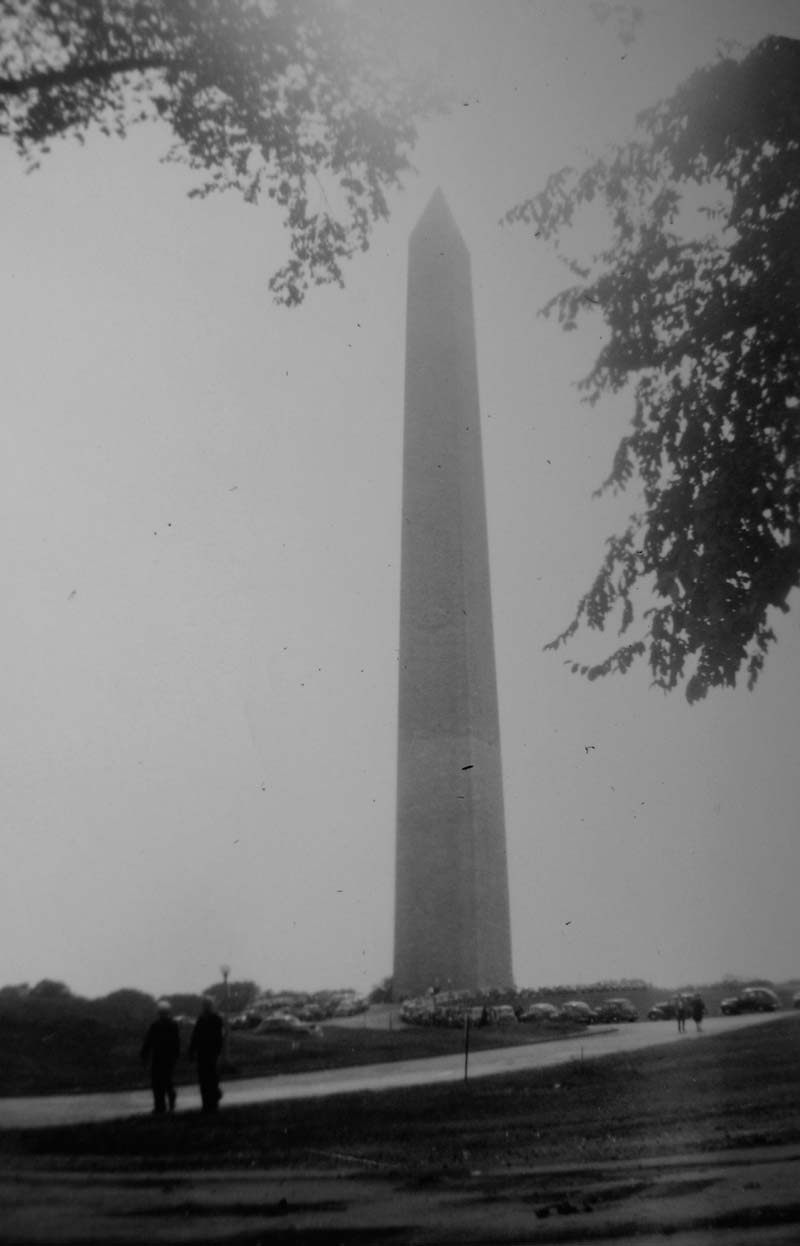
The Washington Monument.
Baltimore
Visiting Friends
August 30, 1944
Leaving much to be seen in a future visit, we left Washington for the trucking terminal. Fortunately, we got a ride directly to Baltimore, our next destination. Baltimore was the home of my dear childhood friend Peggy Keiss Stoddard. We had gone to School #74 in Buffalo, attended the same Sunday School, and had been Camp Fire Girls together. Now we were to see her after a long absence.
We landed in that city near the fish market, at a place behind the City Hall. We called Peggy, and when we told her where we were, she said her father let out an expletive and said to tell us not to talk to anyone. He would be right down to pick us up! It seems that we were only a block or so from the worst "red light" district, which was still active in World War II, and there might be a pimp doing some recruiting there.
How good it was to see old friends again! It was Peggy’s 21st birthday, and her darling 8-month-old baby was there to greet us, too. Her husband was still in India, a 2nd Lt. in the Air Force who would return home the following year.
We had dinner together with her parents at their Silver Hill Avenue home. The evening was spent telling them the story of our adventures and reminiscing about our growing up together in Buffalo. Fond memories of our days together with our Camp Fire group at Camp Aloha, where, on a winter weekend, we would all take turns passing on the alarm clock during the night to the next person to add a log to the fire. How we loved Camp Aloha, and how hard we worked to earn a week at camp. Those were Depression years, and it cost $7.00 a week to attend, not within my family’s income. An outstanding Buffalo Bakery supported the Camp Fire organization through a Doughnut Drive. By selling 120 doughnut-shaped tickets for 26 cents a dozen, we could earn a week at camp. Every day, after school, I made my rounds of the neighborhood to reach my goal of a week at camp.
In my memory, I recall the Hall Baking Company in Buffalo with their yellow horse-drawn wagon clip-clopping down the street selling their baked goods. Just hail them to stop and give them your ticket. Fond memories linger to this day of my one week at camp each year. Lifelong friendships were formed as we gained swimming skills and learned to identify wild flowers, build camp fires, make bread on a stick, cook beans in a hole, and sing unforgettable songs around the council fire. All this once again to share with friend Peggy!
The next morning Peggy’s mother gave us each a handful of streetcar tokens. Using these, we traveled the city, transferring from one area to the other, visiting the shot tower, the harbor where Francis Scott Key wrote the "Star Spangled Banner" from a ship defending Fort McHenry during the War of 1812.
Baltimore is a great commercial shipping center and port used in World War II for industries building war materials and repairing ships. One of America’s most famous writers, Edgar Allen Poe, lived here on Amity Street and was buried in the Westminster Churchyard in 1849.
* * *
August 31, 1944
Today we must leave for New York City. After saying our final goodbyes and taking the last pictures of Peggy and daughter Judy, we headed for a terminal to hail a trucker going north. We managed to get a ride straight through to Manhattan! Finding no rooms at the YWCA, we were referred to a dormitory of a religious school apparently closed for the summer. It was rather bare and gray and empty, but with our sleeping bags, we made ourselves comfortable on cots.
While we were in the city we made sure we added to our list of famous streets we’ve bicycled down, dodging the traffic on Broadway and Fifth Avenue. Eating in the automat was a fun experience, too.
I called up another childhood friend who had gone to elementary school in Buffalo with me and was now living in New York City. She had studied journalism at Antioch College and was now working for a newspaper in New York. As kids, she and I pooled our meager supply of books and set up a lending library at her house, charging two cents to borrow. In our brief encounter, she managed to arrange a meeting with a photographer to take a picture. There we were in the newspaper, on our bikes in Greenwich Village, and I still wearing my green and white striped dress!
Almost Home
from New York City to Buffalo
September 1, 1944
Time was fleeing and that critical day of starting my teaching career on September 4th was swiftly arriving! This morning we biked to a truck terminal tucked under the overhead rails of the "elevated train." Good fortune followed us again! A good man en route to Buffalo with his nine-year-old son offered us a ride in his truck. He was leaving New York in the evening. The truck had an enclosed wooden trailer. We sat in the cab with the driver, and the boy slept on blankets in the trailer. As the sun was setting, we said farewell to New York and headed home by way of Scranton, Pennsylvania. About 1:00 a.m. the driver became drowsy. Brave Doris offered to take over. How did she know how to drive a truck? I didn’t even have my driver’s license yet. Her father had taught her how to shift truck gears! From Scranton, we headed for Binghamton, Corning, Rochester and Buffalo.
* * *
September 2, 1944
Now it was morning and the driver had reached his destination. He left us off on Main Street in Buffalo. How grateful we were for the kindness of this man in helping us to safely reach the conclusion of this marvelous journey.
The next thing was to telephone our parents to announce our arrival! Our parents were anxiously waiting at Doris’s house and trying to keep dinner warm for us, but we needed to freshen up as best we could after that long ride. So, relying on the nearest, cleanest gas station, we used their facilities to resume a respectable appearance. However, I still wore my green and white striped outfit!
At great speed, we bicycled the last few miles down Bailey Avenue to Doris’s home on Lisbon Avenue. And what a greeting we received! Doris’s tiny grandmother and both our parents were there to welcome us. A delicious home-cooked meal was set before us. Doris’s mother gave the blessing and thanks for the safe return of their children and, of course, questions and answers were overflowing about our wonderful adventure.
However, my parents were very anxious to get me home and unpack, as in two days I was due to be in Middleport, New York, to begin my new job of teaching first grade on September 4th. To complicate things, I did not have a place to room yet! Good fortune continued to follow me, as I soon found a room in the home of an elderly lady and a place to eat dinner with another friendly family down the street. The school in which I was to start teaching was just two blocks away.
Shortly after I was settled, Ethel Swierat arrived from Buffalo, and we decided to room together. She was the newly-hired, very talented Home Economics teacher, and we had graduated from Buffalo State College together. We each had a soldier friend (Gordie and Ted) who had been shipped overseas to the European Theater in World War II.
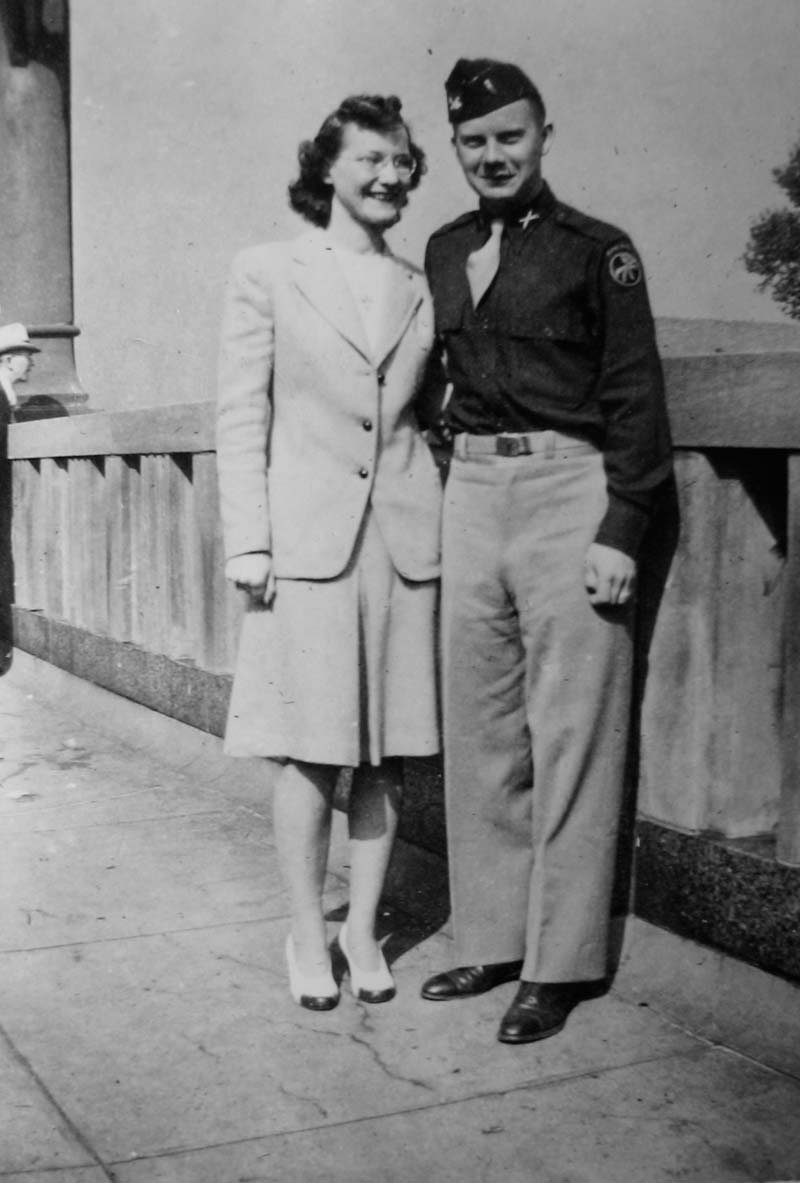
My Soldier.
Soon the walls of our room were a gallery of romantic pictures of handsome soldiers and their smiling girlfriends cut from magazines. Ethel also had a cute little red convertible, which we popped into directly after school ended each Friday and roared off to Buffalo, blowing the horn on the way out! Our hearts were young and happy!
And so I entered a new period in my life with a serious desire to enjoy and succeed in my teaching career. Soon after World War II ended Gordon Jones and I were married. We are proud of our four children, Susan, Thomas, Robin and Peter who are outstanding in the careers they have chosen.
This trip would never have succeeded without the thoughtful assistance of our parents. I am thankful and ever grateful for my parents, who were apprehensive of our bicycle trip. They worried about us, phoned and wrote but never discouraged us, and were helpful to us from beginning to end.
My admiration is for my biking companion, Doris Roy Gibson. Our compatibility on this bike trip, as well as her inspiring vision and understanding, wove a tight and everlasting bond between us. May we continue to sing our old camp song that lured us to the open road.
Along the road that leads the way
We travel as it will
Itself a guidepost good enough
To find both dale and hill.
Our hearts are light, our courage high,
The way is good and broad.
Give a cheer, give a cheer, give a cheer, Rah!
Hurrah for the open road!
The Lure of the Road
By W. H. Neidlinger
Our bicycle trip and spirit of adventure have never left me. Now in my eighties I continue to travel and explore new parts of the world with Gordon, the soldier I married!